

The United States Army is deploying four surveillance and reconnaissance systems that were produced in-house to further secure the 3,145-kilometer southern border from illegal activity, including narcotics smuggling, the Army’s intelligence, electronic warfare and sensors (IEW&S) office said in December 2025. “Obviously, real-world operations are occurring down there. We have some capabilities down there that are helping with persistent surveillance, long-range detection and data integration,” said Brig. Gen. Kevin Chaney, head of the Army’s IEW&S office, according to DefenseScoop, a military affairs website.
The reconnaissance and surveillance systems have different roles and can be deployed on the ground and in the air. The Ground Based Operational Surveillance System is a mobile, self-contained trailer-mounted tower. Also known as the “G-Boss(E),” the system has multispectral sensors that let operators collect, detect, identify, observe, record and track potential threats. G-Boss can be integrated into the command and control network on the southern border, according to the Army.
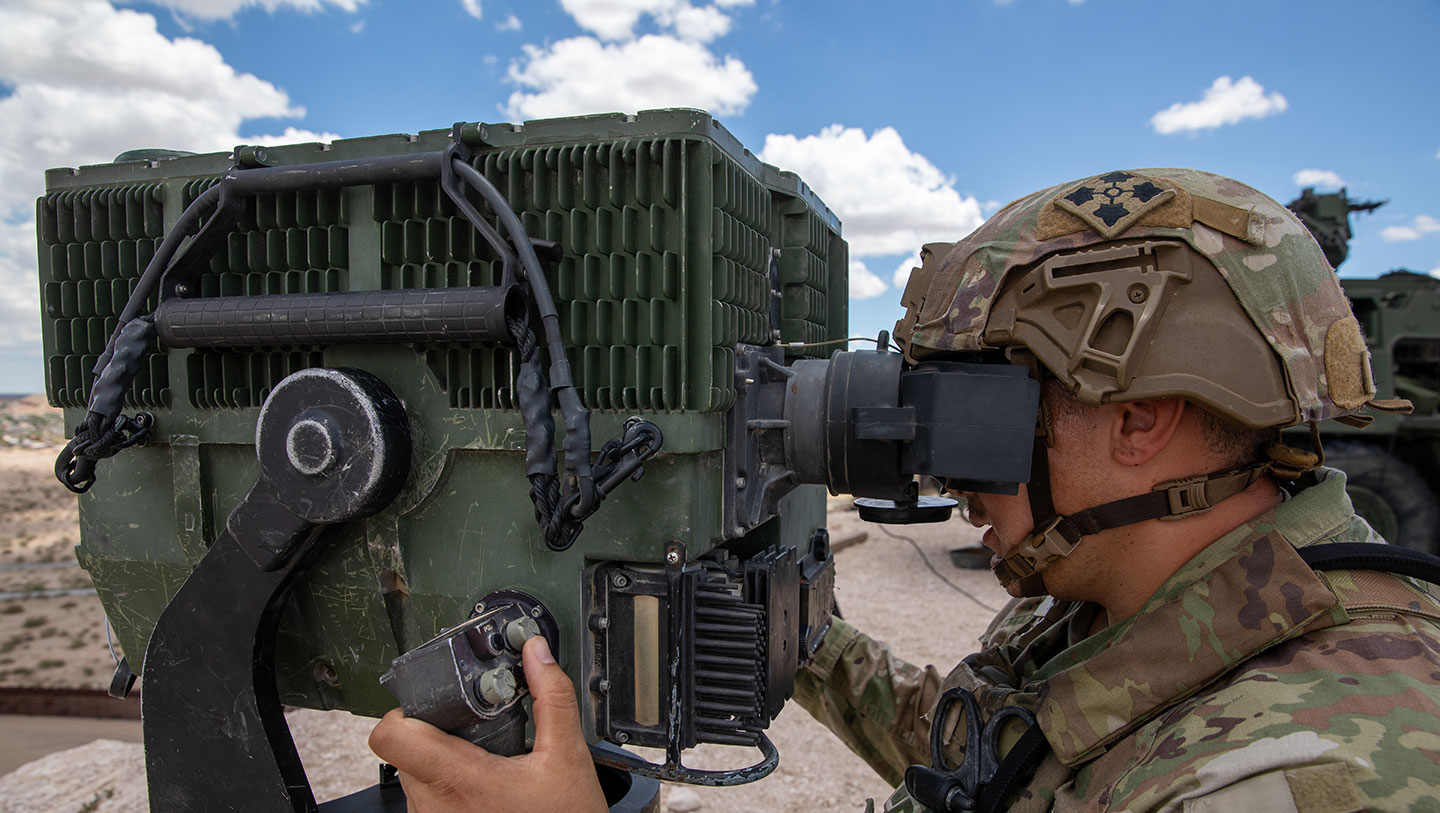
Two systems are meant to be highly mobile and tactical. The Long-Range Advance Scout Surveillance System can be deployed in vehicles or by dismounted Soldiers. The line-of-sight target acquisition sensor identifies targets while automatically determining target location coordinates, according to DefenseScoop. Another platform, the Instrument Set, Reconnaissance and Surveying — or ENFIRE — is an engineering system that integrates digital tools into a single platform for reconnaissance, route clearance, hazard identification, inventory and construction management, according to the website.
The final platform is the Common Sensor Payload (CSP), which is mounted on MQ-1C Gray Eagle drones. The CSP provides aerial intelligence and target detection around the clock for battlefield commanders. “These four systems there are helping to cover gaps that others identify down there,” Chaney said, according to DefenseScoop. “They provide situational awareness, allowing us to see further and in multiple spectrums in order to assist on identifying potential threats and risks to our border.”
Together, the four systems provide a clear advantage to U.S. troops deployed to the border. Since January, illegal immigration has plummeted to record lows as more than 10,000 troops have been deployed to augment National Guard units already in the region. Mexico also has surged a similar number of security forces to its side of the border. Mexican President Claudia Sheinbaum has touted a drastic reduction in fentanyl, a dangerous opioid, being seized by U.S. authorities at the border, an indication, she says, of increased Mexican disruption of smuggling routes used by transnational criminal organizations, or TCOs. Still, challenges remain. Smugglers have tried to find more remote routes or dig tunnels, several of which recently have been discovered. They also have increased their use of unmanned aerial systems for reconnaissance purposes. The last six months of 2024 saw more than 27,000 drone flights within 500 meters of the U.S. southern border, according to Department of Homeland Security testimony before Congress in July 2025.
The new Army reconnaissance and surveillance systems will make such attempts to circumvent a secure border much less likely to succeed as interoperability and collaboration with other U.S. border agencies, especially U.S. Customs and Border Protection, continue to improve. “My experiences in past deployments and working in Europe have reinforced the importance of partner collaboration — a principle directly applicable to our current mission with Border Patrol,” said Lt. Col. Cris Gasperini, commander of the 1st Battalion, 41st Infantry Regiment, 2nd Stryker Brigade Combat Team, 4th Infantry Division, assigned to Joint Task Force-Southern Border said in a September Army news release. “The integration of our organic assets with those of Border Patrol has been exceptionally effective, demonstrating the necessity of a whole-of-government approach to border security.”