

The Danish military’s Arctic commander and a newly published report from a leading think tank have issued similar warnings: Russia will pivot to the Arctic after its war in Ukraine ends. Escalating rhetoric, ominous military activity and Moscow’s increasing geopolitical emphasis on the High North have concerned NATO’s Nordic members, all of whom have rapidly increased defense spending since Moscow invaded Ukraine in 2022. “My expectation is that when the war in Ukraine is over, Russia will devote its efforts to arming itself in the Arctic,” Maj. Gen. Søren Andersen, commander of Denmark’s Joint Arctic Command, said in an interview published in December 2025 by the Danish Armed Forces magazine Honnør.
Just a few weeks earlier, the Arctic Institute, a U.S.-based think tank and research organization, issued a report on recent Russian actions in the Svalbard archipelago, a key maritime transit point linking the Arctic to the Atlantic Ocean. Since 2022, Russia has taken a series of increasingly provocative steps in Svalbard, the report states. It has staged patriotic parades and has erected a Russian Orthodox cross painted with Russian military colors above Barentsburg, the center of Russian activity in the archipelago.
Barentsburg has broken off most contact with the regional capital, Longyearbyen, or mainland Norway, which has sovereignty over the territory. A sabotage incident in 2022 in which a key fiber-optic cable was cut highlighted Svalbard’s vulnerability to attack, which could disrupt key satellite links across the globe. Although Russia never has been formally linked to the attack, Russian trawlers were sighted in the vicinity of the rupture, and Moscow is strongly suspected to be behind the sabotage. This string of incidents, accompanied by aggressive Russian diplomatic language challenging terms and conditions of the 1920 treaty demilitarizing the archipelago, indicates a troubling pattern, the report concludes.
It’s not all shadowy sabotage and bellicose rhetoric, the Arctic Institute warns. Russia has revamped a once-seasonal military base just 260 kilometers northeast of Svalbard.
Nagurskoye air base is Russia’s northernmost military installation. Located in Russia’s Frans Josef Land archipelago, the base extended its runway in 2020 to accommodate Russia’s heaviest military aircraft, including MiG-31 and Su-34 fighters and Il-76 heavy transporters. Bastion missile systems also have been deployed to the archipelago. Military experts estimate Russian troops could execute a Crimean-like paramilitary operation to cut off Svalbard from Norway within hours, the report states.
The Russian Navy also has markedly increased its maritime exercises, at least one of which practiced an amphibious assault on Svalbard. Significantly, the report states, the Russian naval exercises have shifted to the seas around Svalbard since 2022.
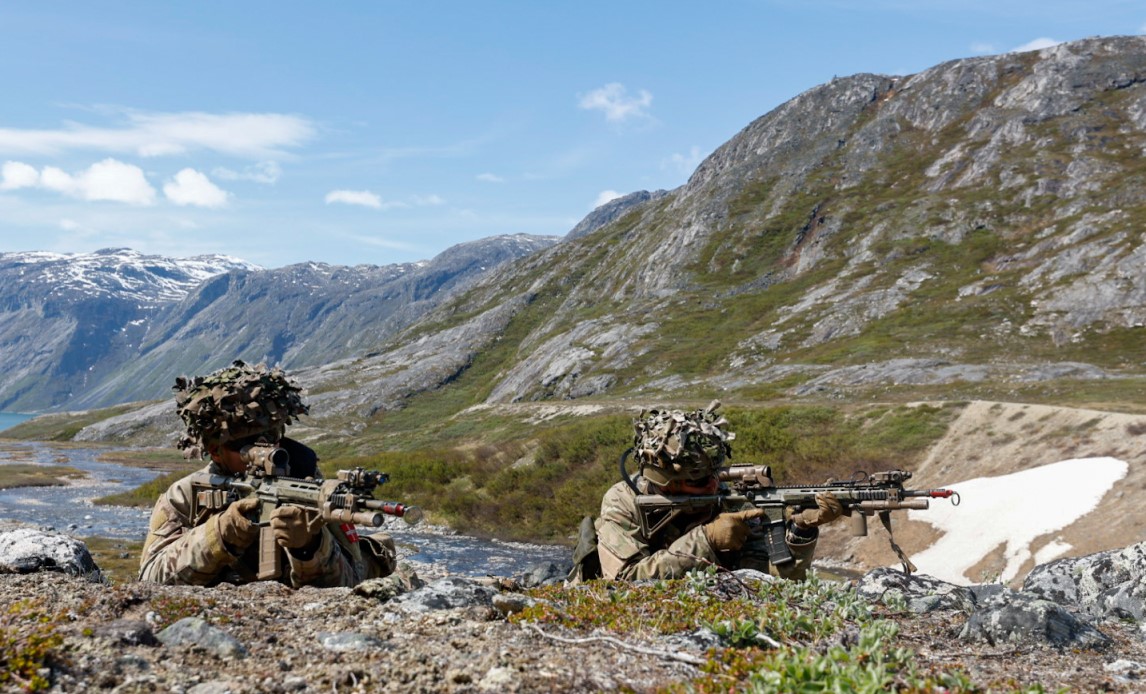
As Norway continues to monitor Russian activities in its northernmost region, Denmark has bolstered its Arctic defenses in Greenland. The Danish military recently conducted its biggest exercise ever in the autonomous territory with Danish forces conducting drills in defense of the world’s largest island.
The Arctic Light exercise, which ran from September 9 to 19, was a “short-notice planned-activity exercise,” involving more than 550 troops from Denmark, France, Germany, Norway and Sweden. The exercise is the latest version of similar operations in recent years.
In June, as part of a larger set of exercises, Denmark deployed a frigate and two EH101 Merlin helicopters to Greenland, the aircrafts’ first visit to the island, according to Defense News, a military affairs website. “Our Armed Forces have shown that we can deploy from Denmark to Greenland at short notice — one example is the Merlin rescue helicopters, which can fly from Karup Air Base to Nuuk in 13 hours. They’ve been absolutely crucial for the training there,” Andersen said, according to the website.