
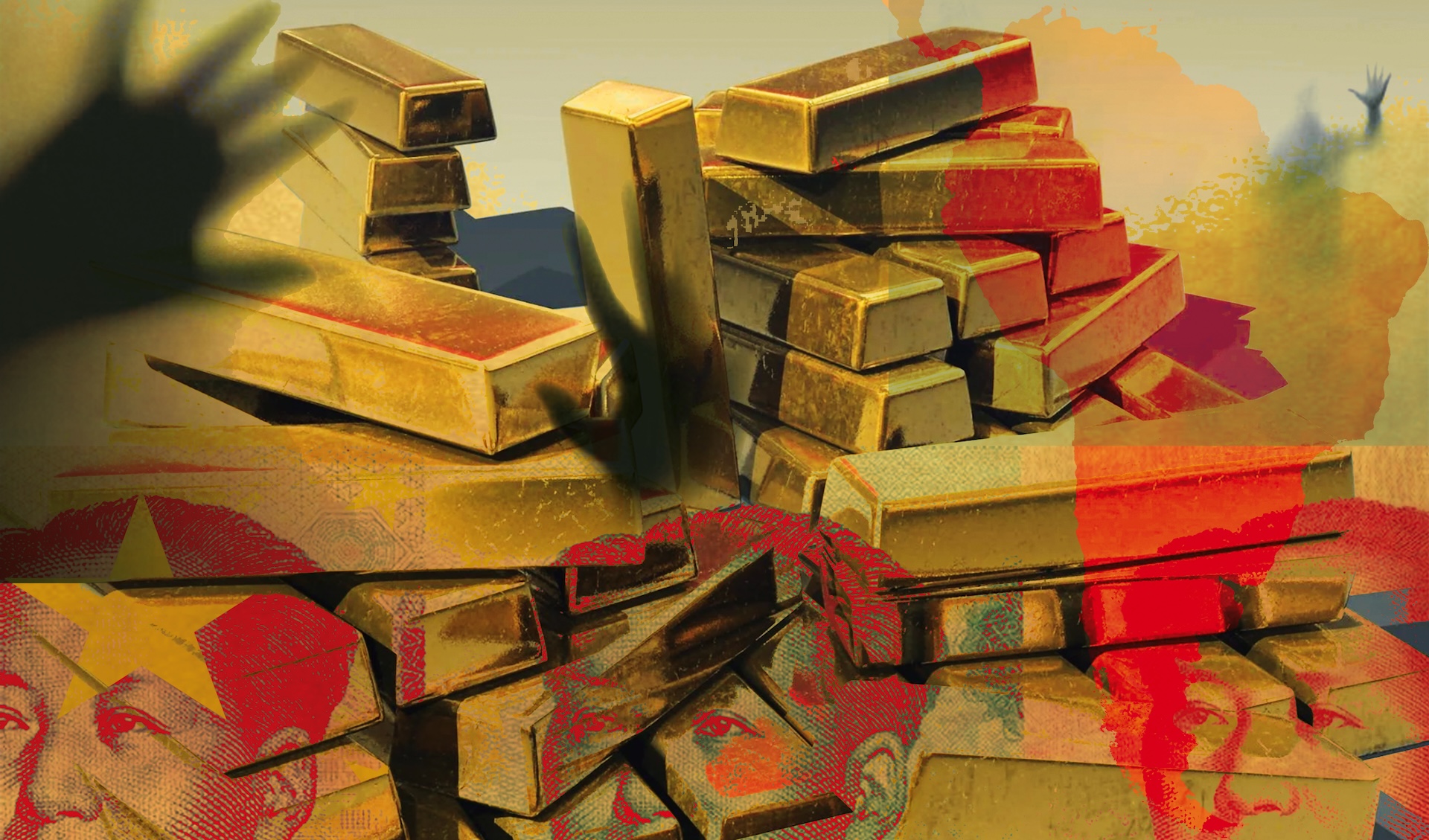
Latin America plays an increasingly central role in the Chinese Communist Party’s (CCP) gold supply strategy, which, according to a figure cited by the French Foundation for Strategic Research (FRS), could already account for up to 10% of global reserves. The CCP uses gold to reduce its dependence on the dollar and strengthen resource security, a core tenet of Xi Jinping’s “global concept of national security.”
“Gold, as a universal currency that can circulate outside the global financial system, serves not only as a store of value but also as a tool to circumvent economic sanctions in the event of diplomatic crises,” explained David Soud, an expert on illicit supply chains and criminal exploitation of extractive resources and head of research and analysis at I.R. Consilium, an international consulting firm.
The CCP is directly involved in acquiring gold, using both the People’s Bank and brokers, and through policies that encourage foreign purchases and extraction. These ventures often rely on opaque supply chains with high environmental and social costs.
A prime example is El Mirador, a copper and gold megaproject located at an altitude of about 1,000 meters in the Cordillera del Cóndor mountain range in Ecuador’s Zamora-Chinchipe province. Considered one of the largest deposits globally, the concession holds 136,645 kilograms of gold and 179,736 kilograms of silver. The Chinese transnational company Ecuacorriente S.A. (ECSA), part of the state-owned China Railways Construction Corp. (CRCC)-Tongguan consortium, holds the concession and has faced accusations of corruption and serious environmental disasters in China and elsewhere.
According to a report by nongovernmental organization Acción Ecológica and the Central University of Ecuador, Mirador’s expansion has led to several problems: heavy traffic damaging roads, the displacement of local communities, severe river contamination affecting fishing and health, abusive working conditions and a climate of violence.
“The collective price of the predatory behavior that too often characterizes rampant gold mining is devastating: It damages the environment, compromises public health, and deprives countries of vital resource revenues,” Soud said.
In the same area, another Chinese mining company, Totalfor, suddenly withdrew in May, leaving dozens of families in ruin and owing over $1.9 million to local businesses and workers. Broken contracts, bounced checks and environmental damage turned the promise of development into poverty and debt.
Between informal and illegal mining
A recent report by the United Nations Office on Drugs and Crime (UNODC) indicates that growing Chinese demand, which pushed prices above $3,000 an ounce, is fueling an illegal gold market in Latin America. This illicit economy heightens regional instability, involving powerful criminal actors, from drug cartels to Chinese mafias like the triads and the Fujian mafia.
In Bolivia, Chinese criminal networks hide behind local cooperatives that receive a small share of the profits in return. In Peru, they are transforming small-scale artisanal mining into industrial activities with a high environmental impact, especially in the Amazon’s Madre de Dios region, Puno, and the Andes, near the Ecuadorian border. The use of highly toxic cyanide is common because it lets miners extract two to three times more gold from the same ore than mercury.
Authorities in Guyana and Venezuela also have identified Chinese investors and operators as central figures in illegal gold trafficking, managing logistics networks that facilitate transport. In Ecuador, recent reports point to their presence in the northern mining areas of the province of Imbabura. Between 2017 and 2024, illegal gold mining ravaged more than 1,700 hectares of the Ecuadorian Amazon, particularly in Napo province. Clinical analyses in 2024 detected heavy metals in the blood of the Kichwaruna indigenous communities, while violence continues to rise. In May, 11 Soldiers died in Orellana province during an operation against armed groups linked to gold trafficking.
Network of international traders
According to the Latin American Mining Conflict Observatory (OCMAL), exports of gold concentrates from Peru have skyrocketed since 2020, with nearly all of them going to China. In 2024, they reached almost 400,000 tons, valued at $884 million, a 20-fold increase since 2019.
The main exporters are not mining companies but international traders who buy the concentrate from third parties without declaring its origin at the time of shipment. Major operators in Peru include IXM, controlled by the Chinese consortium CMOC, and Humon Latin America, part of the Humon group, which operates smelters in China.
“Some Chinese companies that export, for example, raw ore or concentrate are subsidiaries of, or closely linked to, Chinese companies specializing in the extraction of critical minerals,” Soud said.
Gold concentrates are, in fact, multi-metallic. Soud said that when exporters ship them, they often declare only the main metal, such as gold, allowing other precious elements they contain, including rare earths and critical minerals, to be shipped to China undeclared.
OCMAL reports that gold concentrates also arrive in Peru from neighboring countries such as Bolivia, Colombia and Ecuador. Chinese traders like IXM use the Port of Callao’s warehouses as a logistics center to ship this cargo, along with that of Peruvian origin, to China.
Traffickers also use Chinese mules to transport gold concentrate to their country. In recent months, authorities have made several seizures at Brazilian airports, with Hong Kong being one of the most frequent destinations.
“Gold concentrate lends itself perfectly to money laundering: It looks like sand, has no recognized price references, is difficult for most customs officials to identify, and can easily be fraudulently invoiced or inaccurately declared,” Soud said. This opacity and use for financial crime represent a core regional security challenge.
Diálogo Américas is a publication of U.S. Southern Command.