

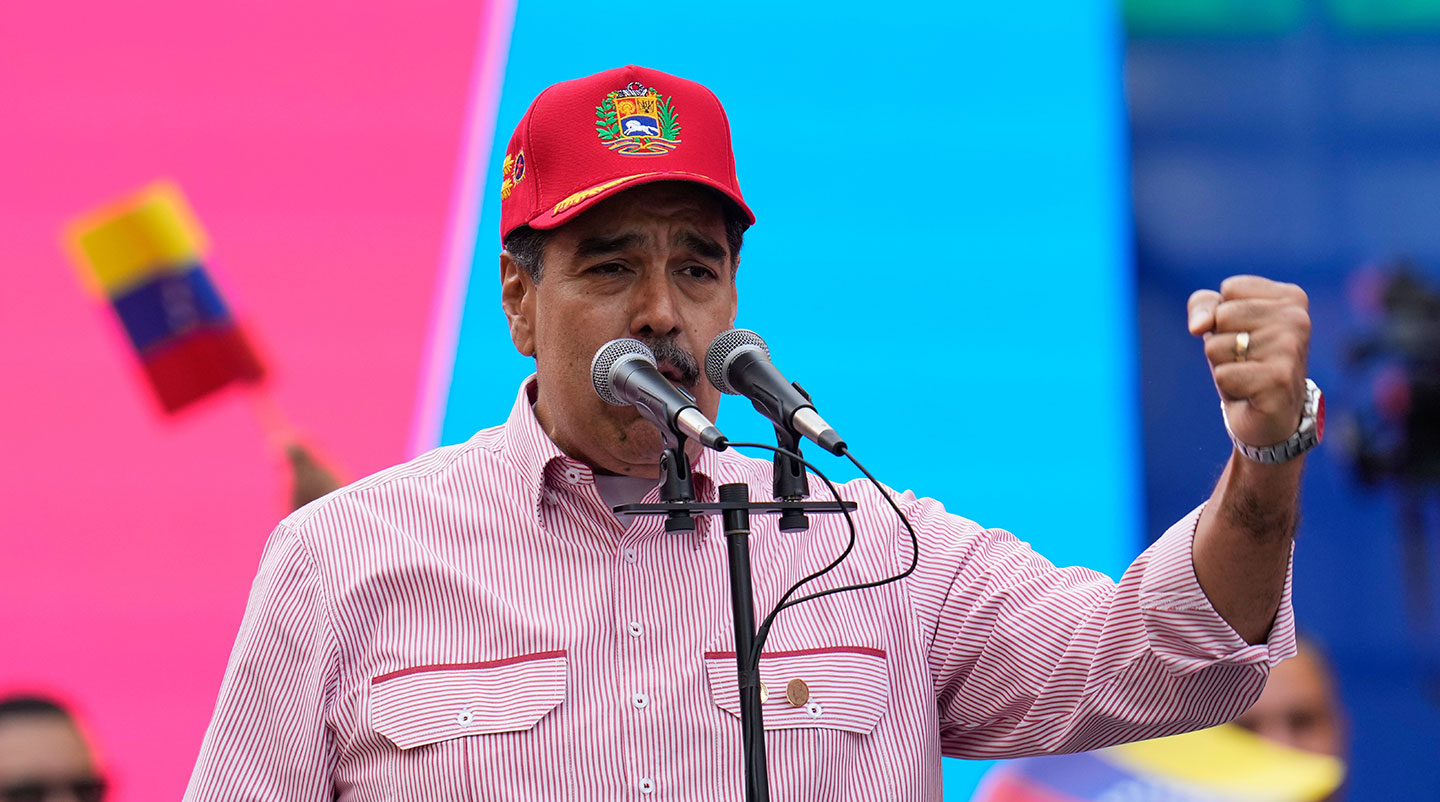
The United States has ramped up pressure on Venezuelan President Nicolás Maduro by designating the Cartel de los Soles as a foreign terrorist organization. But the entity that the U.S. government alleges is led by Maduro is not a cartel per se.
The designation, published November 24, 2025, in the Federal Register, is the latest measure in the U.S. campaign to combat drug trafficking. In previewing the step earlier in November, U.S. Secretary of State Marco Rubio accused Cartel de los Soles, or Cartel of the Suns, of being “responsible for terrorist violence” in the Western Hemisphere.
Venezuelans began using the term Cartel de los Soles in the 1990s to refer to high-ranking military officers who had grown rich from drug-running. As corruption expanded nationwide, first under the late President Hugo Chávez and then under Maduro, its use loosely expanded to police and government officials as well as activities like illegal mining and fuel trafficking. The “suns” in the name refer to the epaulettes affixed to the uniforms of high-ranking military officers. The umbrella term was elevated to a Maduro-led drug-trafficking organization in 2020, when the U.S. Justice Department in President Donald J. Trump’s first term announced the indictment of Venezuela’s leader and his inner circle on narcoterrorism and other charges. “It is not a group,” said Adam Isaacson, director for defense oversight at the Washington Office on Latin America organization. “It’s not like a group that people would ever identify themselves as members. They don’t have regular meetings. They don’t have a hierarchy.”
Expansion of terror label to cartels
Maduro’s government in a statement Monday categorically denied the existence of the cartel, describing the accusation as a “ridiculous fabrication” meant to “justify an illegitimate and illegal intervention against Venezuela.”
Up until this year, the label of foreign terrorist organization had been reserved for groups like the Islamic State or al-Qaida that use violence for political ends. The Trump administration applied it in February to eight Latin American criminal organizations involved in drug trafficking, migrant smuggling and other activities.
U.S. Defense Secretary Pete Hegseth said in November that the designation of Cartel de los Soles will provide a “whole bunch of new options to the United States” for dealing with Maduro. “So nothing is off the table, but nothing’s automatically on the table,” he said.
Trump administration officials have signaled that they find it difficult to see a situation in which Maduro remaining in power could be an acceptable endgame. But as Trump considers an array of military and non-military options, there is strong belief inside the administration that Maduro’s rule “is not sustainable,” according to a senior administration official who was not authorized to comment publicly.
Indictment alleges conspiracy to flood U.S. with drugs
A 2020 U.S. indictment accused Maduro, Interior Minister Diosdado Cabello and Defense Minister Vladimir Padrino López, among others, of conspiring with Colombian rebels and members of the Venezuelan military for several years “to flood the United States with cocaine” and use the drug trade as a “weapon against America.” Colombia is the world’s top cocaine producer.
Before laying down weapons as part of a 2016 peace deal, members of the Revolutionary Armed Forces of Colombia, or FARC, regularly used the porous border region with Venezuela as a haven and hub for U.S.-bound cocaine shipments — often with the support or at least consent of Venezuelan security forces.
The U.S. Treasury Department imposed sanctions on the Cartel de los Soles in July, saying Maduro and his top allies had bent the power of the Venezuelan government, military and intelligence services to assist the cartel in trafficking narcotics to the U.S.
U.S. authorities also alleged Maduro’s cartel gave material support to the Venezuelan gang Tren de Aragua and the Sinaloa Cartel, both of which were among the organizations that the U.S. designated as foreign terror organizations in February.