

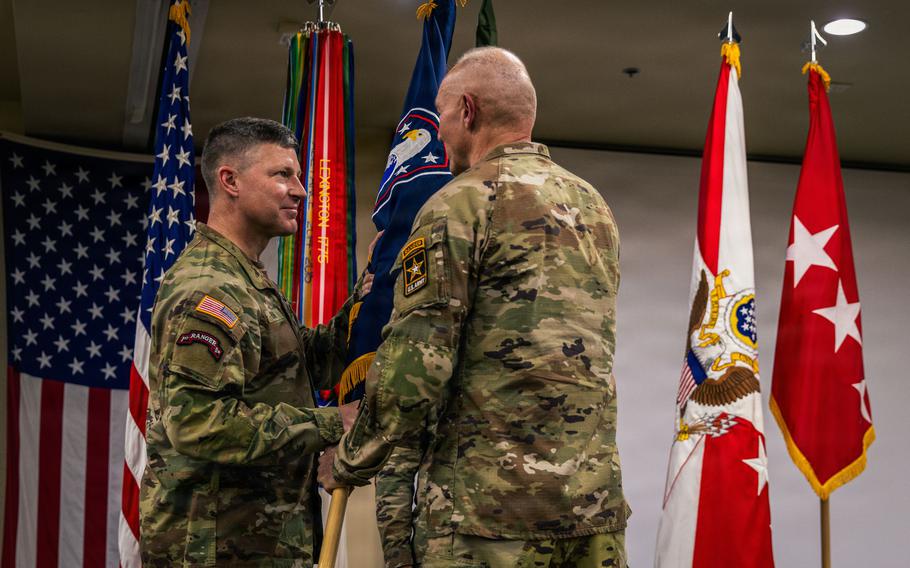
The United States Army officially stood up a new command in December 2025 to reflect emerging threats in the nation’s geographical backyard, including its Arctic and Caribbean approaches. Based at Fort Bragg, North Carolina, the U.S. Western Hemisphere Command will be composed of the former U.S. Army Forces Command, U.S. Army North and U.S. Army South. “The Army is transforming because our adversaries increasingly aim to exploit vulnerabilities in the homeland and throughout North, Central and Southern America,” Gen. Joseph Ryan, Western Hemisphere’s commander, said at a ceremony marking the activation of the command on December 5, according to CNN. “We have allowed this insidious activity to continue for too long, and we have not addressed it effectively.”
The U.S. Department of War announced the measure in May, a foreshadowing of the increased importance of the Western Hemisphere in U.S. strategic thinking. This new defensive posture was clearly outlined in the National Security Strategy released in December. In an April 30 memorandum to senior Army officials, War Secretary Pete Hesgeth said the Army’s priority must be deterring the Chinese Communist Party and “defending the homeland” and outlined a series of steps to streamline commands and rebalance force structures to increase U.S. force projection in the Western Hemisphere.
The Army Transformation Initiative, launched soon after Hesgeth’s order, seeks to deliver “critical warfighting capabilities, optimize our force structure, and eliminate waste and obsolete programs,” according to a May 1 letter to senior officials from Army Secretary Dan Driscoll. The initiative prioritizes unmanned aerial systems (UAS) and counter-UAS development and deployment, the M1E3 tank and long-range missiles. “Adaptation is no longer an advantage — it’s a requirement for survival,” Driscoll’s letter stated. The letter also announced the Western Hemisphere Command as part of a streamlining effort to “sharpen the spear” of force readiness. The Army’s Aviation, Aerial Cavalry Squadron and Brigade Combat Teams also will be reimagined to “trade weight for speed, and mass for decisive force.” Wasteful programs and obsolete programs will be eliminated, Driscoll’s letter stated.
The structural reorganization is further explained by the National Security Strategy: “Our goals for the Western Hemisphere can be summarized as “Enlist and Expand.” We will enlist established friends in the Hemisphere to control migration, stop drug flows, and strengthen stability and security on land and sea. We will expand by cultivating and strengthening new partners while bolstering our own nation’s appeal as the Hemisphere’s economic and security partner of choice,” the strategy states.
The Western Hemisphere Command will be fully operational in June 2026, said Col. Mike Burns, the new command’s spokesman, according to CNN. “This reform modernizes the Army’s command structure, reduces overhead, eliminates duplication, and puts more soldiers in operational formations where they can directly contribute to warfighting readiness,” Burns said. “It’s based on threat, strategy and the need to treat the homeland as a priority theater.”