

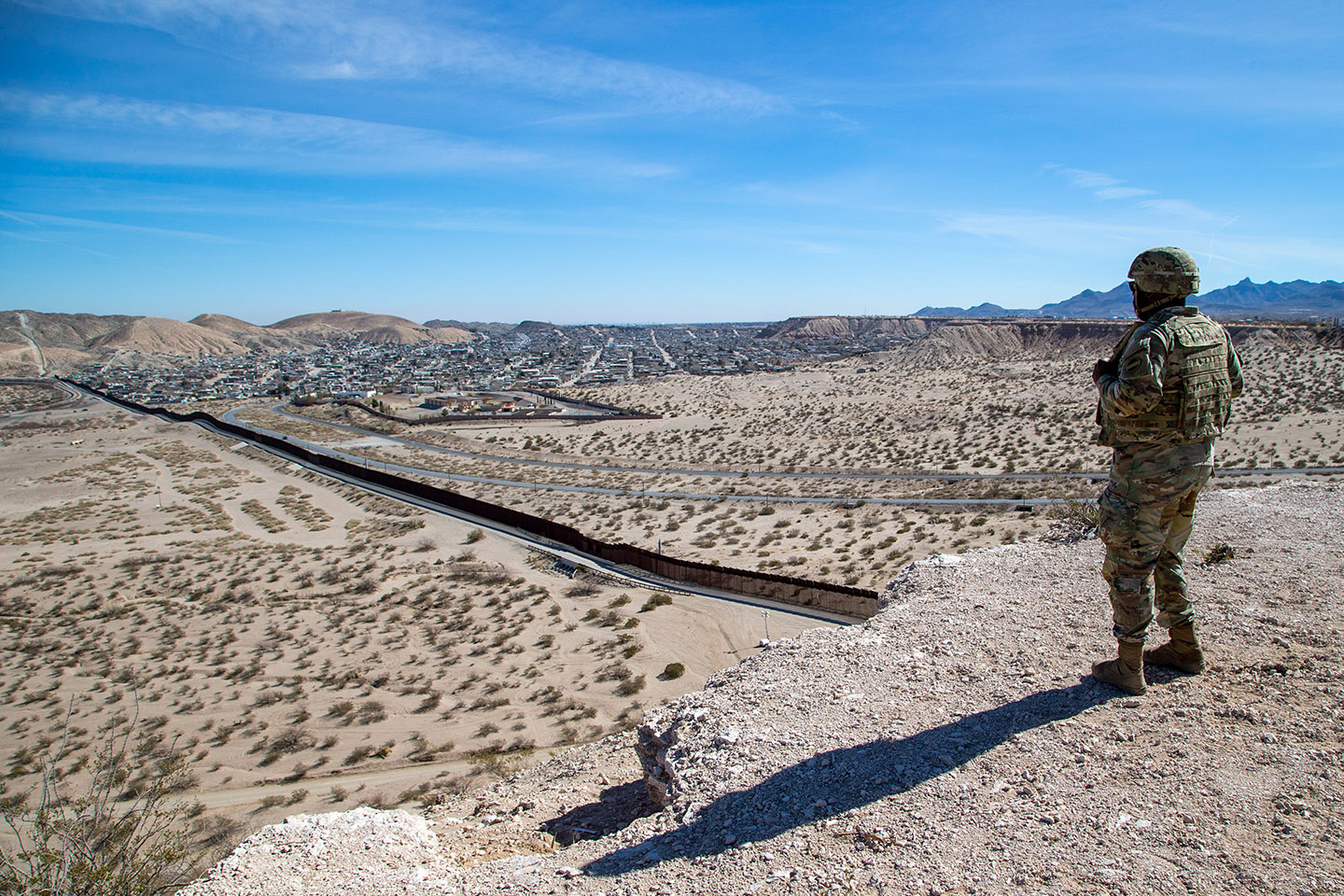
Mexico and the United States agreed in December 2025 to share intelligence to thwart the use of unmanned aerial systems (UAS) operating along their shared frontier. The agreement comes after transnational criminal organizations, or TCOs, in Mexico increasingly have used drones in their criminal enterprises, including an attack on a government building in Tijuana in October.
A December 11 meeting of the Security Implementation Group (SIG) involved a half-dozen U.S. agencies and their Mexican counterparts, according to a U.S. Department of State news release. “There was a topic of particular interest to the United States: the use of drones by criminals. This is something we had not previously discussed,” Mexican President Claudia Sheinbaum said after the meeting. “(They asked) what Mexico is doing, what is it that we know. These are discussions that contribute to strengthen security on both sides of the border.”
UAS activity along the border has caught the attention of Mexican and U.S. authorities. Gen. Gregory M. Guillot, commander of U.S. Northern Command and North American Aerospace Defense Command, testified before Congress in 2024 that about 1,000 unauthorized drone incursions a month occurred along the 3,145-kilometer border. Cartels have attacked rival criminal groups in the Mexican states of Guerrero and Michoacán in recent years. UAS activity has become such a common tactic in violence between TCOs that some cartels have used electronic signals to protect themselves, Henry Ziemer, associate fellow for the Americas Program at the Center for Strategic and International Studies (CSIS), told Border Report, a U.S. news site. “Mexico has been at the leading edge of illicit drone use not just as a weapon against the state and rivals but also as a means of intimidating and pressuring the civilian population,” Ziemer said.
The Mexican and U.S. SIG delegations agreed to link intelligence analytics software to identify drone threats and to discuss the issue further when the group reconvenes in January 2026. Sheinbaum said the agreement doesn’t mean the U.S. will have permanent access to Mexican security assets or pursue its own counter-UAS operations on Mexican soil, according to Border Report.
Ziemer has proposed a Southwest “drone wall” to deter TCOs from tracking border patrols and U.S. forces along the border and to stem the smuggling of narcotics and other contraband. “While Mexican criminal groups have yet to employ weaponized drones on U.S. territory, these unmanned aerial systems help cartels track border patrols, monitor U.S. forces, and deliver narcotics and other contraband,” Ziemer wrote in a December CSIS report. “Drones are a boon to these groups, allowing them to monitor wide swaths of territory and penetrate weak points along the land border.”
European nations are considering a similar wall along NATO’s border with Russia as Moscow has been linked to a series of drone incursions in recent months that shut airports and scrambled military assets. The U.S., Ziemer contends, would have an easier path to building its counter-UAS defenses. “There are good reasons to believe the Southwest land border is a strong test case for area drone defense. For one, the infrastructure is already at least partially in place, with ground and tower-based sensors deployed at strategic points along its length. While this remains plainly insufficient to address the sheer number of drone incursions, the United States would not need to start from zero. Rather than having to achieve consensus among 27 member states, the United States laid much of the groundwork for border drone defense more or less unilaterally,” Ziemer wrote.
SIG was formed in September after Secretary of State Marco Rubio’s visit to Mexico. The group is designed to meet regularly to bolster effective security cooperation on fentanyl trafficking, border security, illicit finance, fuel theft and TCO activity while respecting sovereignty and territorial integrity, according to the State Department.