

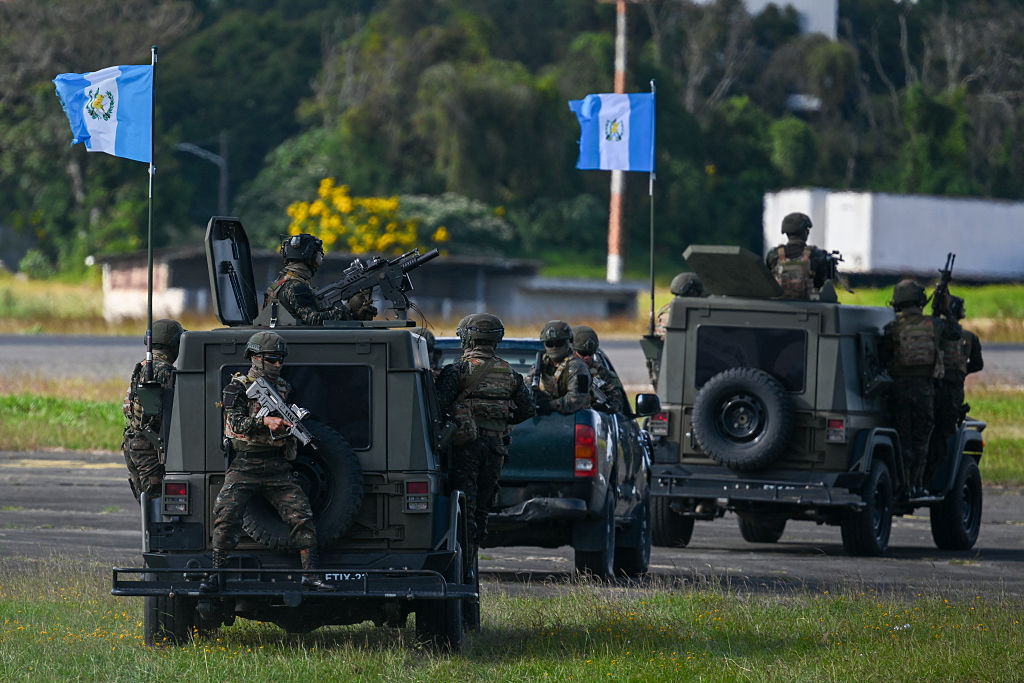
Guatemala has intensified its border security strategy with Mexico, marking a pivotal moment in its fight against transnational crime. The strategy centers on building a new military base in Petén, creating the Strategic Command Against Transnational Threats (CECAT) and engaging in unprecedented cooperation with Mexico and the United States. These decisive actions aim to curb the advance of transnational criminal organizations, or TCOs, and strengthen surveillance against increasingly sophisticated regional threats.
A pillar in the jungle
In early October 2025, Guatemalan President Bernardo Arévalo traveled to the Petén department to oversee the construction of a military base set to transform security along the northern border. Located in western Petén, the Special Jungle Operations Brigade base is scheduled for inauguration in early 2026. This infrastructure is designed to support operations against TCOs, controlling both riverine and land areas of the border.
“The military base of the Special Jungle Operations Brigade, in the town of El Subín, is an essential pillar in combating the illegal activities that affect the department of Petén,” Arévalo said via X. This new facility will enable permanent surveillance of more than 1,000 kilometers of shared border, a region historically exploited by criminal groups due to its numerous blind spots.
The new base is part of the national strategy aimed at closing the corridors most vulnerable to criminal penetration. Critical areas have been identified in Huehuetenango and San Marcos, which border Chiapas, and in Petén, which shares a border with Tabasco and Campeche. Petén, the country’s largest department, is characterized by its dense jungles and major rivers such as the Usumacinta and the Río Azul, which facilitate clandestine routes for trafficking drugs, arms and people.
Initiated in early 2024, the Guatemalan Army’s Operation Ring of Fire received major reinforcement starting in July 2024, deploying thousands of Soldiers across Petén, San Marcos and Huehuetenango, establishing checkpoints and increasing aerial and ground surveillance. In the first month of the reinforcement, forces carried out more than 4,200 land and 69 maritime operations. These early efforts contributed to great overall results for Operation Ring of Fire, which tallied the seizure of nearly 20 tons of drugs and 13.8 tons of chemical precursors through September 2025, the news website EFE reported.
The advance of TCOs
The U.S. State Department has identified Mexican cartels and their local allied networks as the principal threats at the border. They are focused on moving cocaine, methamphetamines and heroin northward.
The Sinaloa Cartel, designated a Foreign Terrorist Organization (FTO) in early 2025, maintains its hegemony through alliances with Guatemalan families such as the Lorenzanas and Mendozas, who have been the subject of key extraditions in 2025. Steven Ovaldino Lorenzana Alvarenga and Allan Mendoza were extradited to the United States for cocaine trafficking and illegal use of firearms, while Haroldo Waldemar Lorenzana Terraza remains at large, with a $5 million reward for information leading to his arrest.
The Jalisco New Generation Cartel, also designated as an FTO in 2025, has expanded its presence in at least 10 departments, including Petén and Huehuetenango, and has been subject to sanctions for its involvement in fuel theft and drug trafficking.
In addition, the emergence of new criminal networks such as the Huistas and the Pochos underscores the fragmentation and adaptation of criminal structures.
Transnational gangs: MS-13 and Barrio 18 under scrutiny
In a major policy move on October 21, 2025, Arévalo declared the MS-13 and Barrio 18 gangs as terrorist organizations. This declaration allows for the allocation of greater resources, the application of harsher penalties and the construction of a specialized prison. This decision follows the U.S. designation of both gangs as FTOs in 2025.
In 2025, Moisés Humberto Rivera Luna, an international leader of MS-13, was extradited to the U.S. on organized crime charges. Meanwhile, Barrio 18 staged a brazen escape of 20 leaders from Fraijanes II prison, leading to the arrest of 23 guards and prompting the reinforcement of border security.
CECAT: A model of multinational cooperation
The creation of the Strategic Command Against Transnational Threats (CECAT) in June 2025 marks a milestone in Guatemalan security strategy. CECAT coordinates defense operations against threats such as drug, arms and human trafficking, as well as money laundering and cybercrime, integrating resources from the Army, Air Force and Navy.
Retired Honduran Gen. Luis Armando Galeas, a security analyst, told Diálogo that CECAT “is a convenient, timely and relevant mechanism for addressing the regional insecurity generated by transnational organized crime.” He highlighted its “holistic, comprehensive and multilateral approach,” which allows for the coordinated use of deterrence, prevention and control by participating states.
Since its creation, CECAT has coordinated joint operations with Mexico and the U.S., destroying more than 1.6 million coca bushes, 1.3 million marijuana plants and 4,582 poppy plants, as well as dismantling drug runways and clandestine laboratories. In addition, 7.56 metric tons of chemical precursors and more than 6 tons of cocaine have been seized, and more than 410 arrests and 355 convictions related to criminal networks have been secured.
U.S. support and international cooperation
U.S. Southern Command (SOUTHCOM) and the U.S. Department of State have been pillars of assistance to Guatemala, providing logistical, technical and equipment support to strengthen the police and armed forces.
In 2024, the United States allocated $164.5 million in assistance to Guatemala, including funds for counternarcotics operations, military training and institutional modernization. SOUTHCOM has coordinated joint exercises, facilitated interoperability and donated vehicles and vessels to strengthen maritime and land interdiction capabilities.
Cooperation also includes community programs to prevent youth recruitment into gangs, supported by the U.S. government through the Bureau of International Narcotics and Law Enforcement Affairs and other agencies. This support is paired with institutional reforms, such as the Guatemala Se Transforma initiative and training programs in customs and border management.
Persistent challenges and the future of border security
Despite tangible progress — including successful drug interdiction and the capture of criminal leaders — the fragmentation of criminal groups and the emergence of new networks underscore the need for a comprehensive and sustained strategy. Gen. Galeas warns that “Guatemala must update its doctrine and specialization in cybersecurity. With the support of related states or other extra-continental allies, it must review and update its legal framework in light of the aforementioned threats, expand international agreements, strengthen institutions, and define public policies and strategies that decisively address new threats.”
The constant pressure from transnational organized crime groups, the sophistication of their operations and the complexity of the border geography require a coordinated, flexible response backed by international cooperation. The fortification of the Guatemala-Mexico border represents a critical new era in the fight against transnational organized crime. Long-term success will depend on the ability to adapt, the professionalization of security forces and the consolidation of regional alliances.
Diálogo Américas is a publication of U.S. Southern Command.