

The United States Space Force (USSF) is exploring possible upgrades at Vandenberg Space Force Base (VSFB) to launch much bigger rockets from the California facility. The USSF released a request for information, or RFI, on December 29, 2025, seeking industry interest in leasing and developing a site that could accommodate heavy and superheavy lift vehicles like SpaceX’s Starship.
USSF is seeking responses from launch service providers by February 12, 2026. SpaceX is already the most active tenant at Vandenberg, with frequent launches of its smaller Falcon 9 rockets, and the space community has been vocal about the possibility of billionaire Elon Musk’s rocket company bringing its Starship operations to the West Coast.
The RFI outlines plans for Space Launch Complex (SLC) 14 — a new site at the southernmost point of the Space Force base. The site is undeveloped and years away from being launch-ready.
Space Force’s goal, the RFI says, is to “establish operational heavy or super-heavy launch capabilities at VSFB.” Launch vehicles are classified by their low Earth orbit payload capacity, which is rated heavy at 20,000 to 50,000 kilograms, and superheavy at payloads of more than 50,000 kilograms. The SpaceX Starship is designed for a reusable payload capacity of 100,000 to 150,000 kilograms to low Earth orbit.
“A heavy/super-heavy launch capability at VSFB offers a strategic advantage to the USSF, enabling the deployment of larger, more capable military satellites and facilitating rapid response missions during national security emergencies,” the RFI says. “Adding heavy/super-heavy launch capabilities at VSFB enhances resilience, diversifies the government’s portfolio, and accelerates satellite constellation reconstitution due to increased lift capacity.”
The RFI seeks to increase launch diversity at Vandenberg, using the base for new launch vehicles that aren’t already there. Space Force also is looking for spacecraft with unique capabilities, like point-to-point delivery, payload return, survivability and reuse. The RFI calls for a launch service provider that can operate at SLC-14 within five years of signing a lease agreement.
Qualified providers would “finance, design, construct, operate and maintain a heavy or super-heavy vertical space launch vehicle capability to provide space launch services” to the Department of War and commercial entities, the RFI says. The companies would bear all development and compliance costs in exchange for a lease at fair market value determined by an appraisal.
The SpaceX Starship, when fully stacked with its Super Heavy booster, is 123 meters tall, which is taller than the length of a football field. As the world’s largest and most powerful launch system, Starship is being developed and tested for future NASA human moon missions and possibly the first crewed flights to Mars.
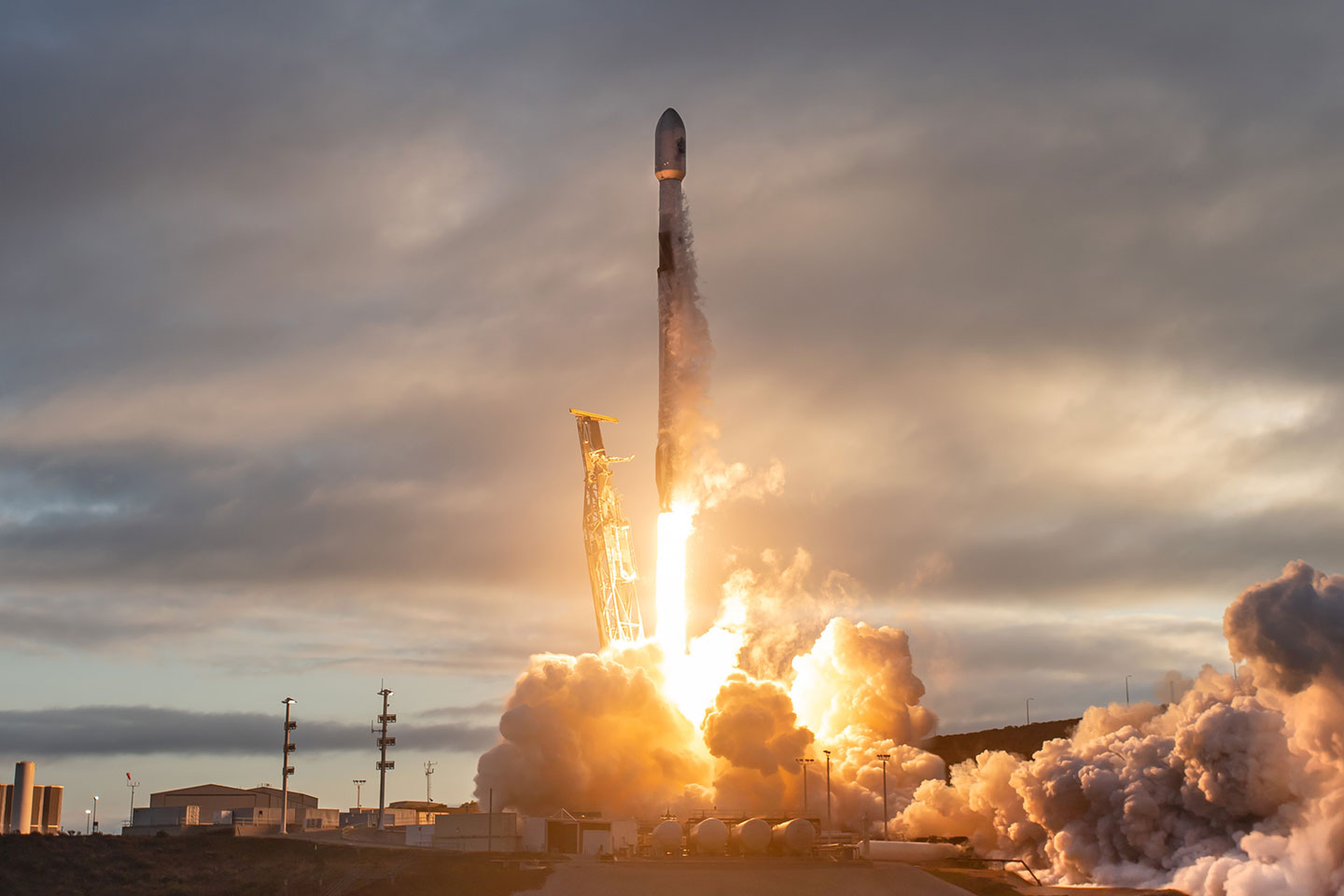
SpaceX regularly launches its smaller Falcon 9 rockets from Vandenberg. Each Falcon 9, standing 70 meters tall, typically hauls 29 Starlink internet satellites into space, adding to the Starlink constellation.
All of Starship’s test flights so far have launched from Starbase, the SpaceX headquarters in Texas. The company also plans to launch Starship from Florida in 2026.
Company officials must weigh the advantages a West Coast launch pad could offer SpaceX. The SLC-14 site would be excellent for sun-synchronous orbits and other high-inclination missions, scientists say, because its location allows for direct, efficient north-south launches over the Pacific Ocean, avoiding dogleg maneuvers needed in Florida to avoid flying over populated land.