

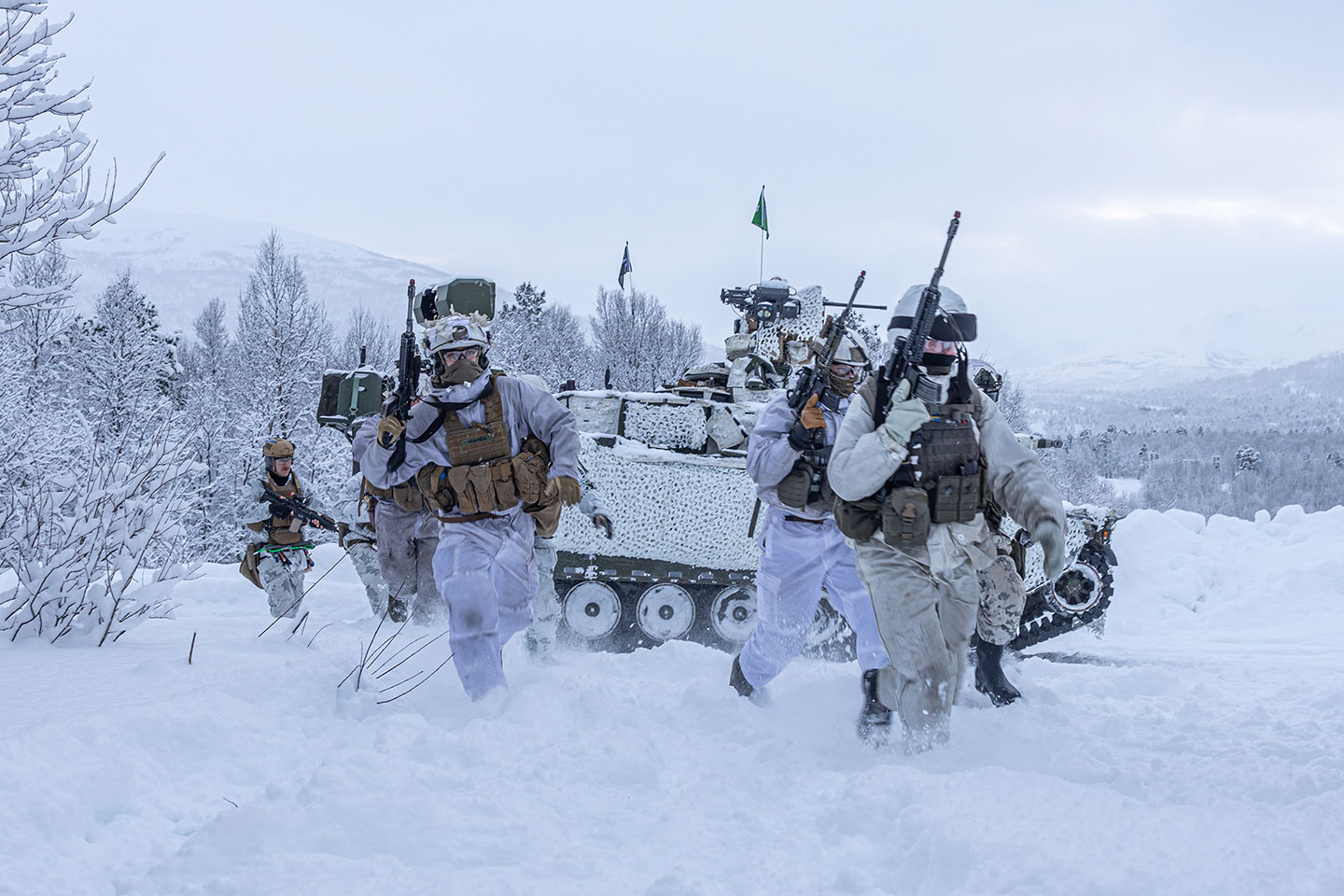
United States Marines deployed to northern Norway in January 2026 to participate in NATO’s Cold Response exercise, which is designed to enhance the troops’ ability to operate in harsh Arctic climates and defend the alliance’s northern flank. About 3,000 Marines from Camp Lejeune in North Carolina will take part in Cold Response alongside troops from 14 NATO countries when the exercise begins in March, according to the Army Times. “This exercise isn’t just about preparing for today’s threats,” Maj. Gen. Daniel L. Shipley, commander of U.S. Marine Corps Forces Europe and Africa, said in a Marine Corps news release. “It’s about building the capabilities and strengthening the capacity necessary to deter future aggression and safeguard our shared interests.”
In addition to U.S. and Norwegian troops, the Norwegian-led exercise will incorporate military assets and troops from Belgium, Canada, Denmark, Finland, France, Germany, Italy, the Netherlands, Spain, Sweden, Turkey and the United Kingdom, according to a Norwegian Armed Forces news release. Cold Response will be directed from a joint Norwegian-U.S. headquarters at Reitan, near Bodo, and involve about 25,000 Soldiers. Cold Response occurs every two years and is Norway’s largest military exercise and a key part of its NATO contribution. “The overall purpose of the exercise is to contribute to deterrence, strengthen Norwegian and allied defence capabilities, and reassure the population. This is achieved by demonstrating Norway’s and NATO’s ability to defend the Alliance’s northern flank,” the release stated.
Although Cold Response will run from March 9 to March 19, allied activities will take place before the official start and in the weeks after as troops begin to rotate back to their home countries. Logistically, the exercise represents “a significant milestone to demonstrate the readiness of a U.S.-based Marine Air Ground Task Force to swiftly assemble and deploy across the Atlantic, be received by Norwegian forces, and conduct operations to enable larger NATO missions,” the Marine Corps release stated.
The primary land and air operations will be concentrated in northern Norway and northern Finland. At sea, the exercise will take place in Norwegian waters, according to the Norwegian military. The multidomain operation will coordinate military efforts on land, air and sea as well as the cyber and space domains. A simultaneous large-scale simulation, involving significantly larger forces, will test command and control protocols and real-time decision making at Reitan and in Norfolk, Virginia, home of NATO Joint Forces Command – Norfolk, which recently assumed operational control over the Nordic region.
Marines from the 2nd Marine Division, II Marine Expeditionary Force will play a significant role in Cold Response. They will be joined by assets and troops from other U.S. branches, including a U.S. Navy Seabee detachment and P-8 Poseidon maritime patrol aircraft; bulk fuel capabilities from the U.S. Army’s 21st Theater Sustainment Command; F-35A Lightning IIs, KC-135 Stratotankers, HH60W Jolly Green IIs, MC-130J Commando IIs, and CV-22 Ospreys from the U.S. Air Force; and forces from U.S. Special Operations Command, according to the Marine Corps release.
“Our focus during Cold Response [26] is to position European success and seamlessly support Norwegian-led defense plans,” said U.S. Marine Corps Maj. Gen. Farrell J. Sullivan, the commanding general of 2nd Marine Division. “This means ensuring every domain is synchronized to support the warfighter on the ground and to provide our NATO partners with the decisive combat power they need, when they need it. This exercise is about more than just technology; it’s about forging the habits of discipline and trust that define true combat readiness, and it demonstrates our unwavering commitment to the collective defense of this Alliance.”