

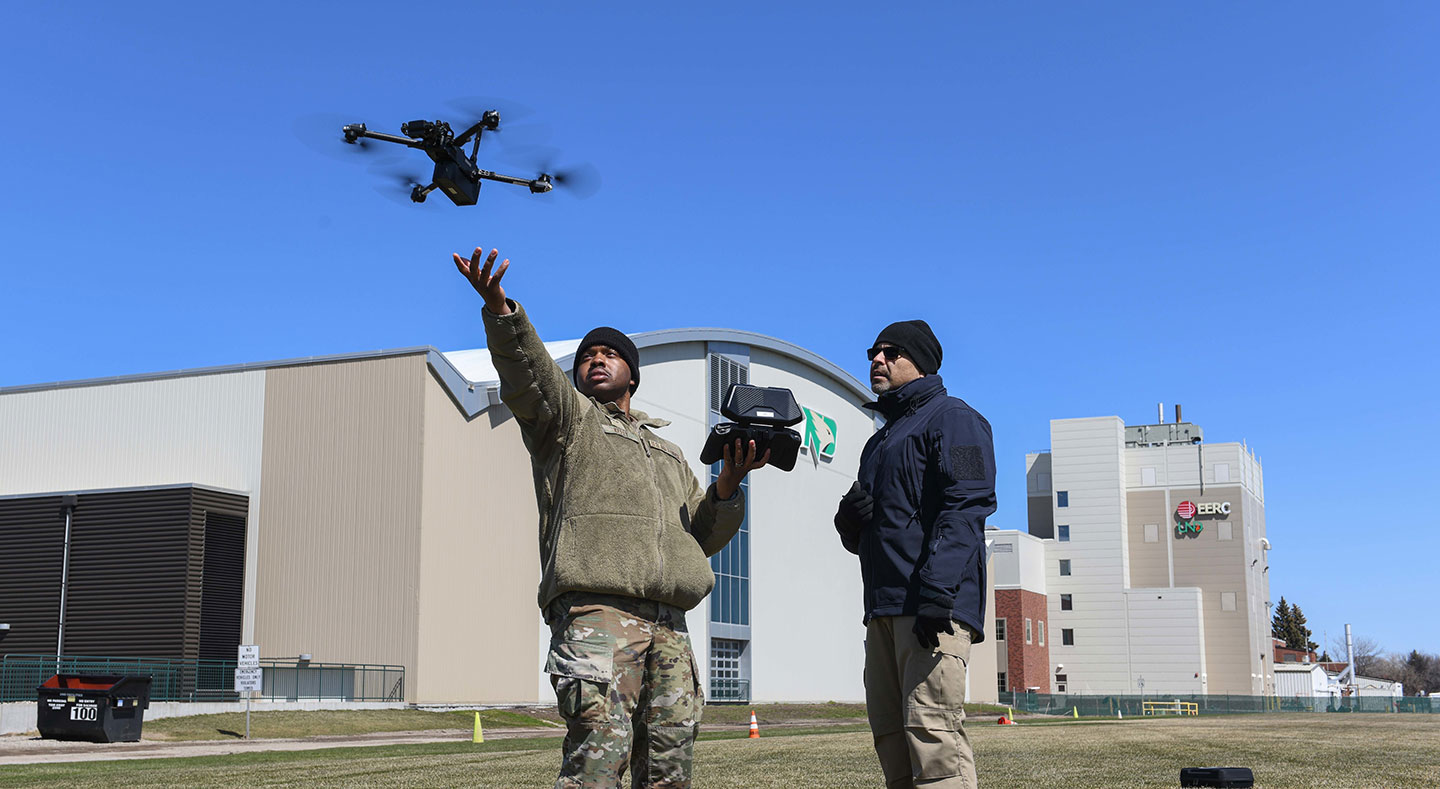
The United States Air Force has chosen the 319th Reconnaissance Wing (RW) at Grand Forks Air Force Base, North Dakota, supported by the 184th Wing, Kansas Air National Guard, to oversee efforts to counter small unmanned aerial systems (C-sUAS) at U.S. military facilities, the service announced in January. “The Point Defense Battle Lab will serve as a hub for collaboration, pushing boundaries in C-sUAS capabilities” and expanding the Air Force’s ability to detect, track and neutralize airborne threats, a Grand Forks Air Force Base news release said.
The Total Force team at the Battle Lab will support Air Combat Command’s Point Defense Task Force, a larger C-sUAS effort within the Air Force. The Battle Lab is designed to safeguard installations, protect vital assets and ensure continuity of air operations. Priorities include upgrading installation defense to a more proactive stance; integrating the newest evolving technologies to develop C-sUAS tactics, techniques and procedures; and developing and evaluating technologies to ensure tactical superiority.
“Total Force integration enhances our ability to field emerging technologies and match our capabilities to the threat environment,” said Col. Alfred Rosales, 319th RW commander. “The men and women of the 319th RW have extensive knowledge with unmanned, remotely piloted technology and will ensure our force is poised to secure our installations and defend the homeland.”
“We’re not going to become a new test base for the Air Force testing things that have never been turned on,” Rosales told DefenseScoop, a military news website. “This is an opportunity for us to build out exercises to further show that we can maintain our resiliency when it comes to defending the base and maintain our tactical air superiority above the airfield here.”
The 184th Wing of the Kansas Air National Guard was chosen to support the Battle Lab because of “its expertise in air battle management, cyber operations, and AI-enabled intelligence, surveillance, and reconnaissance [ISR],” the Grand Forks Air Force Base news release said. “Our Air Battle Managers, cyber warriors, ISR operators, and AI specialists are ready to work alongside the 319th Reconnaissance Wing to ensure the success of the Point Defense Battle Lab and to enhance the security of Air Force installations,” said Col. Joe Deeds, commander of the 184th Wing.
Drone intrusions at military installations have become a growing concern. In February 2025, Gen. Gregory M. Guillot, commander of U.S. Northern Command and North American Aerospace Defense Command, testified before the Senate Armed Services Committee about the threat.
“The availability and utility of small drones has grown exponentially over the last decade, and some have repeatedly employed these systems for illicit purposes. While U.S. and coalition forces overseas have faced the threat of weaponized unmanned systems for years, small drones have emerged as a significant risk to infrastructure and safety in the United States in a relatively short period of time.”
“The primary threat I see for them in the way they’ve been operating is detection and perhaps surveillance of sensitive capabilities on our installations,” he said during the hearing. “There were 350 detections reported in 2024 on military installations, and that was 350 over a total of 100 different installations of all types and levels of security.”
Addressing the threat, the War Department’s Joint Inter-Agency Task Force 401 (JIATF-401) announced on January 26, 2026, the release of updated guidance for c-UAS operations, “empowering installation commanders to take decisive action to protect military facilities, assets, and personnel within the homeland,” a War Department news release said. Under the guidance, signed by Secretary of War Pete Hegseth on December 8, 2025, all unauthorized drone flights near U.S. military installations have been classed as a surveillance threat.
“Countering drones does not start and stop at the fence line,” Brig. Gen. Matt Ross, director of JIATF-401, said in the War Department news release. “With this new guidance installation commanders are empowered to address threats as they develop, and the guidance makes clear that unauthorized drone flights are a surveillance threat even before they breach an installation perimeter.”
The new policy directs installation commanders to issue operating procedures for their facilities within 60 days. The commanders must “assess vulnerabilities, conduct rigorous training drills, and develop a robust defensive posture to deter and defeat any aerial threat,” the release says.