

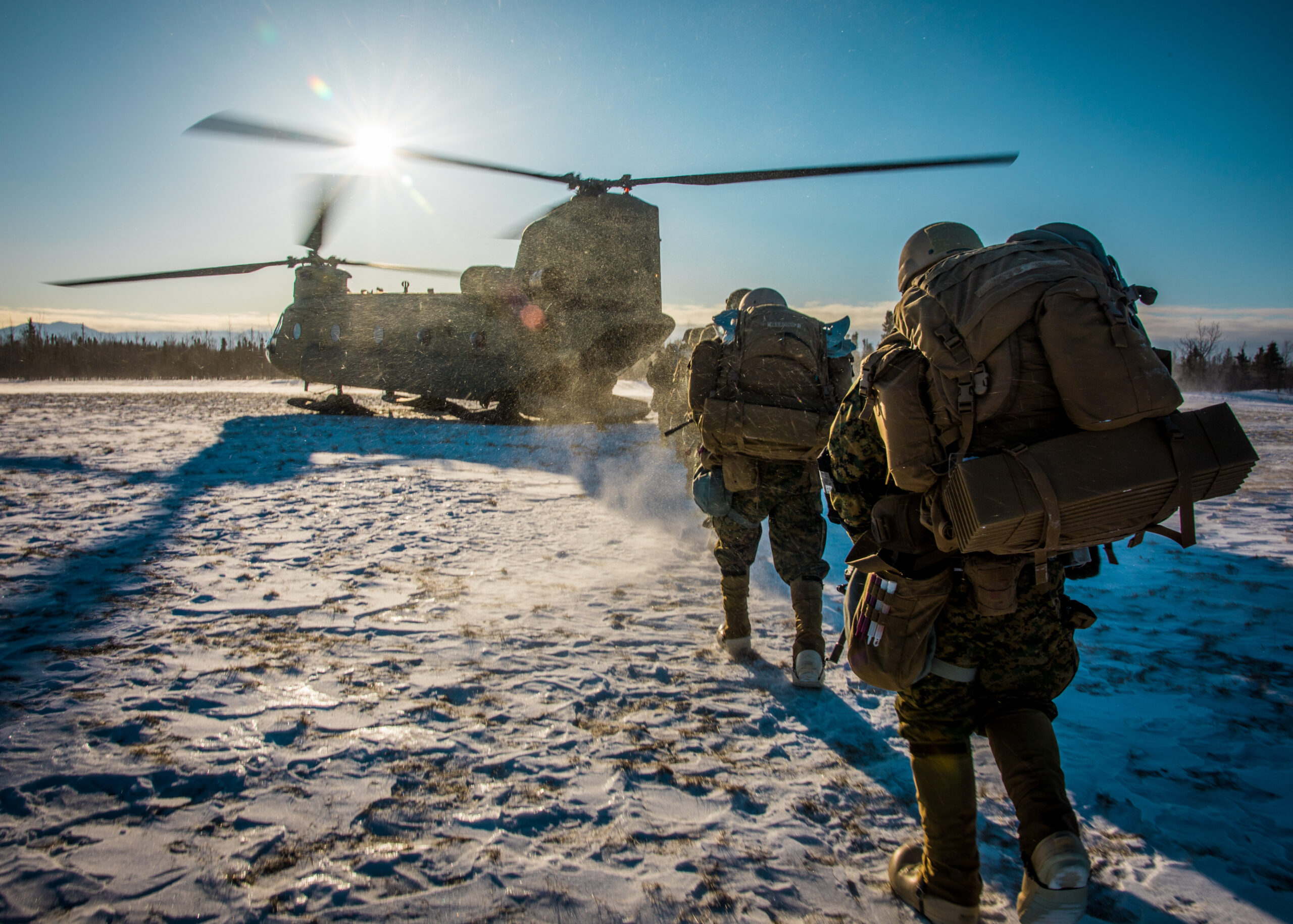
Arctic Edge, a multinational, multidomain exercise that began in February 2026 in Alaska and Greenland, made history in two ways. It is the first time Greenland was included in the annual exercise, which will conclude mid-March. It also is the first time that United States Northern Command (USNORTHCOM) organized the exercise after Greenland’s defense was transferred to USNORTHCOM from U.S. European Command last year. Canadian, Danish and U.S. forces are taking part in Arctic Edge, designed to highlight the military capabilities of the allies in an often inhospitable region.
Danish forces first participated in Arctic Edge in 2025, and this year’s participation “underscores the strong and trusted relationship” between the U.S. and Denmark, a USNORTHCOM spokesperson told Stars and Stripes, a U.S. military affairs newspaper. The nearly three week exercise will focus on integrating command and control relationships to support missions in the Arctic region. Some of the key objectives include cruise missile defense, defense of power grids and oil refineries, counter unmanned aerial systems and synchronizing base defense responsibilities as well as conducting joint experimentation and technology demonstrations. In Greenland, troops will carry out Arctic survival and mobility training, according to a North American Aerospace Defense Command (NORAD) news release.
The defense of critical infrastructure will be coordinated with state and interagency partners, the release stated, and local Alaskan communities will be involved. Municipalities closest to the designated military exercise operating areas include Anchorage, Fairbanks, Kodiak and Kotzebue in Alaska, and Kangerlussuaq and Nuuk in Greenland.
Arctic Edge will include NORAD and USNORTHCOM forces from Air Forces Northern, Army North, Naval Forces Northern, Marine Forces Northern, Special Operations Command North, Alaskan NORAD Region, Canadian NORAD Region, Alaska Command, and the Continental U.S. NORAD Region. Also participating are the Alaska National Guard and interagency partners including the FBI, U.S. Coast Guard, National Oceanic and Atmospheric Administration, the Federal Aviation Administration and Alaska state and local law enforcement, the release stated.
The exercise comes amid heightened interest in the region as melting sea ice creates navigable shipping lanes and potentially creates access to rich mineral deposits. Both the Chinese Communist Party and Russia have stepped up their Arctic presence, frequently collaborating in the refurbishment of ports and dual-use infrastructure. To counter this threat, NATO announced in February that it would create Arctic Sentry, an effort modeled on Baltic Sentry, put in place in 2025 after repeated sabotage incidents in that region linked to Russia. Arctic Sentry will incorporate a wide range of naval surveillance drones, warships, submarines and aircraft to identify and track ships, according to Stars and Stripes. “The activity will even further strengthen NATO’s posture in the Arctic and High North,” said Col. Martin L. O’Donnell, a spokesman for the Supreme Headquarters Allied Powers Europe.