


The success of the Artemis II mission will be measured by technological breakthroughs: a second test for the most powerful rocket ever to achieve orbit, a rendezvous and proximity operation (RPO) proving key capabilities for future deep-space missions, and the return of a crew to lunar orbit for the first time in 53 years.
Just as importantly, success will be measured in the growing international coalition that powers the long-term goals behind the United States-led Artemis program. There are the 10 European states who helped create the mission’s Orion crew spacecraft — and the 61 nations that have signed onto the underlying Artemis Accords, the first practical principles of safety, transparency and coordination for exploration of the moon, Mars and beyond.
What’s more, Artemis II carries the first astronaut from outside the U.S. to travel to the moon — mission specialist Jeremy Hansen of Canada — and four CubeSats from Argentina, Germany, the Republic of Korea and Saudi Arabia that were deployed in low Earth orbit shortly after launch.
The mission has space defense implications, as well, said U.S. Space Force Gen. Stephen N. Whiting, leader of U.S. Space Command: “Any time we know something is going to the moon, we’re going to use it,” Whiting told tech website Ars Technica in February 2026. “This is a location for potential military operations in the future, so at U.S. Space Command, we are very interested in being able to track what’s happening in cislunar space.”
 The four-member Artemis II crew swung around the far side of the moon and completed their lunar observation about 9:35 p.m. Monday. Soon after, they initiated another first for the mission — a return trip home guided by gravity with minimal need for onboard power. The chief goal of the 10-day mission is to test NASA’s Orion spacecraft and Space Launch System (SLS), validating life support, navigation and radiation shielding for future landing missions. An Artemis mission could land on the moon as soon as 2028.
For the first time, NASA is using a European-built system as a critical element to power and propel a U.S. spacecraft, the agency said at its website. Orion’s service module was built by the European Space Agency and partner Airbus Space, extending international cooperation from the International Space Station to deep space exploration.
The service module is the powerhouse of the spacecraft, providing maneuvering capability, power and astronaut life support including water, oxygen and nitrogen.
After launch Wednesday, April 1, Canadian Prime Minister Mark Carney lauded Artemis II and Hansen’s participation as a “remarkable achievement,” calling it “a testament to Canada and our world-class science, our cutting-edge technology, and our remarkable astronauts.”
Laryssa Patten, a Ukrainian-Canadian engineer and a space program manager with NATO, said, “This is more than a milestone — it’s a powerful demonstration of how far space technology has come — bringing together advanced propulsion, deep space navigation, and international collaboration to enable humanity’s return to the moon.”
The Orion crew was scheduled to splash down in the Pacific Ocean near San Diego on Friday, April 10. In addition to Hanson, they are NASA mission commander Reid Wiseman, pilot Victor Glover and mission specialist Christina Koch, all from the U.S.
The shoebox-sized CubeSats deployed during the mission were designed to expand knowledge of the space environment. They are:
- ATENEA, developed by the Argentina National Space Activities Commission to investigate radiation shielding, orbital design optimization and long-range communications.
- Space Weather CubeSat-1, developed by the Saudi Space Agency, measuring space weather effects such as radiation, solar X-rays, solar energy particles and magnetic fields.
- TACHELES, developed by the German Aerospace Center, demonstrating in-space technologies such as electrical components for future lunar logistics vehicles and operations.
- K-Rad Cube, developed by the Korea AeroSpace Administration to measure space radiation and its biological effect across the Van Allen radiation belts.
The seven-page Artemis Accords emphasize cooperation in space. “The Signatories recognize that the development of interoperable and common exploration infrastructure and standards … will enhance space-based exploration, scientific discovery, and commercial utilization,” says one of the accords’13 provisions.
Many of Orion’s maneuvers, such as big propulsive burns, are automated, NASA said. But a key RPO test in high Earth orbit evaluated manual handling. It proved successful.
Some three hours into the mission, the crew commanded their Orion capsule Integrity through a series of moves using the detached upper stage of the SLS rocket as a mark. As Integrity and the crew moved away from the stage, an automated backflip turned them around to face it. The crew took over with hand controls and moved from within 300 feet of the stage to 30 feet using thrusters on the European service module.
Then they backed away, followed the stage and initiated a second round of maneuvers using another target mounted on the side of the stage, again within 30 feet. They performed a fine-handling check before again backing away and heading this time toward their destination.
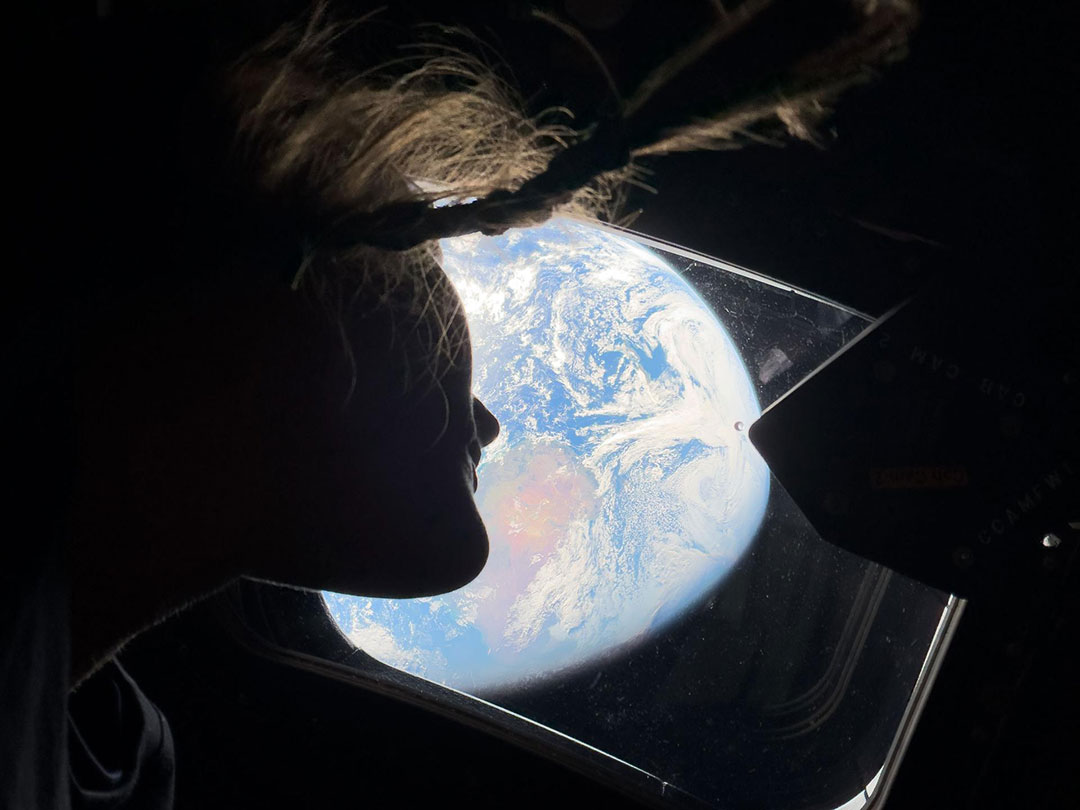
Artemis II launched on the day of a full moon, providing those on Earth a dramatic daily reminder that humankind was heading back there. As the spacecraft neared the moon early Sunday, April 5, with craters looming larger, mission commander Wiseman described the approach with the wonder astronauts first experienced during the Apollo moon missions of the ’60s and ’70s.
“You know, I’m not one for hyperbole,” said Wiseman, an engineer and pilot who has served 27 years in the U.S. Navy, after he was asked for his impressions. “But it’s the only thing I could come up with. Just seeing Tycho. There’s mountains to the north. You can see Copernicus, Reiner Gamma. It’s just everything from the training but in three dimension and just absolutely unbelievable.”
Mission control responded with a chuckle: “Copy. Moon joy.”