

THE WATCH STAFF
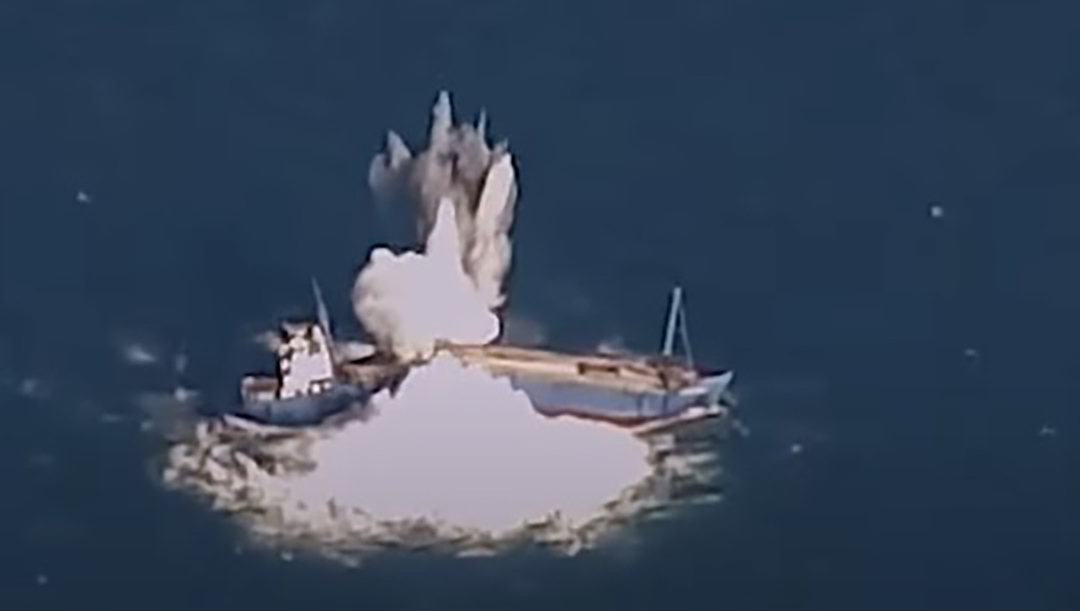
Struck by a single missile launched from a fighter jet, a container ship the length of three football fields took just 40 seconds to sink beneath the Gulf of Mexico. The plunging tip of its bow was the last to disappear, sending a geyser skyward. The experiment known as the Quicksink Joint Capability Technology Demonstration, conducted April 28, 2022, by the Air Force Research Laboratory and the Eglin Air Force Base Integrated Test Team, had earned its name.
The missile represents the modification of a modification: A special “seeking” device for added precision and acquisition is attached to an unguided bomb already fitted with a tail kit that converts it into a guided weapon. The new seeker is called WOSA, for weapon open systems architecture. The tail kit is known as JDAM, for Joint Direct Attack Munition – a technology first deployed in 1999 during the NATO campaign in the former Yugoslavia and hailed for helping expand the overall capabilities of U.S. bombers. (Pictured: A newly modified Quicksink missile fired from an Air Force fighter jet struck near the waterline and sank a container ship during a demonstration April 28, 2022, at a Gulf of Mexico test range.)
Quicksink builds on the cost efficiencies and target precision that have been JDAM’s hallmark. The tail kits cost just U.S. $18,000 each when the Air Force and Navy first acquired them for air-to-surface use. Hundreds of thousands have been ordered since then. Similarly, Quicksink can use 2,000-pound general-purpose bombs as its payload and the WOSA seeker features a modular approach, allowing the plug-and-play of different manufacturers’ seeker components and the potential for lower costs. The Quicksink technology would enable attacking aircraft to fire from up to 40 miles away from their targets. Quicksink also is designed to work in foul weather.
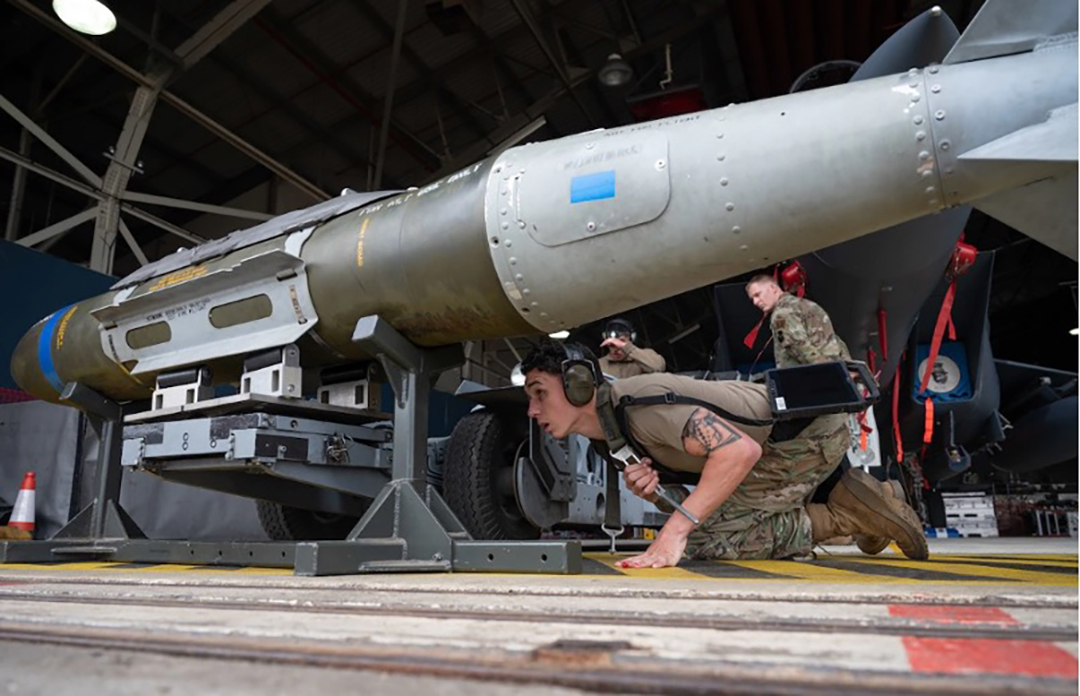
With the new modifications, Quicksink enables the Pentagon’s more-numerous and wider-ranging air assets to serve as an alternative to submarines and their sophisticated torpedoes in anti-surface ship warfare. “Heavyweight torpedoes are effective but are expensive and employed by a small portion of naval assets,” said Maj. Andrew Swanson, division chief of Advanced Programs with the 85th Test and Evaluation Squadron at Eglin, according to a news release from the Air Force Research Laboratory. “With Quicksink, we have demonstrated a low-cost and more agile solution that has the potential to be employed by the majority of Air Force combat aircraft, providing combatant commanders and warfighters with more options.”
It was the second experiment in the Quicksink demonstration program, the Air Force said. An earlier experiment helped show that one of the modified missiles could strike at a precise point on a ship, according to reports. The Air Force Research Lab is technical lead on the Quicksink program, a partnership with the Navy.
This advance in air-launched, anti-ship missiles comes as global tensions mount over military aggression at sea. Russia, with 40 frontline warships in its Black Sea fleet, has seized by force the ports of Sevastopol and Mariupol from Ukraine. Top U.S. intelligence officials have warned Congress that the People’s Republic of China (PRC) is “working hard” toward a military takeover of Taiwan just as a new agreement allows PRC navy ships to use ports in the Solomon Islands.
Quicksink’s capabilities are on display in a two-minute video created with computer-generated imagery and posted to YouTube in March 2022 by the Air Force Research Lab. In the fictional scenario, a missile with the features of the modified JDAM is attached to an Air Force F-35 and the fighter takes off from a desert base for a routine maritime patrol. Meantime, there is a “cargo ship heading to the West Coast armed with a long-range ballistic missile disguised as typical cargo containers,” according to text in the video. In the dark and rain, among the dozens of containers stacked on the ship’s deck, the roof on one opens and a missile launcher rises into a vertical position. Patrolling overhead, a Navy P-8 Poseidon reconnaissance plane confirms the threat and redirects the F-35 for an intercept. The coordinates and heading are uploaded to the jet and the pilot releases the missile, described in the video as an all-weather, maritime, seeker-enabled munition. The missile acquires the ship, determines the ship’s speed and flies toward the middle of the hull. An explosion occurs below the water line and the ship splits in two, scattering containers across the deck and into the ocean on both sides.
Less than two months later, a similar attack scenario played out for real on another Air Force Research Lab video – minus the threat and the containers – in the 120,000-square-mile Eglin Gulf Test and Training Range. The GBU-31 JDAM missile was fired from an Air Force F-15E Strike Eagle. A month later, the one-minute video was approaching 1 million views on YouTube thanks to links from news and other websites, some of whom added lively soundtracks to the dramatic sinking of the ship.
IMAGE CREDITS: U.S. AIR FORCE RESEARCH LAB