

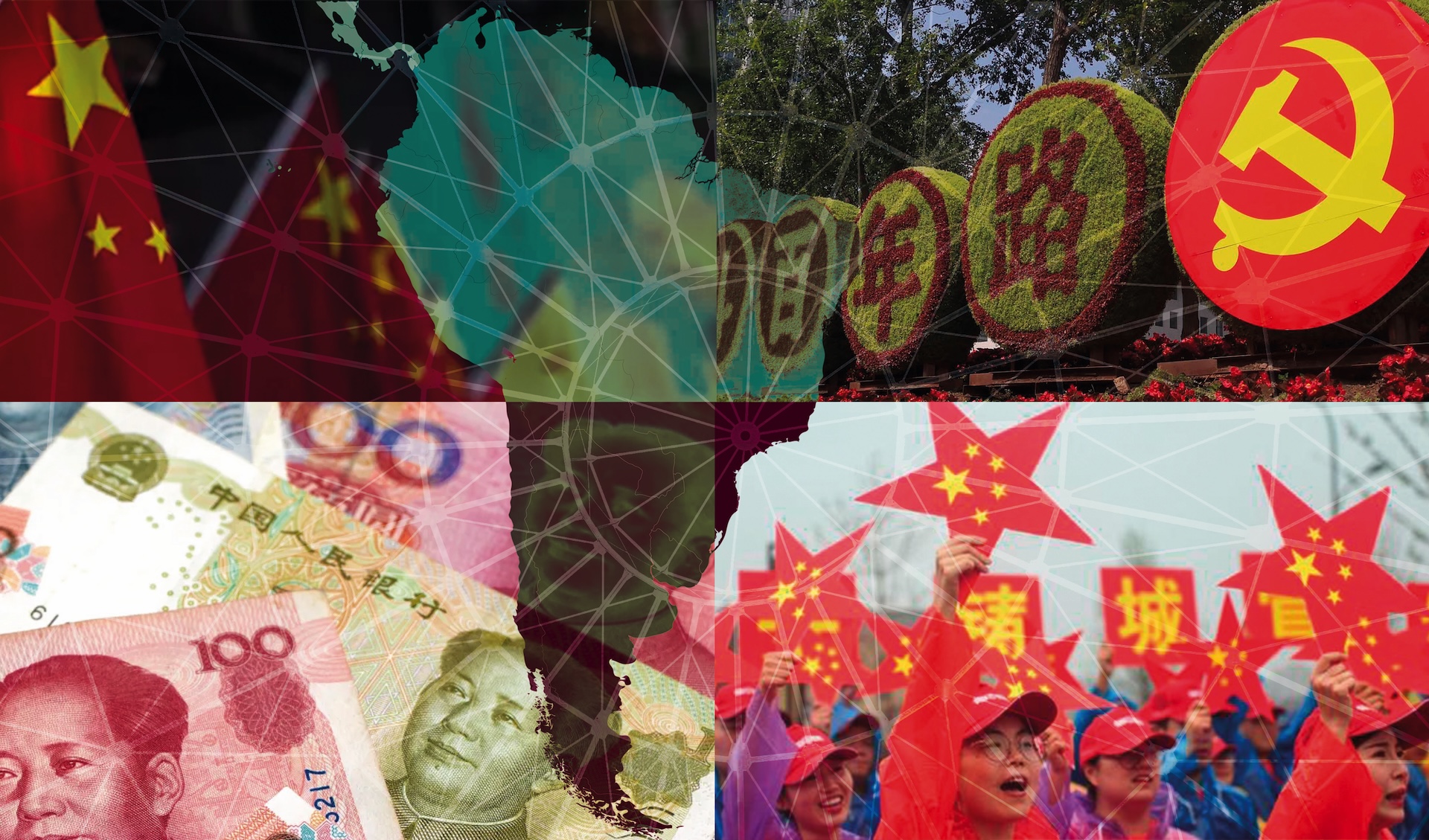
In Latin America, China’s influence is increasingly projected through the United Front, a sophisticated political and cultural apparatus of the Chinese Communist Party (CCP). Often misunderstood, this apparatus is responsible for consolidating Beijing’s soft power strategy abroad. Under the direction of the United Front Work Department, which reports to CCP General Secretary Xi Jinping, it seeks to neutralize opponents, control the diaspora and reinforce the CCP’s strategic interests.
In the region, it operates through a fluid network of cultural associations, chambers of commerce, friendship centers and media outlets. The goal is to gain legitimacy among local elites, promote Beijing’s interests and shape public opinion.
“In practice, the United Front brings together hundreds of organizations under the influence of the CCP, but without necessarily implying direct affiliation or a formal link to it,” explained Alonso E. Illueca, a professor and associate researcher at Santa María La Antigua University in Panama. This strategy allows the CCP to expand its influence more discreetly, making its operations appear to be autonomous initiatives. As a result, its power and methods are often underestimated.
The power of propaganda
According to Illueca, the United Front leverages the Chinese diaspora, whose media outlets are controlled to disseminate content aligned with the CCP’s narrative. Through surveillance and pressure, the United Front ensures these communities do not become spaces for dissent on sensitive issues such as Taiwan, Tibet or Falun Gong.
The United Front invests heavily in propaganda aimed at the diaspora. It organizes the biennial Chinese Language Global Media Forum, which brings together Chinese media outlets abroad and controls the China News Service (CNS), the CCP’s main media network, with its Latin American headquarters in Brazil. Through CNS, the United Front collaborates with local media within Chinese communities, amplifying content favorable to Beijing.
A report by cybersecurity company Nisos revealed that a subsidiary of CNS, Sinoing — also known as Beijing Zhongxin Chinese Technology Development or Beijing Zhongxin Chinese Media Service — has developed 36 websites and mobile applications for a dozen diaspora media outlets. This is part of a global network with a significant presence in Latin America, including the South America Overseas Chinese Press Network, based in Brazil. According to Nisos, these applications are particularly invasive in their collection of personal data.
The Canberra-based think tank Australian Strategic Policy Institute (ASPI) also notes that Sinoing manages at least 26 WeChat accounts as part of this network, some in Brazil, followed by thousands of users. This is a critical element of the United Front’s strategy because WeChat is not merely a messaging app but also is a primary source of news and a vital link to mainland China for the diaspora. This reliance allows the CCP to extend its censorship and surveillance capabilities beyond its borders, monitoring private communications and using the content to train censorship algorithms, even for users residing in democratic nations. As various Western intelligence services also reported in 2021, the CCP uses these tools to exercise pervasive control, even intimidating activists and dissidents in the diaspora.
United Front organizations and influence
The United Front often operates by funding or co-opting interest groups. In many cases, these organizations, which include commercial corporations, student associations and “friendship” associations, engage in political activities designed to deflect criticism of the CCP or counter policies considered hostile to Beijing. This reliance on semi-autonomous groups and influential people is a core tactic, blurring the lines between private interests and CCP objectives.
The United Front’s influence extends far beyond the Chinese diaspora. Its strategy is to cultivate close relationships with Latin American politicians, business leaders, academics and journalists to build long-term goodwill and trust. The goal is to align a nation’s policies with Beijing’s interests by fostering a deep network of influence among local elites.
“These organizations aim to deploy soft power through scholarship programs and cultural diplomacy, using other tools such as funding official visits and training programs for journalists, academics, political parties and public servants,” Illueca said. Among the centers linked to the United Front is, according to ASPI, the Hunan Foreign Friendship Association, which in Latin America maintains links with local friendship associations, such as the Colombo-China Friendship Association in Colombia and the Ecuador-China Friendship Association in Ecuador. These organizations promote meetings with Latin American politicians and representatives of sectors strategic to the CCP.
According to Illueca, “the United Front’s operations focus mainly on fundraising, as well as involvement in domestic politics and support for government officials and candidates for elected office, with the aim of achieving high levels of influence in the formulation of public policy.”
A key step was the appointment in 2023 of Yang Wanming as president of the Hunan Foreign Friendship Association. As a former ambassador to Brazil between 2019 and 2022, his new role in a “friendship” association is a significant promotion because it places a high-level diplomat in a key position to expand the United Front’s influence throughout the region.
Technological and economic interests
The United Front supports the CCP’s strategy of promoting economic interests and acquiring technology through coordination with the Ministry of Science and Technology. In Latin America, sectors such as mining and agriculture are high priorities, but so are infrastructure and technology.
Beijing’s push for access to strategic resources like lithium and copper is paramount for its high-tech manufacturing and electric vehicle industries. At the same time, it secures agricultural goods like soybeans and beef to ensure its food security.
The focus on infrastructure is equally significant, with investments in ports, railways and highways designed to streamline the export of these resources. In the tech sector, Chinese companies are building 5G networks and surveillance systems across the region. This is demonstrated by the recent agreement signed in Brazil by Huaqiao University to create a gem laboratory with the participation of Chinese researchers.
At the same time, the CCP cultivates interest groups in the region that, although representing private interests, actively support the economic policies of Beijing. One example is the China-Brazil Business Council (CEBC). With offices in Brazil and China, the latter under the supervision of the Chinese Ministry of Commerce, the CEBC functions as a strategic channel for the implementation of Chinese economic policies in the region.
To contain the expansion of the United Front in Latin America, according to Illueca, it is necessary to better protect the Chinese diaspora, considered the “magic weapon” used by Beijing to promote its interests. “Recognizing more rights for members of the Chinese diaspora would result in less exclusion and less room for the United Front to operate,” the expert concluded.