

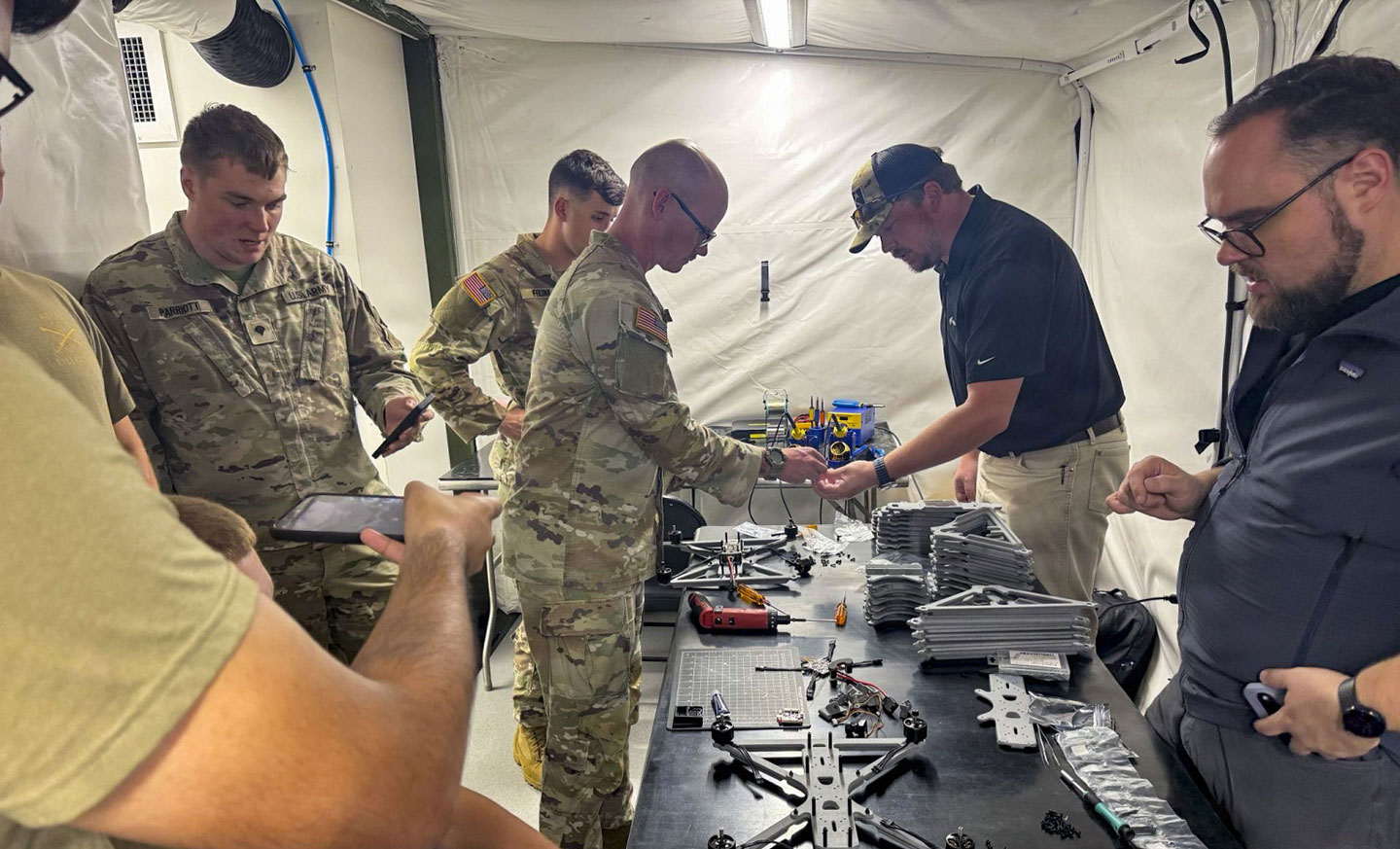
A combat helicopter brigade stationed in Georgia has been training to augment its existing Apache Black Hawk and Chinook assets with unmanned aerial systems (UAS) designed to enhance security and force protection when combat helicopter crews are ferrying troops, supplies and firepower into battle. The 3rd Combat Aviation Brigade (CAB), 3rd Infantry Division, recently demonstrated innovative techniques to rapidly integrate UAS technology into battlefield planning.
The Russia-Ukraine war provides a clear example of how UAS, also known as drones, have transformed 21st-century warfare. Both Russia and Ukraine have deployed drones to attack troops, infrastructure and military assets, often evading traditional defenses. Cheap to produce and easily tweaked on the battlefield, UAS technology will be crucial for any military to protect its troops and sustain future military operations.
The 3rd CAB exercise at Hunter Army Airfield in Savannah, Georgia, let Soldiers demonstrate agile deployments of UAS under battlefield conditions in the September 2025 exercise. The Soldiers trained on the Expeditionary Manufacturing Cell, a mobile 3D-printing system able to produce drone parts in the field, according to a November Department of War news release. Soldiers trained as UAS operators, repairers and allied trade specialists printed more than 90 components in hours — a process that previously took weeks. The Soldiers printed, assembled and flew first-person drones weighing under 9 kilograms and carrying small munitions, testing the drones’ precision, sensors and flight capabilities in a tactical environment. The drill let Soldiers show operational flexibility and ingenuity, a requirement for drone warfare. “Today’s battlefield is adapting rapidly. By teaching our soldiers to understand how drones work and are built, we are giving them the skills to think creatively and apply emerging technologies to enhance mission effectiveness and readiness,” Staff Sgt. Christian Dodson said in the release.
Integrating UAS components into helicopter warfare has clear advantages. “A Black Hawk air assault might still carry troops, but preceding it, a UAS team could scout the route, drop loitering munitions against anti-air threats, or provide a live video feed that shortens the sensor-to-shooter timeline. A Chinook heavy-lift mission might be preceded by unmanned reconnaissance of the landing zone and suppression of nearby sensors,” the release stated.
The U.S. Army in November also began testing the VXE30 Stalker, a larger drone that can carry heavier armaments. The tests were conducted at Fort Rucker in Alabama in advance of a brigade- and battalion-level exercise in December, according to The Defense Post, a military affairs publication. The Stalker is known as a Group 2 UAS, a medium-sized drone weighing between 9 and 25 kilograms and operating below 1,067 meters. Used for battlefield reconnaissance, the Stalker can be armed with 81 mm mortar rounds or custom weaponry, the Defense Post reported. Such armaments cost about $800 a round instead of the $100,000 to $150,000 it costs to launch a Hellfire missile, Army Maj. Rachel Martin, director of the Air Cavalry Leaders Course and Unmanned Advanced Lethality Course, told the publication.