

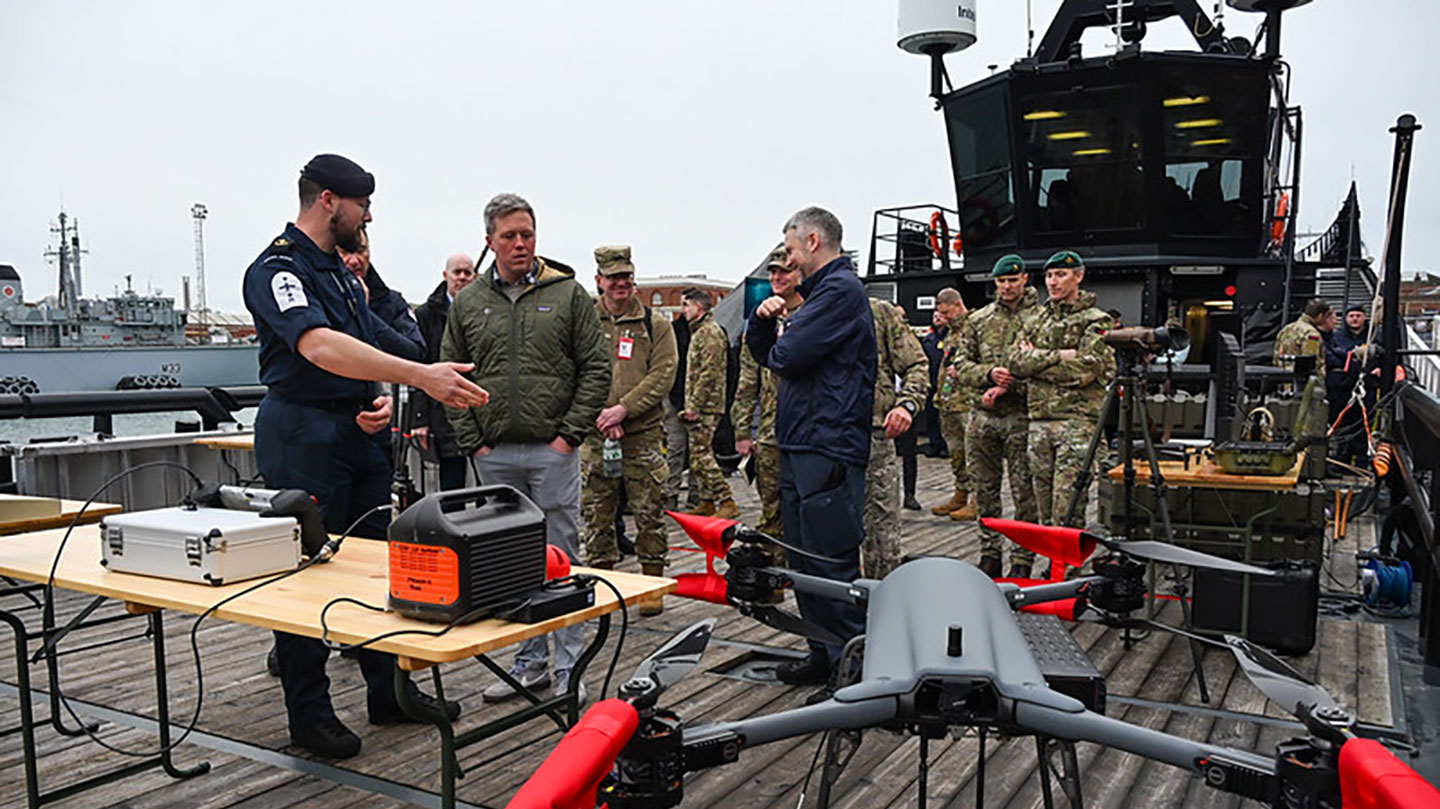
The United States Army has signed a deal with the United Kingdom setting up guidelines for sharing intelligence on drone and counter-drone operations, and Army Secretary Dan Driscoll said he’s seeking similar partnerships in the event of a future conflict where allies must battle an adversary together. The “end state” of such preparation, Driscoll said: “Hopefully, dealing with counter-drone and the threat of drones today has made us a lot stronger for that fight in the future.”
Driscoll said he and Brig. Gen. Matthew Ross, head of the Army’s Joint Interagency Task Force 401, went to the U.K. in December 2025, and the allied nations approved the intelligence-sharing partnership. “We signed a document with them that basically said, ‘Hey, we’re going to work on this together. We’re going to figure out … what are the rules for sharing information?’”
“Because drones can penetrate airspace so quickly and they’re so hard to predict. It’s not like a missile, where you can predict a trajectory and act on it; you have to be able to exchange information,” Driscoll said during a town hall January 12, 2025, at Fort Drum, New York, home of the Army’s 10th Mountain Division.
Driscoll noted that a key advantage of drone partnerships is that the military can ideally build and buy the same tools as its partners, so the U.S. is “going to try to expand that to a couple of other countries.” He did not discuss what other nations the Department of War might partner with, but the U.S. military has been participating in drone and counter-drone exercises and contests with other partner nations recently.
Driscoll’s reveal of the drone agreement came a day after Task Force 401, the Department of War’s key organization to rapidly counter small unmanned aerial systems (UAS), announced its first acquisition under the Replicator 2 initiative, awarding a contract for two DroneHunter F700 systems. Delivery of the systems is expected by April.
The DroneHunter F700 is an autonomous, AI-powered interceptor drone built by Utah-based Fortem Technologies. It can detect and capture other drones using radar and high-powered net guns.
“Once the F700 is within range of the target, escape is highly improbable,” Fortem says on its website. “Statistically, only 15% of target drones evade the first shot … and a second shot is usually ready to follow.”
The Replicator initiative, announced in August 2023, is a War Department effort to accelerate the delivery of innovative technologies to U.S. warfighters. The first phase, Replicator 1, focused on deploying thousands of autonomous systems across multiple domains. Replicator 2 is aimed at countering small UAS.
“We have just one measure of effectiveness: to deliver state-of-the-art counter-UAS capabilities to our warfighters both at home and abroad,” Ross said in a Department of War news article. “This purchase of the DroneHunter system is a key first step in accomplishing our Replicator 2 mission.”