

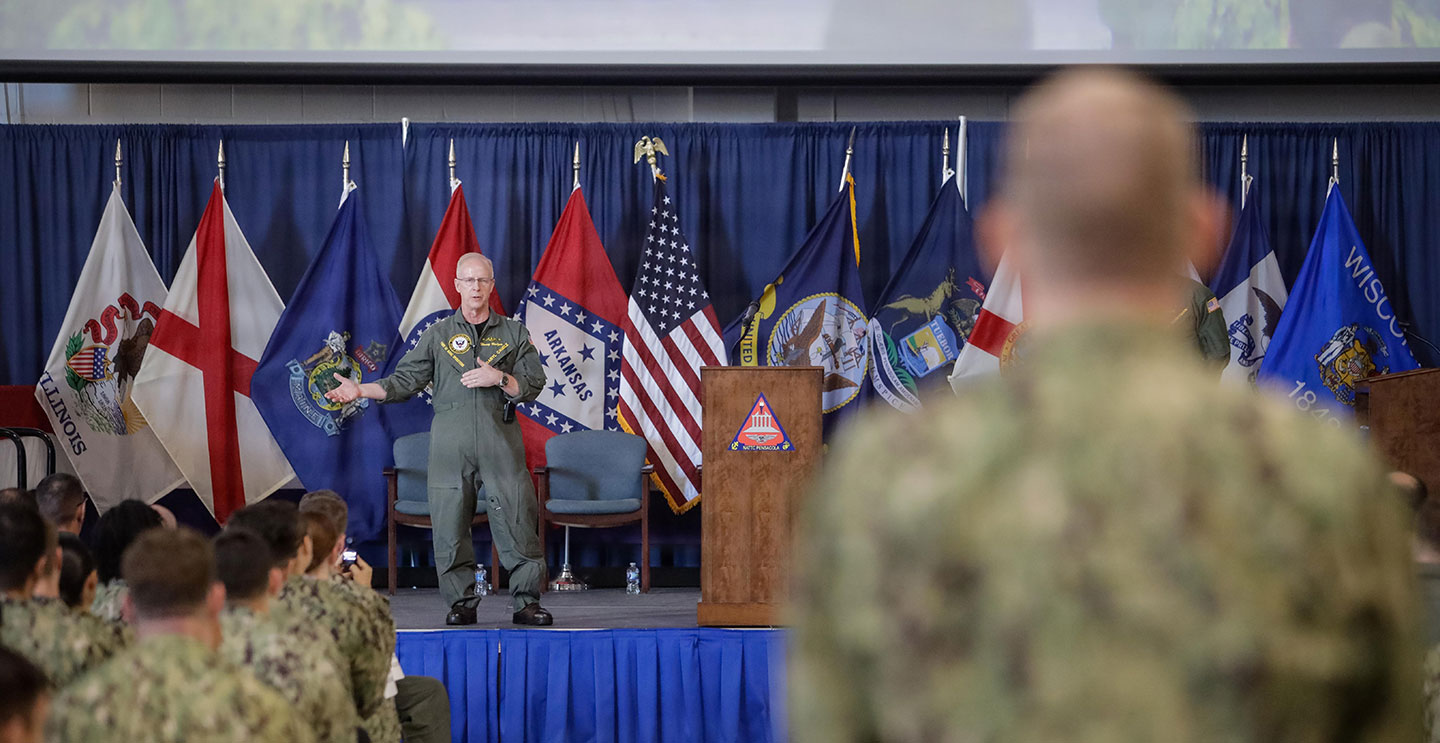
The United States Navy’s Chief of Naval Operations recently outlined a new strategy to bolster force projection globally in an age where multiple threats across oceans have become an increasingly likely scenario. Adm. Daryl Caudle said the Hedge Strategy would focus on forward deployed assets and highlight uncrewed vessels and systems to counter low-probability, high-risk threats. “Hedge Strategy isn’t just a prescriptive effort, it’s an enduring approach to fielding a relevant fleet, across all domains, in an ever dynamic and increasingly challenging environment against the backdrop of unpredictable threat vectors,” he said at a January 2026 defense conference in Washington, D.C., according to National Defense Magazine, a U.S. military affairs publication.
The Navy’s current configuration features expensive, complex carrier strike groups and U.S. Marine Corps expeditionary forces that are highly effective but costly and often take time to deploy. At the core of the Hedge Strategy is a combination of uncrewed ships and robotic or autonomous systems like drones and underwater vessels that would be based in high-risk regions and tailored to the potential conflicts in each, reported the Hudson Institute, a U.S. think tank, in a December 2025 analysis. Cheaper to build and maintain than guided-missile destroyers, aircraft carriers and crewed submarines, these “tailored forces” would respond nimbly to adversaries while dovetailing with the mission of the larger, more traditional “single-use” force, Caudle said at the APEX defense conference on January 27.
The pacing challenges of the Chinese Communist Party and Russian naval forces require the Navy to prepare for defending U.S. interests in every ocean and require a fresh strategy to spread risk and costs appropriately, Caudle said. “So, Hedge Strategy is a means of thoughtfully bringing the full weight of our maritime forces to bear, providing relevant capabilities for every situation,” National Defense reported.
Hedge Strategy is particularly useful to defend against asymmetrical threats and backstop security in other regions when mainline naval forces are engaged elsewhere. Caudle noted that the strategic framework isn’t new: Navy SEALS are hedge forces, he said, as are the E-6B Mercury command and control warplane and the nation’s ballistic missile capabilities. “When you consider the unique capabilities our Navy already provides, you’ll notice hedges are prevalent in almost everything we do,” Caudle said. “Our global network of allies and partners are our enduring hedge when our resources and presence are constrained.”
In a scenario where a large conflict occupied most of the Navy’s existing fleet, drone boats, undersea vehicles and loitering munitions — unmanned aerial systems that can linger over a potential target for long periods before striking — would engage the enemy long enough for the main naval force to arrive, the Hudson Institute analysis stated. In the early stages of such a fight, uncrewed Modular Attack Surface Craft and submarines carrying between 16 and 32 weapons could be crucial in the early phases of the fight to hold off enemy progress, the analysis stated.
Caudle, though, stressed that traditionally crewed vessels would remain the mainstay of U.S. naval strength. “At the end of the day, platforms and capabilities don’t win wars, our people do, and I truly believe that in any scenario, our Sailors will remain our greatest competitive advantage,” he continued. “That is exactly what these fighting instructions and the Hedge Strategy aim to do: providing our Sailors with the asymmetric advantages, capabilities and structures to fight decisively and, if necessary, win with overwhelming success.”
Caudle was promoted to Chief of Naval Operations in August 2025 and is responsible for the command, utilization of resources, and operating efficiency of worldwide naval forces and shore activities. His naval career includes commanding three nuclear-powered submarines, serving as deputy commander of the 6th Fleet, director of operations for U.S. Naval Forces Europe-Africa, and commander of Submarine Group Eight. He also served as commander of the Submarine Force, Pacific Fleet, and vice director for Strategy, Plans, and Policy on the Joint Staff. He then became commander of Naval Submarine Forces before ascending to command the U.S. Fleet Forces Command in 2021.