

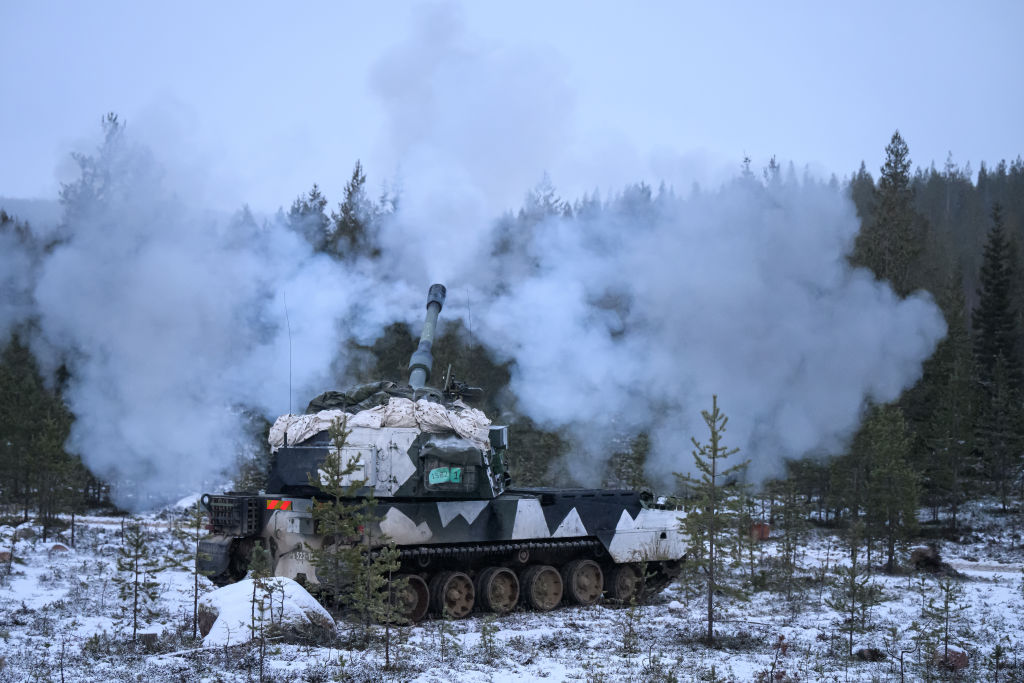
Finland announced the regional capital of Lapland will host a NATO Forward Land Forces (FLF) headquarters staffed by Finnish, Swedish and other NATO members to establish a permanent logistical and planning hub for the defense of the Arctic. Rovaniemi, a city of 66,000 in the interior of Finland’s northernmost province, will host the base, which can be expanded to accommodate brigade-level force strength of Finnish forces with additional capability for NATO forces during exercises or conflict, reported FYE, the Finnish national broadcaster.
“The focus of FLF Finland’s battlegroup activities will be in Northern Finland and, largely supported by Rovaniemi and Sodankylä. Considering the synergies and the ability to support the activities, Rovaniemi is the best location for a permanent FLF Staff Element in Finland,” Defence Minister Antti Häkkänen said in a February 16, 2026, news release. Sodankylä is a smaller city of about 8,000 in Lapland, which is south of Rovaniemi.
Denmark, France, Iceland, Italy, Norway, Sweden and the United Kingdom have said they will participate in exercises and staffing at the headquarters in Rovaniemi, according to the Finnish Defence Ministry. “This is a step towards strengthening NATO’s deterrence and defence in the High North and the Arctic region … Together with the Allies contributing to FLF Finland, we are enhancing readiness across the Alliance and building even better interoperability,” Häkkänen said.
FLFs are designed to counter Russian threats to NATO. Before Finland’s announcement, eight FLF multinational battlegroups were spread across Eastern and Northern Europe in Bulgaria, Estonia, Hungary, Latvia, Lithuania, Poland, Romania and Slovakia, according to a NATO fact sheet. The Finnish FLF will evolve in the coming years with initial plans for about two dozen NATO troops stationed in Rovaniemi permanently — about half of them Finnish and the rest from Sweden and other NATO countries, according to the Defence Ministry’s release. The FLFs are combat-ready formations that regularly train and operate with national home defense forces. The FLFs are part of NATO’s Enhanced Forward Presence strategy created after Russia’s 2014 annexation of Crimea and 2022 invasion of Ukraine. “The forward presence of Allied forces is defensive, proportionate, transparent and in line with the Alliance’s international commitments and obligations. It represents a significant commitment by Allies and is a tangible reminder that an attack on one NATO Ally is an attack on all,” the NATO Fact Sheet stated.
Rovaniemi’s history serves as poignant example of enemy aggression. In the fall of 1944, retreating German military forces pursued a scorched-earth strategy in their retreat from Finland, destroying an estimated 90% of Rovaniemi’s buildings, according to The Guardian, a United Kingdom newspaper. The population evacuated with hundreds of casualties. More Finns died on their return as the Germans had mined the city extensively to cover their retreat.