

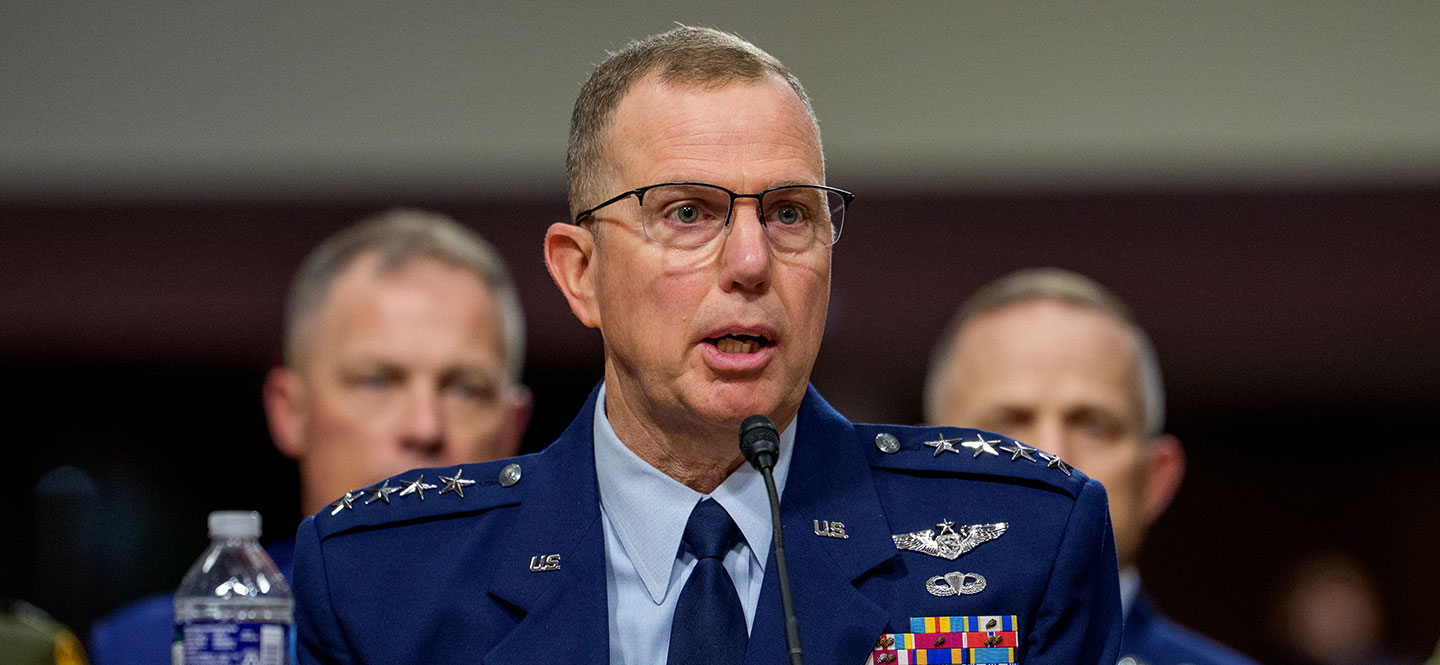
The commander of the United States Northern Command (USNORTHCOM) and the North American Aerospace Defense Command (NORAD) told Congress in March 2026 that the execution of his mission — greatly expanded in the past year — reflects strong interagency and international partnerships. The command also has quickly developed and deployed new technologies and tactics to protect the U.S. homeland and the nation’s North American, Caribbean, and Arctic allies and partners.
“Over the last year, USNORTHCOM and NORAD have transformed the commands and how they operate, taking on critical new missions, standing up new functional units … welcoming new components, and embracing advanced capabilities to meet these dynamic challenges head-on,” Gen. Gregory M. Guillot said before the Senate Armed Services committee on March 19.
USNORTHCOM’s area of responsibility increased in 2025, adding Greenland, the Kingdom of Denmark’s autonomous territory, to its command responsibilities. Adding Denmark as a formal security partner, Guillot said, “has already generated measurable benefits for North American defense.” U.S. and Danish troops trained together in Greenland in the Arctic Edge and Noble Defender exercises, strengthening their already close collaboration.
The command’s relationship with Mexico also deepened with increased military exchanges and the creation of three new components: Joint Task Force-Southern Border, the Joint Interagency Task Force-Southern Border and the Joint Interagency Task Force-Counter Cartel. These task forces increased logistical support, intelligence gathering, surveillance and security along the countries’ 3,145-kilometer border while helping to deter and disrupt cartel activity. Counter small unmanned aerial systems (C-sUAS) neutralized more than 100 small unmanned aerial systems used by cartels to monitor troops and locate smuggling routes. And concurrent patrols with Mexican security forces have reduced illegal migration flows to historic lows. “The year-round partnership with DEFENSA (Mexico’s Secretariat of National Defense) and Marina (Mexico’s Secretariat of the Navy) has generated significant benefits for U.S. homeland defense while enhancing the ability of Mexican partners to defend their nation against Russian and Chinese influence as well as taking the fight to the violent transnational criminal organizations that have plagued both nations,” Guillot said in prepared testimony.
The alliance with Canada remains a cornerstone of U.S. homeland defense, Guillot said. Along with the missile defense capabilities of NORAD, the world’s only binational command, Canada’s efforts to expand its military presence in the Arctic have increased regional security. “The Government of Canada’s commitment to modernization efforts that will directly benefit NORAD missions, coupled with outstanding collaboration between USNORTHCOM and the command’s counterparts in the Canadian Joint Operations Command (CJOC) plays a key role in multi-national operations to detect and monitor potential threats to the homeland,” Guillot said.
Finally, The Bahamas, by strengthening its maritime awareness and force projection in the waters surrounding its vast archipelago, also has proved to be a vital partner in regional defense, Guillot said. “The RBDF’s (Royal Bahamas Defence Force) contribution to maritime security and counternarcotics efforts in the approaches to the homeland have been critical to shared success,” Guillot said.
In another key development, USNORTHCOM further expanded its role in developing and deploying C-sUAS technology to deter drone threats. Designated by the Department of War as the military’s “synchronizer, integrator and coordinator of C-sUAS activities” in the continental U.S. and Alaska, USNORTHCOM acquired the C-sUAS Flyaway Kit (FAK) to rapidly deploy to protect War Department facilities at home and abroad. The command also organized and hosted Falcon Peak 25.2, a public-private partnership to test and improve the latest C-sUAS technology to accelerate the U.S. defensive posture in this emerging field of warfare and security. In addition to the cartel drones disabled by U.S. forces along the southern border, an FAK team disabled an sUAS operating over a strategic U.S. installation in the early days of Operation Epic Fury in Iran, Guillot said. “These combined efforts — and the support provided by this committee to counter the sUAS threat — are already improving the safety and security of installations and service members in the United States,” he said.