

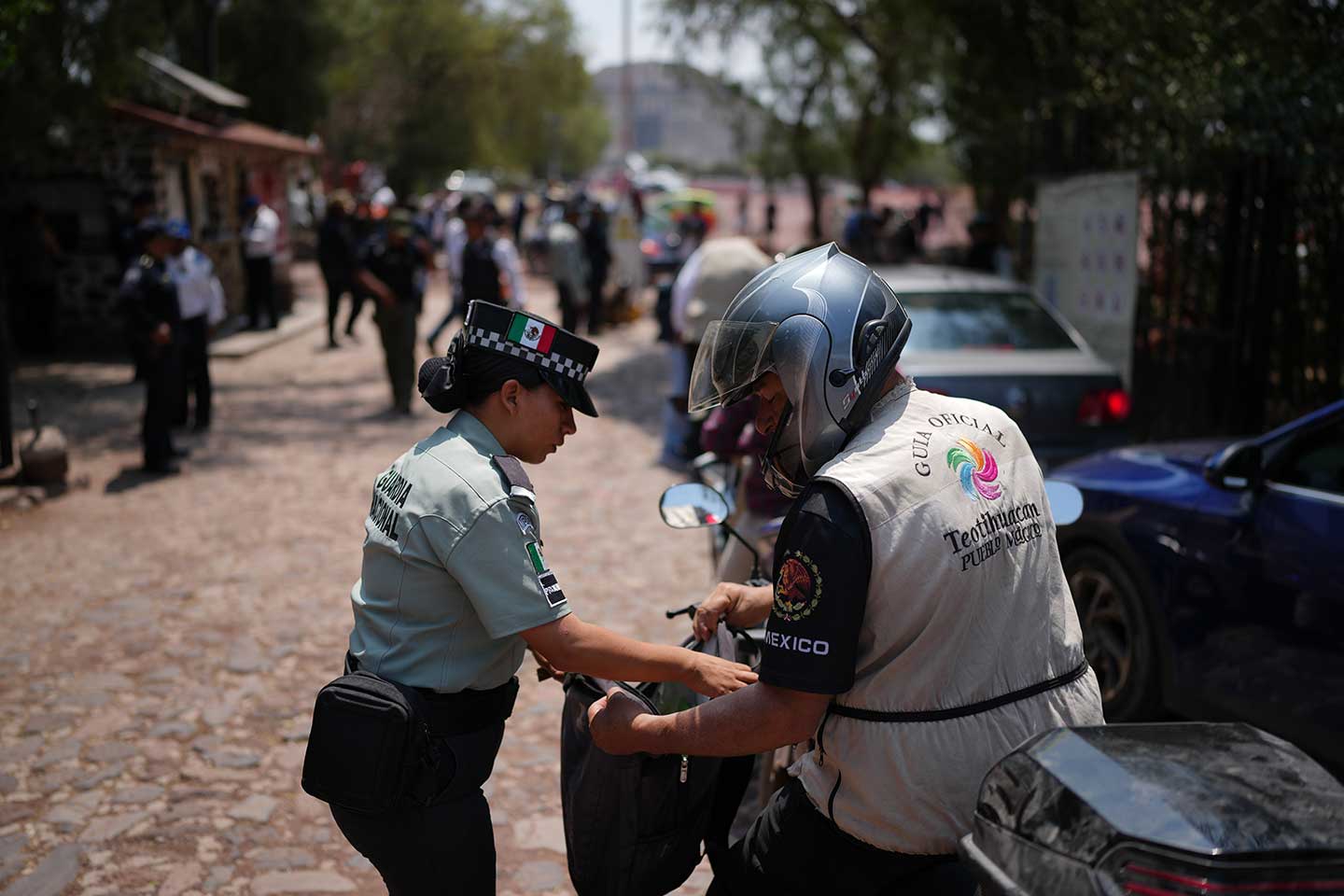
Mexico has deployed more than 100,000 security officers and has tightened security at high-profile tourist sites for the upcoming World Cup soccer tournament. The moves accelerated in April 2026 after an isolated mass shooting unrelated to cartel violence prompted authorities to speed up additional security measures ahead of the global event.
The quadrennial sports tournament will take place in Canada, Mexico and the United States beginning in June. The three partner nations have closely collaborated on joint security measures in preparation for a nearly six-week tournament expected to draw millions of visitors to North America. In March 2026 congressional testimony, Gen. Gregory M. Guillot, commander of the U.S. Northern Command (USNORTHCOM) and the North American Aerospace Defense Command, told the Senate Armed Services Committee that he was confident the games would proceed without incident. “This summer, the strong military relationships among the U.S., Canada, and Mexico will be on full display as our forces work together to ensure a safe World Cup,” Guillot said. “The USNORTHCOM relationship with Mexican military partners stands strong and pays lasting dividends for the security of both the United States and Mexico. USNORTHCOM maintains its longstanding relationships with the Mexican Department of the Navy (MARINA) and Department of National Defense (DEFENSA) and addresses shared security challenges by, with, and through our Mexican partners.”
Mexico has worked hard to improve internal security since President Claudia Sheinbaum took office in 2024. The government has aggressively confronted transnational criminal organizations (TCOs) including the Sinaloa Cartel and the Jalisco New Generation Cartel. Mexico City has extradited dozens of cartel leaders to the U.S. for trial. Increased training and collaboration between U.S. and Mexican special forces and other military units has built trust and capabilities that were demonstrated in the daring raid that resulted in the death of Rubén Oseguera Cervantes, known as “El Mencho,” in February.
In 2025, Mexican military personnel trained with the U.S. Army’s 82nd Airborne Division at the Joint Readiness Training Center. Mexican and U.S. Soldiers conducted mirrored patrols along the Mexico-U.S. coordinated by Joint Task Force-Southern Border. Naval exchanges and growing partnerships with U.S. National Guard forces also demonstrate strong military ties, Guillot noted in his March testimony.
The April shooting at the Teotihuacan pyramids — a UNESCO Heritage Site and one of Mexico’s most frequented tourist attractions — killed a Canadian tourist and injured a dozen more, according to The Associated Press. Sheinbaum dispatched police with bomb-sniffing dogs to the site. Overall, the government has deployed 100,000 security personnel in advance of the Cup, the AP reported. But the Mexican president said the shooting by the lone gunman, wasn’t an indication of future violence during the Cup. “Our obligation as a government is to take the appropriate measures to ensure that a situation like this does not happen again. But clearly, we all know — Mexicans know — that this is something that had not previously taken place,” Sheinbaum said April 21 during her daily morning news conference, the AP reported.
More than $1 billion has been allocated to protect the estimated 6 million fans who will attend 104 matches in 16 venues in the three countries, according to the soccer federation FIFA. The U.S. has dedicated $115 million in counter-unmanned aerial systems technology and the FBI, Secret Service and the Department of Homeland Security are coordinating security for the U.S. events at a level commensurate with presidential inaugurations, FIFA states. FIFA has spent $625 million on security, the organization said.