
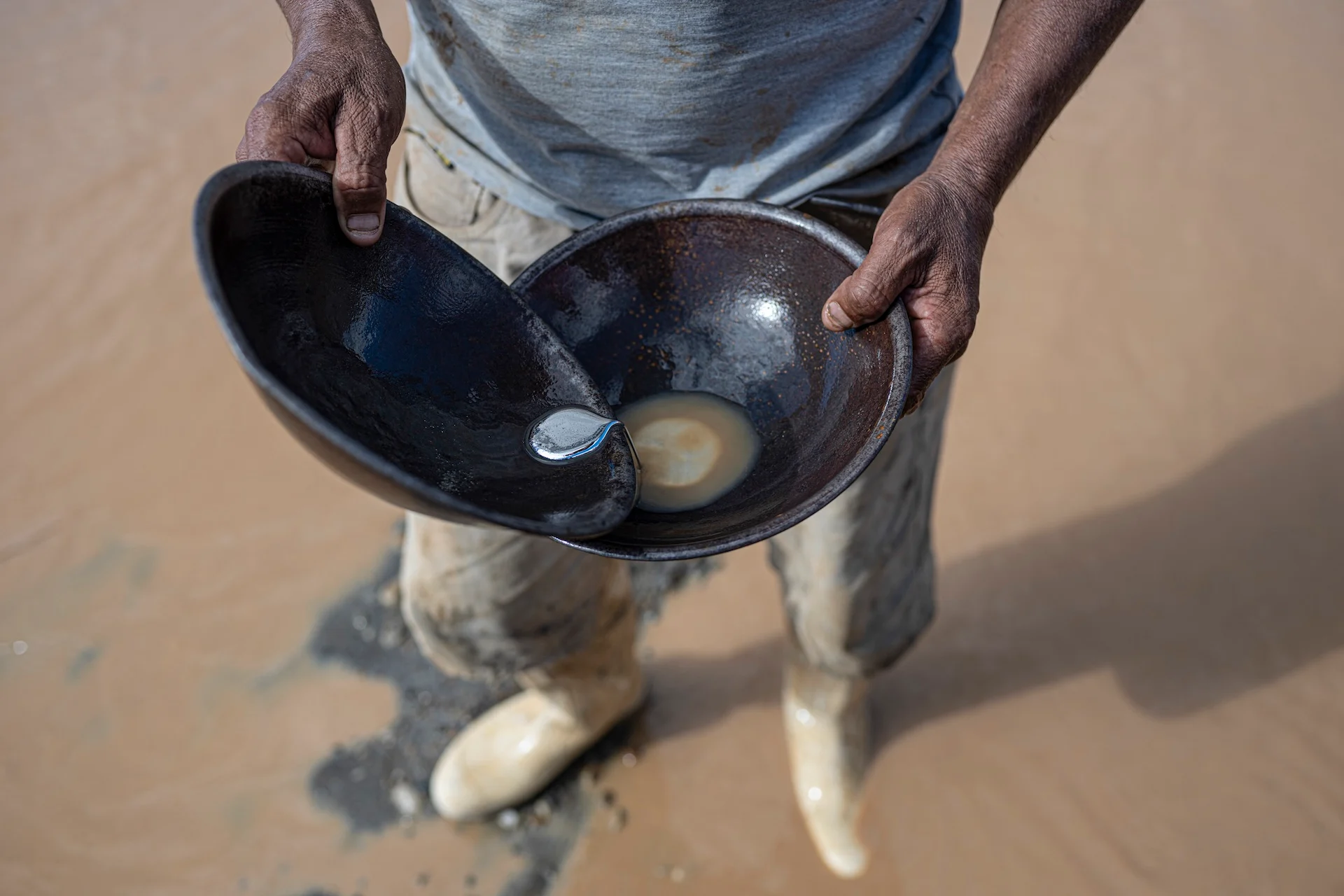
Illegal mercury trafficking is emerging as one of the newest and most lucrative criminal frontiers for the Jalisco New Generation Cartel (CJNG), which in recent years has expanded its activities far beyond drug trafficking. Mercury is essential for illegal gold extraction and is used to separate the precious metal from soil and sediment in alarming proportions. On average, nearly 2.5 tons of the toxic metal are needed to produce 1 ton of gold.
The trend reflects how criminal networks are integrating environmental crimes, narcotrafficking routes, logistical corruption and illicit economies, strengthening their operational and financial capabilities at the transnational level.
According to a report by the U.S.-based Environmental Investigation Agency (EIA), which specializes in environmental crimes, about 200 tons of mercury were smuggled between 2019 and 2025 from mines in the Mexican state of Querétaro — many of them under CJNG control — to Bolivia, Colombia and Peru, averaging roughly 40 tons per year. Some of these mines are located within UNESCO’s Sierra Gorda Biosphere Reserve. “This is the largest illegal mercury flow ever reported worldwide,” the EIA stated.
The growing strategic value of the illegal mercury market could allow the Mexican criminal group to further expand its presence within illegal gold mining supply chains across Latin America with serious implications for regional security and the environment. In this context, the February death of Nemesio Rubén Oseguera Cervantes, known as El Mencho, the cartel’s longtime leader, could open a period of internal restructuring with possible effects on the CJNG’s criminal diversification and alliances.
Peruvian attorney César A. Pinza, an expert on environmental crimes, said mercury smuggling is the “first link” in the new role the CJNG is playing in the Amazon region. “It would not be surprising if they later diversify their activities and move on to control the gold trade or even gold extraction itself,” he told Diálogo.
However, a possible expansion of the CJNG into Latin American mining supply chains also could foster new alliances among criminal organizations in the region, while triggering conflicts between rival groups and within the cartel itself.
One precedent considered particularly concerning by analysts is the internal war that erupted within the Sinaloa Cartel in 2024 between the Chapitos — the sons of Joaquín “El Chapo” Guzmán — and the faction known as the Mayitos, linked to the family of Ismael “El Mayo” Zambada García. The conflict triggered a new escalation of violence and criminal fragmentation in Mexico.
CJNG’s expansion into mercury trafficking
The new “mercury fever,” with record prices of around $330 per kilogram, is linked to rising gold prices and growing demand from illegal mining operations. Paradoxically, this growth is occurring while official mercury imports are declining sharply.
“Since the Minamata Convention entered into force in 2017 — an international treaty designed to reduce mercury use because of its severe impacts on health and the environment — legal mercury imports in Peru have collapsed from more than 100,000 kg in 2011 to just 6,770 kg in 2025, creating space for illegal networks that exploit the shortage,” investigative newspaper Ojo Público reported.
Today, the CJNG is the main Latin American supplier of smuggled mercury to Boliva, Colombia and Peru. Its expansion has been facilitated by three factors: limited controls in Mexico due to the absence of widespread illegal gold mining, the presence of mercury mines — considered the world’s second-largest reserves — in the central state of Querétaro, and CJNG’s strategic control of the Port of Manzanillo.
CJNG has transformed the mines in Querétaro into heavily militarized enclaves protected by fortified gates, surveillance towers with cameras, barbed wire and armed guards carrying high-caliber weapons. This level of security reflects the enormous economic value of mercury trafficking and the CJNG’s growing ability to consolidate territorial control over the mines.
Another key point along the illegal mercury route is the Port of Manzanillo, on Mexico’s Pacific coast, where both the CJNG and the Sinaloa Cartel operate. One of the largest mercury shipments ever seized departed from there. Nearly 4 tons of mercury concealed in crushed stone and destined for Bolivia was intercepted in 2025 at Peru’s Port of Callao.
Authorities highlighted the sophistication of the concealment method. The mercury had been absorbed into the stones and later recovered through high-temperature industrial processes. In other cases, the CJNG hid the metal among coffee beans, iron pipes, paint cans or mineral powders.
Mercury trafficking routes
Experts emphasize that mercury trafficking already relies on the same routes and strategies used in narcotrafficking. This overlap could allow the CJNG to further expand its presence in cocaine markets such as Bolivia, where the cartel has operated mainly through intermediaries and alliances with local groups.
Bolivia, in addition to being the world’s third-largest coca-growing country, also is the world’s second-largest importer of mercury. One of the most critical points is Desaguadero, on the border with Peru, where homicides and violence linked to mercury trafficking have increased in recent years. Ecuador also has become a gateway for illegal mercury destined for clandestine mines in Peru’s Amazonian region of Madre de Dios.
The situation in Colombia is particularly delicate, where the CJNG maintains ties with dissident factions of the Revolutionary Armed Forces of Colombia (FARC) and local narcotrafficking networks to purchase cocaine in areas such as Chocó, along the Pacific coast, and Antioquia, in northwestern Colombia, which also coincide with major illegal mining areas. Any expansion of the cartel into the gold supply chain could intensify conflicts among armed and criminal groups, further increasing violence in the region.
Environmental impact
Mercury, one of the 10 most dangerous chemicals to public health according to the World Health Organization, is dumped into rivers or released into the atmosphere during illegal gold extraction, contaminating forests and Amazonian waterways for decades. Gold mining is the world’s leading source of atmospheric mercury pollution, releasing more than 800 tons each year.
“The mercury use facilitated and trafficked by the CJNG in the Amazon region, mainly associated with illegal gold mining, has devastating environmental, health, and socioeconomic implications,” Ipenza said.
The effects are already visible in different parts of the Amazon. Scientific studies have detected high levels of mercury in rivers, fish and the blood of Indigenous communities in Peru’s Madre de Dios region and among Yanomami populations in Brazil.
According to Ipenza, these damages could increase exponentially if the CJNG ultimately transforms itself into a “global entrepreneurial criminal organization that dominates extractive industries.” In that scenario, the cartel would strengthen its control over illegal economies linked to gold while simultaneously increasing deforestation, environmental contamination, violence and pressure on Indigenous communities.
As illegal mining networks expand across remote border regions, authorities face an increasingly complex challenge in confronting criminal organizations that now combine environmental crimes, trafficking routes, corruption networks and transnational logistics into their criminal activities.
Diálogo Américas is a publication of the United States Southern Command.