

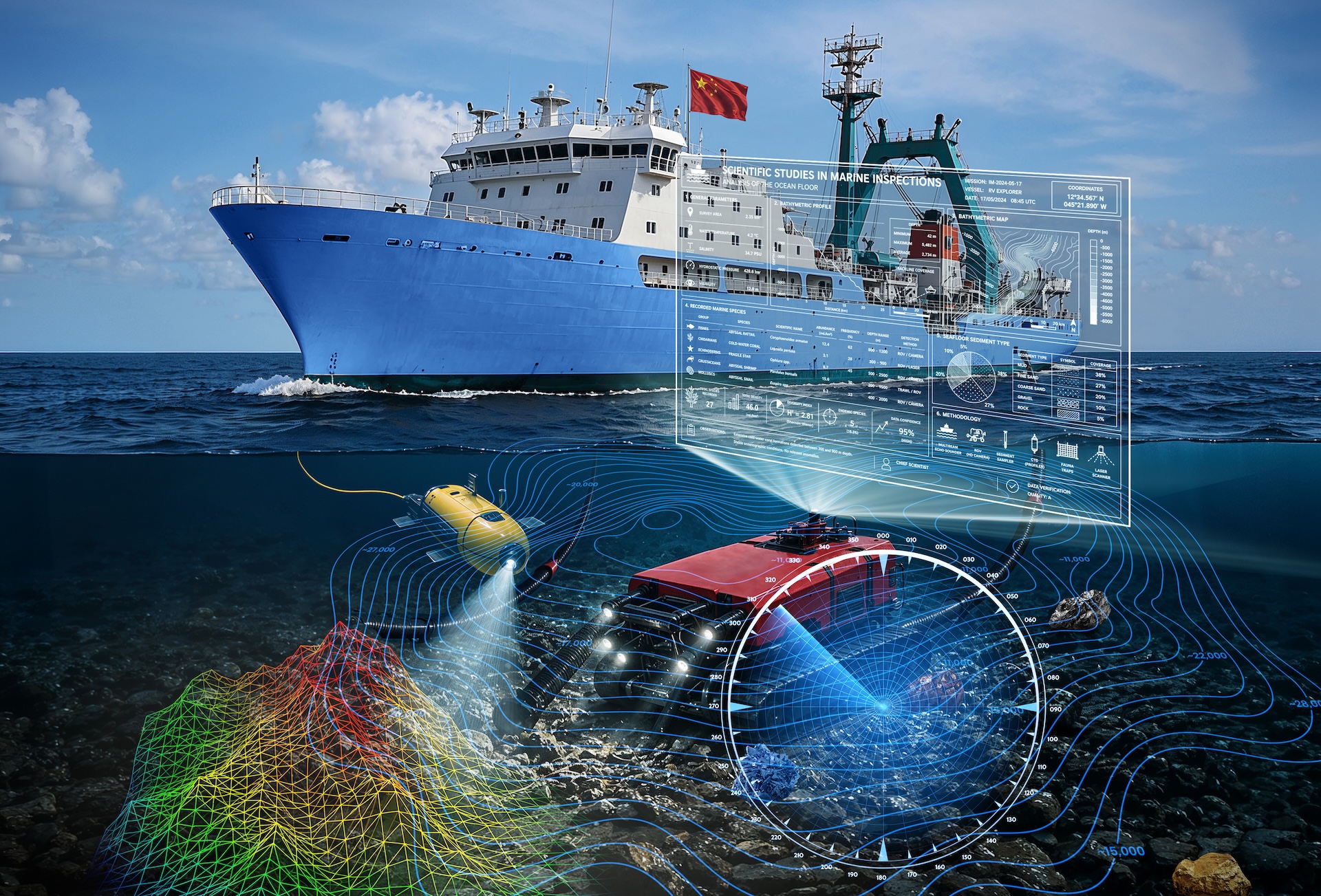
The Chinese Communist Party (CCP) is carrying out an expansive effort to strengthen its position across the world’s oceans, driven by both strategic military interests and the search for critical seabed resources. Recent investigations and maritime tracking data indicate that Beijing has deployed a broad network of underwater mapping and surveillance activities spanning the Arctic, Indian and Pacific oceans. Analysts say the information collected could provide a significant advantage in maritime conflicts, particularly in submarine operations and undersea warfare.
A Reuters report indicates that the data being gathered includes detailed information on seabed conditions, underwater terrain and oceanographic patterns that could support submarine navigation, underwater surveillance and the identification of critical undersea infrastructure such as communications cables. Much of this activity is conducted through civilian research vessels, allowing the CCP to expand its maritime data collection while attracting less international scrutiny.
One of the most closely watched examples is the Dong Fang Hong 3, operated by the Ocean University of China. During 2024 and 2025, the vessel traveled through waters near Taiwan, Guam and strategic areas of the Indian Ocean. Although officially assigned to sediment and climate research, scientific publications linked to the vessel also documented extensive deep-sea mapping operations.
The information collected could improve the CCP’s ability to operate submarines more effectively while enhancing its capacity to detect adversary vessels. “We know that China is mapping the seabed and fishery resources. Many vessels in its fishing fleet engage in activities beyond fishing, even serving as intelligence tools and paramilitary forces,” Argentine marine conservation specialist Milko Schvartzman said.
According to Schvartzman, these activities are not new. In the South Atlantic, Chinese vessels have been linked to unauthorized mapping activity near Argentina’s continental shelf, in addition to previous illegal fishing incidents involving Chinese fleets in the region.
Critical minerals on the ocean floor
The CCP’s maritime ambitions extend beyond military considerations. Beijing also is seeking to secure access to strategic minerals found on the ocean floor — resources considered essential for advanced technology, renewable energy systems and defense industries.
A joint investigation by CNN and Mongabay found that several Chinese vessels, publicly identified as fishing or scientific research ships, displayed operational patterns consistent with mineral exploration activities. Over the past five years, investigators tracked eight Chinese vessels linked to deep-sea mining exploration. According to the report, only 6% of their time at sea was spent within officially authorized exploration zones.
The investigation also documented cases in which vessels disabled their Automatic Identification System to avoid detection. While these activities do not prove military involvement, analysts say they reflect the CCP’s broader civil-military fusion strategy, which integrates civilian, scientific and commercial capabilities into long-term national strategic objectives.
The CCP holds or is linked to five of the 31 exploration contracts granted by the International Seabed Authority (ISA), the United Nations-affiliated body responsible for regulating mineral-related activities in international seabed areas. These contracts involve access to resources such as cobalt, copper, nickel, manganese and rare earth elements — minerals increasingly important for battery production, electronics, advanced manufacturing and military technologies.
“Strategic minerals such as manganese, essential for ferroalloys and special steels, can be found on the ocean floor,” civil engineer and metallurgy consultant Sergio Paredes said. “Furthermore, copper, whose scarcity threatens to become a bottleneck for electromobility, is also found in these depths.”
Implications for Latin America
Latin America is not immune to these developments. In parts of the Southeast Pacific, including areas off the coast of Chile, studies have identified seabed mineral potential involving copper, manganese and other strategic resources. Although large-scale extraction remains technologically complex and environmentally controversial, the CCP continues investing heavily in technologies needed to expand deep-sea mining capabilities.
Argentina’s continental shelf also has drawn attention because of its relatively accessible maritime geography and the growing presence of Chinese distant-water fleets in the South Atlantic. Paredes warn that limited regulatory frameworks and challenging maritime oversight could create opportunities for unauthorized exploration or resource exploitation.
Security experts also warn that seabed mapping could have implications for maritime domain awareness, the protection of undersea infrastructure, and the security of strategic maritime corridors and communications networks.
Dual threat
The growing body of evidence suggests that many of the CCP’s maritime activities serve both scientific and strategic purposes. Experts say seabed mapping, oceanographic surveys and the collection of fisheries data can all contribute to a broader effort to strengthen the CCP’s long-term maritime posture.
Analysts also note that some operations continue to raise legal and sovereign concerns. As Schvartzman explained, conducting scientific studies or resource-related surveys in areas linked to another country’s maritime jurisdiction without authorization remains highly controversial.
For many governments and maritime-security specialists, the concern extends beyond environmental impact or commercial competition. What appears to be civilian scientific research may also be helping lay the groundwork for future geopolitical and military competition beneath the world’s oceans.
Diálogo Américas is a publication of U.S. Southern Command.