

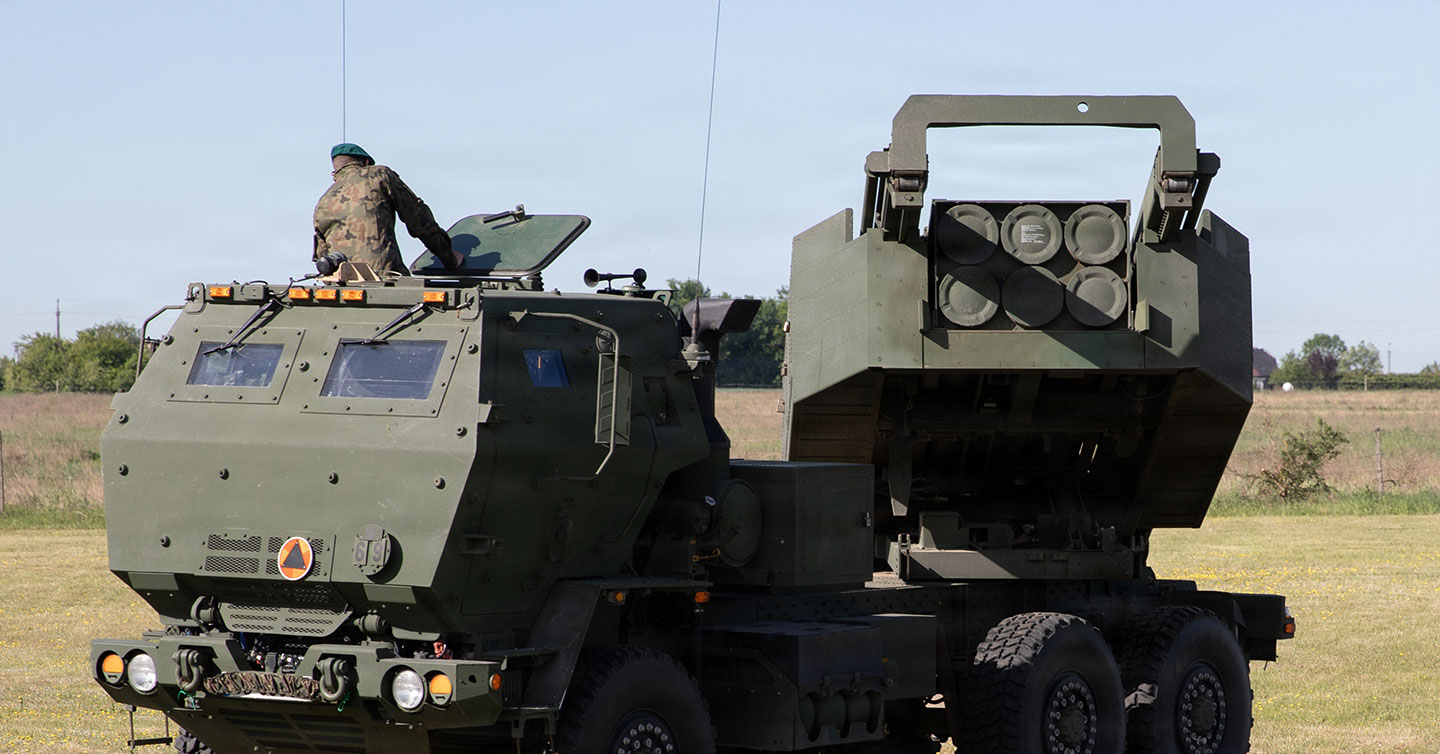
Canada’s $1.9 billion purchase of 26 High Mobility Artillery Rocket Systems (HIMARS) from the United States adds advanced long-range missile capabilities to its land and maritime defenses for the first time. Ottawa’s June 2026 announcement formalized the purchase under the Foreign Military Sales program administered by the U.S. State and War departments. The HIMARS will have integrated features that allow them to fire anti-ship missiles, bolstering coastal and Arctic defenses, the government news release said. “Canada’s Armed Forces (CAF) must have the capabilities required to meet today’s threats and tomorrow’s challenges. The long-range missile capability is a critical step in supporting our military so it remains ready and equipped to protect Canadians and support our allies and partners when needed,” Minister of National Defence David J. McGuinty said in the June 2 release.
The HIMARS, along with munitions and technical support, are scheduled for delivery beginning in 2029. Precision long-range missiles were identified as a priority for the CAF in Canada’s 2024 defense plan, and the rockets were identified by Canadian military and procurement officials as the only system that meets the country’s defense needs. “The launcher systems will be paired with long-range munitions capable of precisely engaging targets at distances of more than 300 kilometers, revolutionizing how the Canadian Army conducts operations and supports joint forces on future missions. The systems are also designed to integrate future land-based anti-ship missile capabilities to support the defence of Canada’s coasts, including the Arctic,” the release stated.
HIMARS will give Canada the missile capabilities needed to meet its NATO obligations, including fielding a front-line multinational combat brigade in Latvia. The maritime capabilities of the artillery system also will bolster continental defenses in maritime Canada and its vast Arctic territories. “This capability marks a major step forward in modernizing the Canadian Army. High Mobility Artillery Rocket System will give the Army a mobile, long-range precision strike capability that can be deployed across Canada, including the Arctic, and abroad using existing Royal Canadian Air Force aircraft. When integrated with other modern capabilities —such as self-propelled artillery systems, sensors, and command and control — it will strengthen Canada’s ability to deter aggression, safeguard our sovereignty, and protect Canadians,” said Lt. Gen. Michael Wright, commander of the Canadian Army.
The M142 HIMARS will be the first anti-ship missile in the CAF arsenal, and its procurement comes amid mounting Russian ambitions in the Arctic, noted USNI News, a U.S. military affairs website. U.S. Marines and the U.S. Army already have used HIMARS in deployments in Europe and the Indo-Pacific. The sale of HIMARS to Ukraine have helped it stem Russian advances. A new variant of the Precision Strike Missile known as Increment 4 will extend the reach of HIMARS launchers against naval vessels to more than 1,000 kilometers, USNI News reported.
The HIMARS acquisition requires Lockheed Martin and its contractors to invest in Canadian firms in support of the missile system. “Our government is investing in long-range missile capabilities that will deliver the advanced systems we need to ensure our security and readiness in this rapidly changing world. We are committed to equipping the Canadian Armed Forces with the tools they need to protect Canada, while creating opportunities for our economy and good-paying jobs for Canadians.” Secretary of State (Defence Procurement) Stephen Fuhr said.