

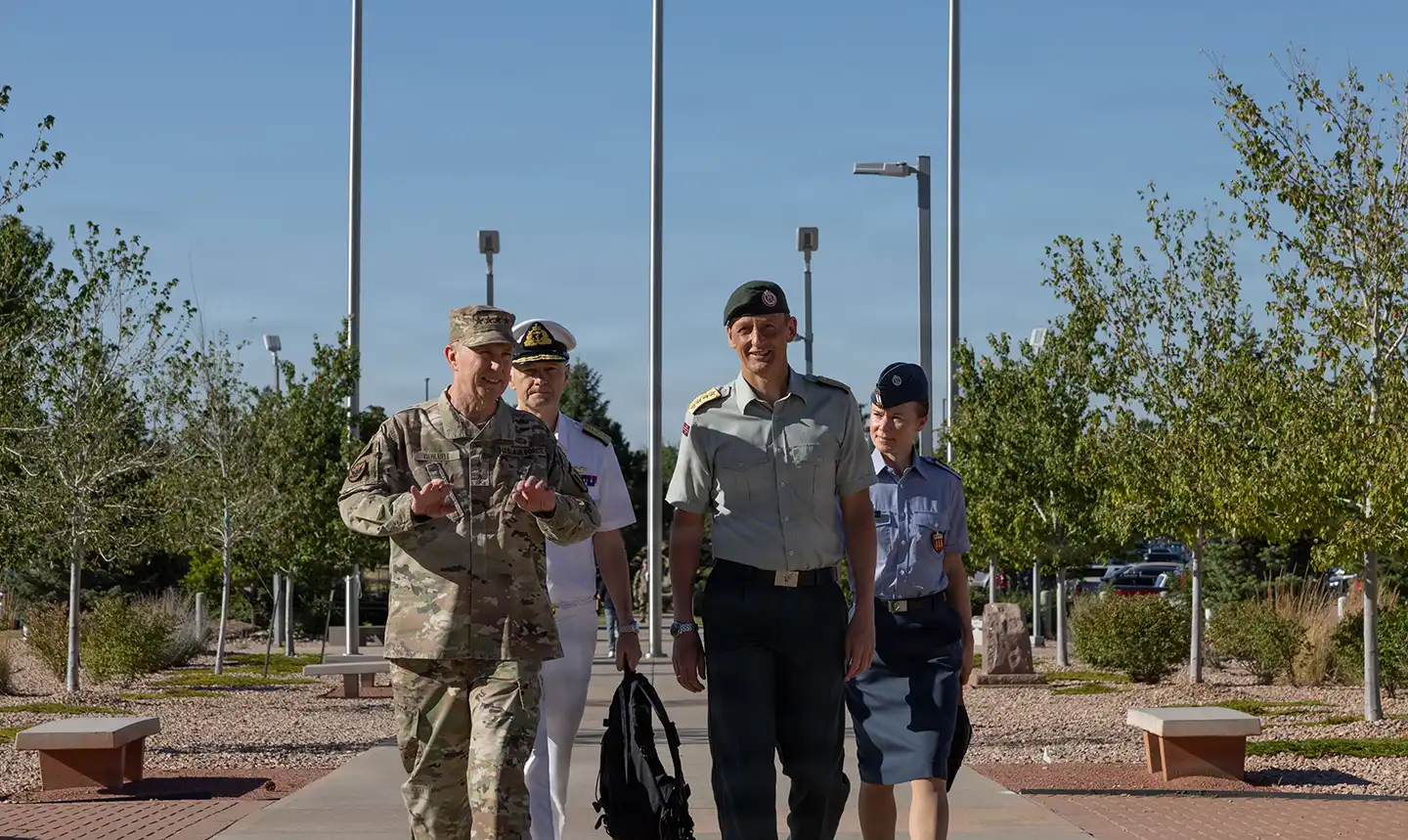
Norway’s chief of defence visited the United States Northern Command in July 2026, meeting with USNORTHCOM’s Commander Gen. Gregory M. Guillot to discuss how the NATO allies can strengthen interoperability and strategic collaboration in the Arctic. Gen. Eirik Kristoffersen’s July 15 visit to USNORTHCOM’s Colorado headquarters “focused on maximizing combined defense capabilities and operational synchronization in the Arctic and High North,” according to a USNORTHCOM news release. Guillot and Kristoffersen explored ways to further integrate alliance forces through collaborative training and joint operations with the aim of maintaining the region’s security and stability. “Both leaders emphasized that deepening ties between the Commands and Norway supports NATO’s collective defense posture,” the release stated.
Norway, a founding member of the alliance, has increased defense spending significantly since Russia’s invasion of Ukraine in 2022. The spending has been focused on Arctic defense, including its most recent $12 billion hike in March. In all, the country is scheduled to spend $205 billion by 2035, meeting NATO’s spending threshold of 3.5% of Gross Domestic Product. Oslo also has increasingly integrated its Air Force and logistics with its Nordic neighbors — Denmark, Finland and Sweden. Sharing a border with Russia allows Norway to collect intelligence on Moscow. The Navy has been strengthened by the acquisition of five new frigates. Its Finnmark brigade, a land force designed for High North conditions and terrain, also has been bolstered.
Kristoffersen told Politico, a U.S. news site, that his visit was an important one because Norway regards the U.S. as its most important ally, and Norway is a front-line defender of the U.S. homeland. “The defense of the U.S. homeland actually starts on the Norwegian border with the Russian military complex on the Kola Peninsula,” he said. The two military leaders also discussed Nordic Bridge, which Guillot described as improving “connectivity” between USNORTHCOM and the Nordic nations’ military headquarters. “It’s something I’ve been working on for a long time, how to connect all the headquarters in the Arctic among the seven Arctic states, excluding Russia,” Kristoffersen said.
Kristoffersen, 57, joined the Norwegian military in 1988, serving in combat engineering battalions and long-range reconnaissance squadrons early in his career. He was promoted to brigadier general in 2014, serving as deputy commander of Norway’s Special Operations Command. He also has been chief of the country’s Home Guard and the Army. He became chief of defence in 2020, according to a NATO fact sheet.
Managing relations with Moscow is a Norwegian specialty. As Russia has remilitarized the Arctic in recent years, that task has become a priority, Kristoffersen told Politico. “We still have mechanisms to speak with Russia. We have a search and rescue agreement in the Barents Sea. We meet regularly with the Russian border security. We have a protocol for what we call incidents at sea. We also have an open line between our joint headquarters and the commander of the Northern Fleet. Everything between Norway and Russia in the High North is about avoiding misunderstandings,” he said.
Rebuilding Europe’s defense industry and quickly rearming in the face of the Russian threat is crucial for a reshaped NATO, he said. “First, it means European nations have to spend more on defense and security and actually have a plan to reach the 3.5 [percent of GDP] requirement for defense spending. Norway has a good path for that. Second, the U.S. will be stretched in case of simultaneous conflicts. We need to invest more in the capabilities that the U.S. traditionally has provided, like tankers for the aircraft, more in ISR [intelligence, surveillance and reconnaissance], but also continue to work closely with our most important ally,” Kristoffersen said.