

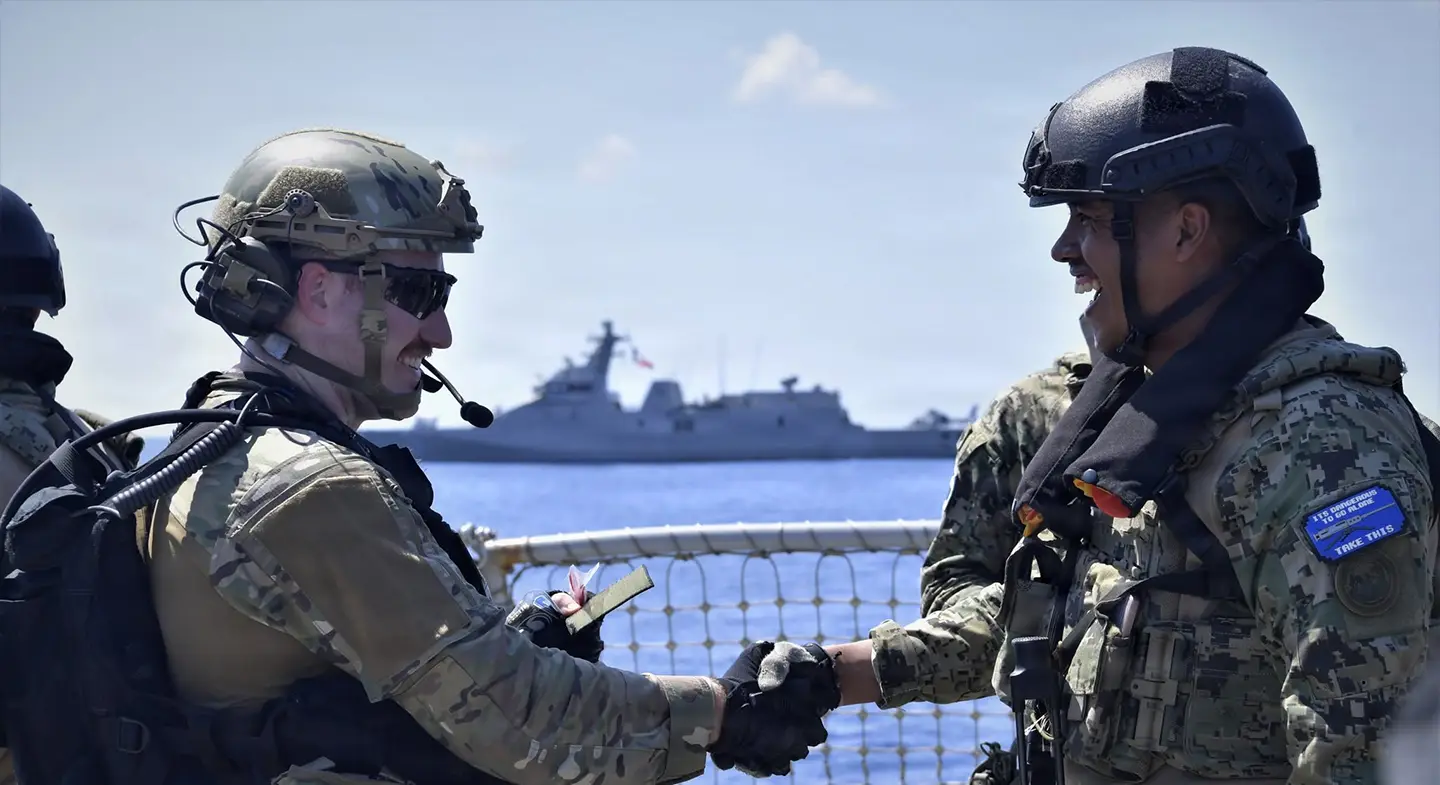
The navies of Mexico and the United States exchanged best practices and became better acquainted with one another’s naval assets during a subject matter expert exchange in the Pacific Ocean during a recent deployment of the U.S. Navy’s 4th Fleet on a mission to circumnavigate the Western Hemisphere.
Sailors from the Mexican Navy’s (MARINA) Reformador-class frigate ARM Benito Juärez met with members of the visit, board, search and seizure team aboard the Arleigh Burke-class guided-missile destroyer USS Gridley in March 2026, according to a Facebook post from the U.S. Northern Command (USNORTHCOM) on April 10.
The exchange, known as a “passing exercise” occurred during increased counter cartel operations to disrupt illegal activity in the seabound approaches to North America. MARINA and the U.S. Navy have increased operations since early 2025 to squeeze sea-based smuggling routes.
“Southern Seas 2026 aims to enhance capabilities, improve interoperability, and strengthen maritime partnerships,” USNORTHCOM’s Facebook post read. “This engagement highlights the decades-long partnership between the U.S. and Mexico, built on trust, mutual benefit, and respect for sovereignty. Together, we continue to enhance operational readiness and coordination to address shared maritime challenges.”
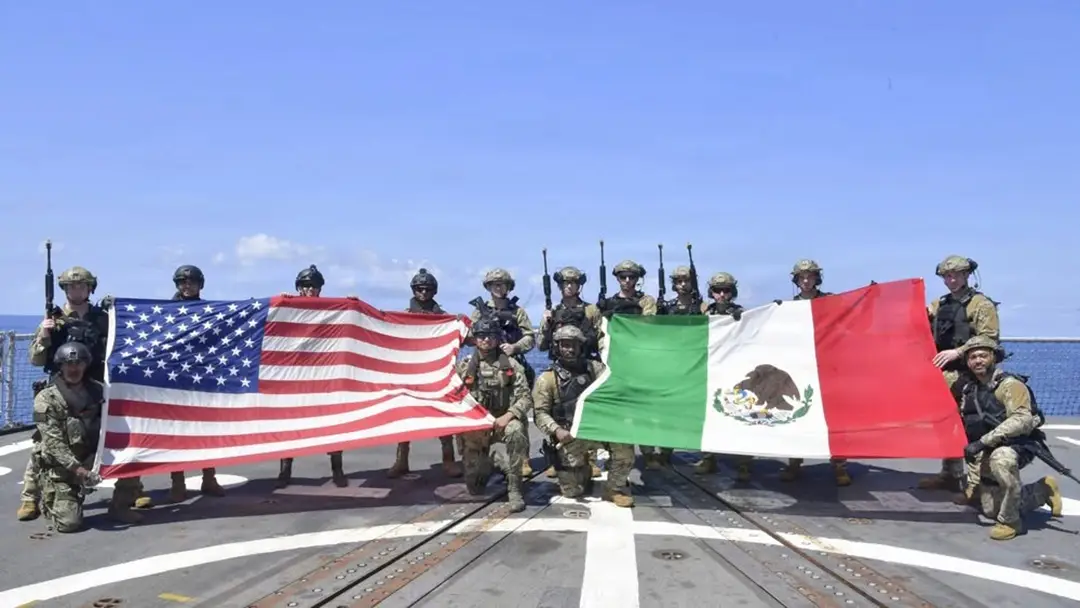
Southern Seas 2026 is a U.S. Navy 4th Fleet deployment of the aircraft carrier USS Nimitz and the Gridley. The 11th iteration of the exercise since 2007 offered opportunities to distinguished visitors from Argentina, Brazil, Chile, Colombia, Ecuador, El Salvador, Guatemala, Mexico, Peru and Uruguay to visit the Nimitz to see operations at close range, according to a U.S. Navy news release. Port visits are planned for Brazil, Chile, Jamaica and Panama. “The Southern Seas 2026 deployment provides a unique opportunity to enhance interoperability and increase proficiency with our partner-nation forces across the maritime domain,” said Rear Adm. Carlos Sardiello, commander, U.S. Naval Forces Southern Command/U.S. 4th Fleet. “Deployments like this demonstrate our unwavering commitment to ensuring a secure and stable Western Hemisphere. This mission is a shining example of our dedication to strengthening maritime partnerships, building trust, and working together to counter shared threats.”
This shared commitment to regional stability, however, is not limited to Pacific fleet engagements. The same cooperative spirit was on full display earlier this year during Gulf Exercise (GULFEX) 2026, conducted under the North American Maritime Security Initiative (NAMSI)—a trilateral forum comprised of Canada, Mexico, and the United States that has been active for 20 years. The complex, live-action scenarios brought together naval and coast guard forces from the three nations to test their collective readiness and secure the maritime approaches to the continent. Underscoring the growing reach of these collaborative efforts, the exercise also welcomed officers from the Royal Bahamas Defense Force, marking the first time they have observed the event since its inception.
For Mexico, these complex, multi-domain operations are viewed as vital to the defense and prosperity of the region. Mexican Navy (Marina) Rear Adm. Carlos Angulo Bermúdez strongly praised the collaborative effort, emphasizing that Mexico’s national security is inextricably linked to the stability of the entire North American continent. He noted that without regular, realistic training, the operational compatibility required to operate seamlessly alongside partner nations would diminish. Instead, through comprehensive operations like GULFEX, the participating forces continue to augment their capabilities, deepen their security cooperation, and build the critical trust necessary to deter illicit activity across all shared waters.