

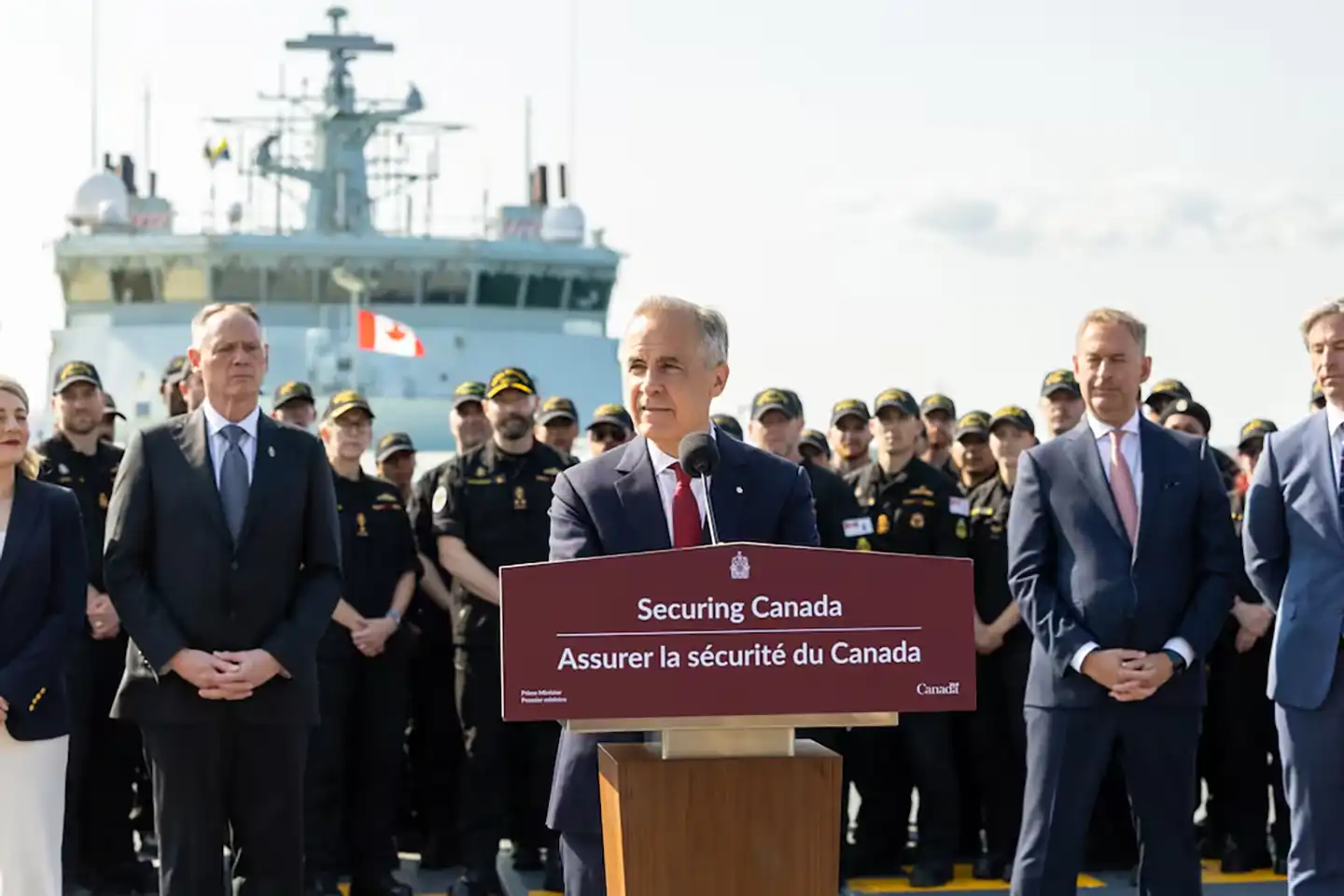
Canada committed to the largest defense procurement in its history in July 2026 by announcing an agreement with a German shipbuilder to supply 12 submarines to replace its aging fleet. The estimated $70 billion outlay will triple its existing fleet and bolster Canada’s ability to defend the Arctic, Atlantic and Pacific oceans.
The Type 212CD submarine will be supplied by TKMS. Fellow NATO members Germany and Norway pledged to reduce their orders for the same submarine to provide Canada with two of the diesel-powered submarines as early as 2034. “These subs will strengthen our defense industrial base, they will deepen our partnerships with trusted allies, and they will open new opportunities for Canadian businesses in European supply chains,” Prime Minister Mark Carney said at a July 6 ceremony in Halifax, Nova Scotia, the nation’s Atlantic naval hub, according to Defense News, a military affairs news site.
TKMS beat out a South Korean competitor, Hanwha, which had sought to sell its KSS-III submarine to Ottawa. In May, the South Korean submarine visited British Columbia to familiarize Canadian officials with the vessel while it participated in naval exercises with the Royal Canadian Navy. The choice was a tough one, Carney said. Canada was impressed with the South Korean bid and promised to look for other opportunities to supply its future needs with vessels from the world’s fourth-largest defense manufacturer.
The 212CD submarines will replace four Victoria-class submarines that were acquired from the United Kingdom in the late 1990s. The four subs have been in service since 1990 and have faced mounting maintenance and repair issues, especially since the U.K. retained many spare parts for its own Trafalgar submarine program, reported The National Post, a Canadian newspaper.
Canada’s decision to triple its submarine fleet will strengthen NATO’s presence in the Arctic and North Atlantic and reduce the burden on Germany and Norway. All three NATO members now will use the same submarine, increasing interoperability and shared resources, according to a TKMS fact sheet.
Powered by two diesel generators and fuel cell technology, the 212CD subs will have advanced sensor technology and greater range than the Victoria-class vessels. Negotiations between Canada and TKMS are expected to last about a year. The process for selecting the submarine took less than a year, a dramatic reversal from previous Canadian procurement practices, said Stephen Fuhr, Canada’s secretary of state for defense procurement. That was a record, he said. Fuhr said the rapid acquisition would be a template for future defense spending, which has been criticized within Canada for taking too long.
The submarines’ acquisition fulfills a pledge from Ottawa’s 2024 defense plan. That blueprint, “Our North, Strong and Free,” focused on beefing up the country’s Arctic presence. “We commit to vastly improving the Canadian Armed Forces’ ability to surveil and control our underwater and maritime approaches,” the plan states. “We will explore options for renewing and expanding our submarine fleet to enable the Royal Canadian Navy to project a persistent deterrent on all three coasts, with under-ice capable, conventionally powered submarines. Submarines allow Canada to covertly detect and deter maritime threats, control our maritime approaches, and project power and striking capability further from our shores, at a time when Russian submarines are probing widely across the Atlantic, Arctic and Pacific Oceans and China is rapidly expanding its underwater fleet.”