

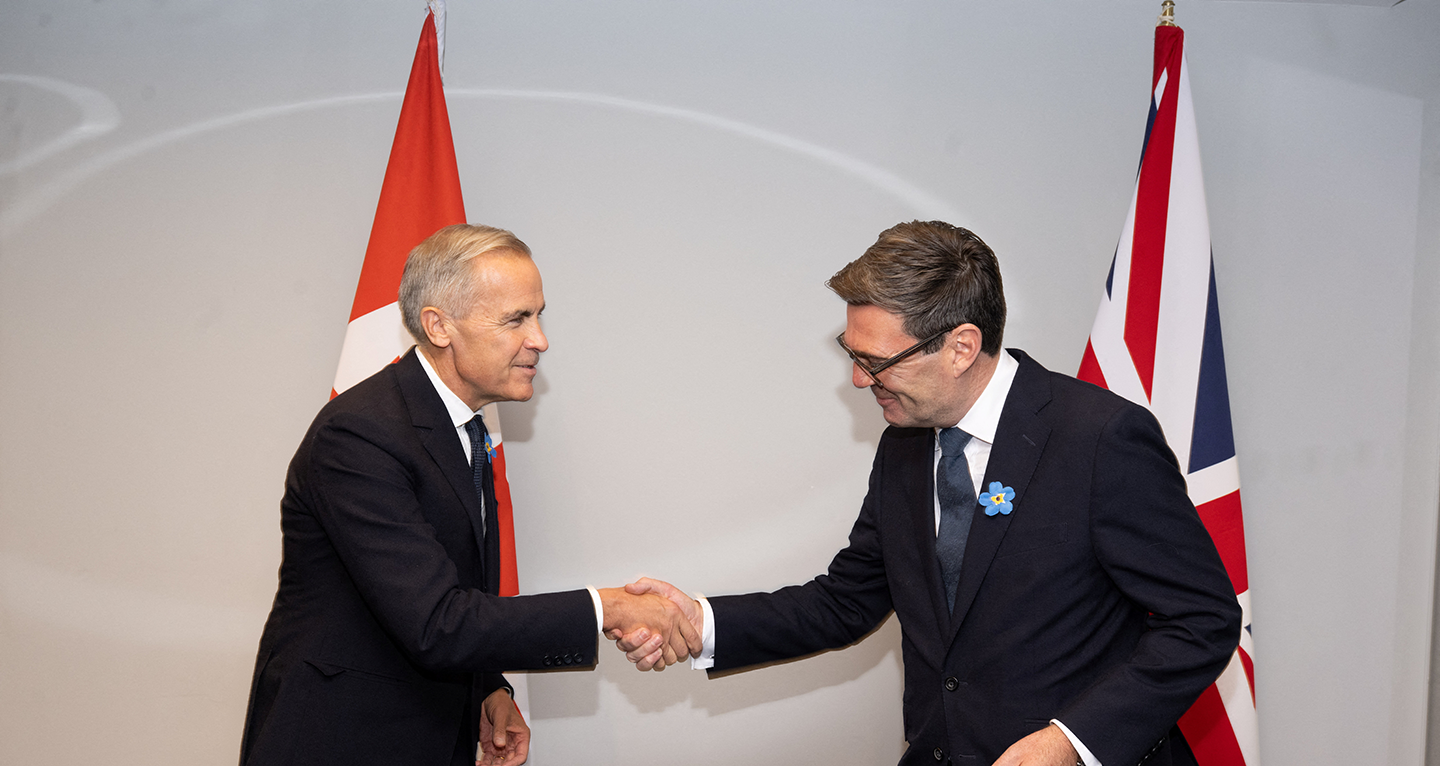
Canadian Prime Minister Mark Carney has formally applied for Canada to join the Joint Expeditionary Force (JEF), a defense coalition of 10 Northern European NATO nations. Carney’s office announced the move after he met with British Prime Minister Andy Burnham during a visit to the United Kingdom in mid-September.
The prime ministers “underscored the close relationship between Canada and the U.K., rooted in historic ties and shared values,” a statement issued by Carney’s office said. “They noted the deep and growing defence and security partnership between the two countries and discussed opportunities to further strengthen these efforts.”
The JEF includes Denmark, Estonia, Finland, Iceland, Latvia, Lithuania, the Netherlands, Norway, Sweden and the U.K., which serves as its operational leader. The joint force focuses on mutual support, military cooperation and interoperability among members.
The 10-nation coalition is designed for rapid crisis response in Northern Europe, the High North and the Baltic region. Itcan deploy specialized air, land and naval forces to the Arctic quickly to counter Russian aggression and the Chinese Communist Party’s growing presence.
The JEF also can integrate into larger international operations, including those led by NATO and the United Nations, and supports NATO as the bedrock of defense for the region, working with the alliance through joint exercises, military planning and the protection of critical infrastructure. The JEF is deeply involved, for example, in coordinating activities for NATO’s Arctic Sentry, a year-round multidomain mission that serves as an overarching framework for synchronizing national military exercises, air policing and maritime patrols in the High North.
The U.K. first invited Canada to join the JEF in 2014, when it was formed. Then-Prime Minister Stephen Harper chose not to participate at a time when Canada was facing budget constraints.
At the meeting in September, Carney and Burnham also discussed other opportunities for defense-industrial cooperation. Through the BATUS Future Project, Canada and the U.K. are working on a long-term plan to modernize the British Army Training Unit Suffield. The project aims to position Canadian Forces Base Suffield in Alberta, Canada, as a world-class center for testing next-generation technology and equipment.
Carney and Burnham also voiced their support for strengthening economic cooperation and agreed to deepen collaboration on emerging technologies, including the safe and responsible development and use of artificial intelligence. “Prime Minister Carney and Prime Minister Burnham agreed to remain in close contact,” Carney’s office said in the statement.