

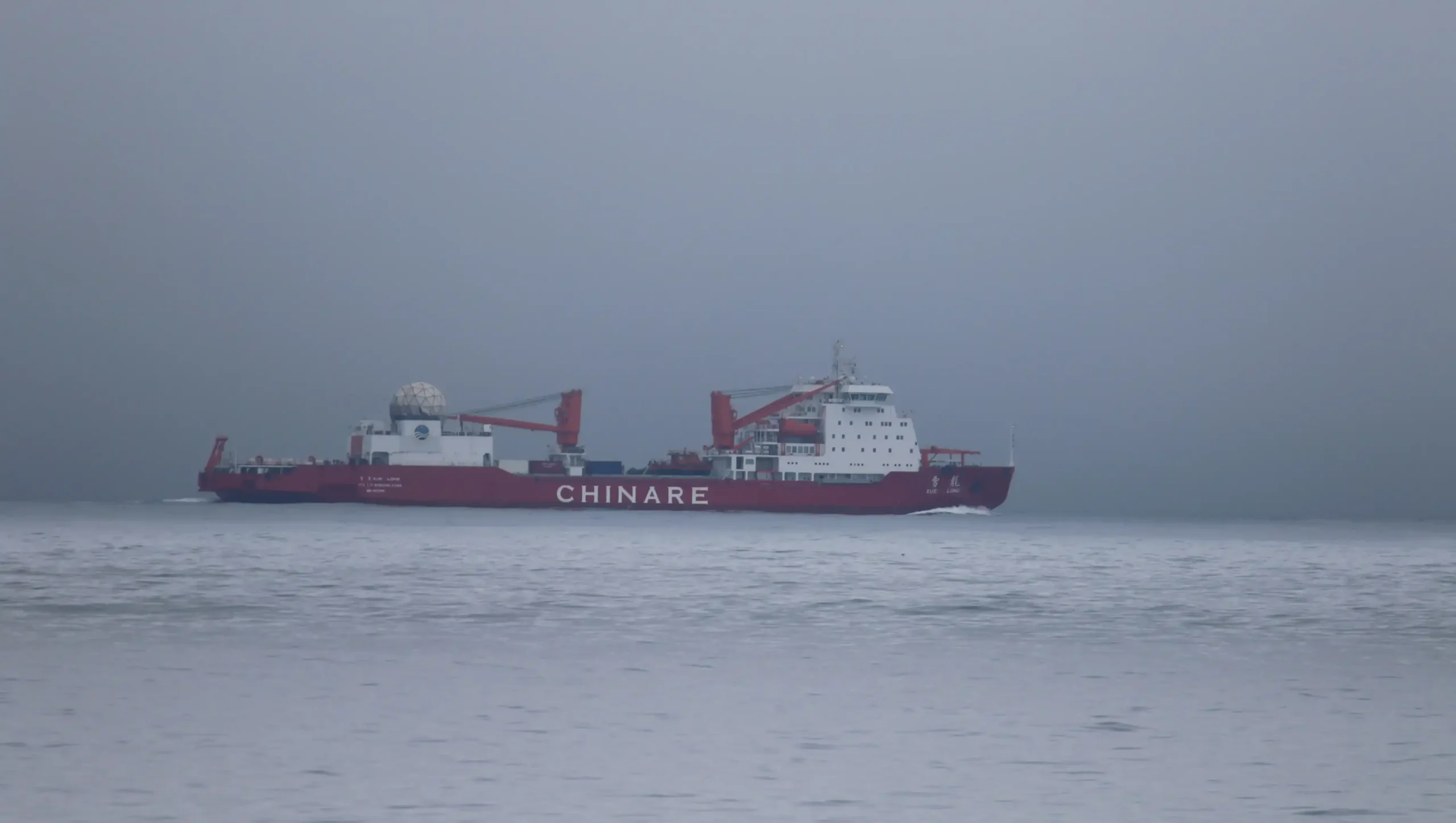
Senior military officials in the United States are keeping a close watch on Chinese maritime activity off the coast of Alaska and into the High North, citing potential implications for homeland security. As of September 2026, four Chinese research vessels had been observed in the U.S. Arctic, compared to five throughout 2025, said Rear Adm. Bob Little, commander of the U.S. Coast Guard’s Arctic District.
Speaking at the Arctic Security Conference 2026 in Oslo, Norway, on September 16, Little said the Chinese vessels were operating in maritime areas surrounding Alaska, including the Aleutian Islands, through the Bering Strait, and as far north as the North Pole. “Where I have responsibility, interest and concern is when they are operating in and around U.S. sovereign space,” he said. “So inside of our exclusive economic zones, or over our extended continental shelf, we certainly have a security concern. And so those are the types of activities that we see that we’re watching very closely.”
The vessels stayed in international waters but did not notify the U.S. of their presence in advance through diplomatic channels, which is customary. “When we challenge them and query them as to the purpose of their activities, their response typically is either ‘we are conducting operations in international waters’ or ‘we are conducting scientific research,’” Little said.
The U.S. and its allies and partners are increasingly apprehensive about these vessels and their actual objectives. A January 2024 article written for the Center for Strategic and International Studies, a U.S.-based think tank, said: “To survey the Earth’s oceans, China has developed the world’s largest fleet of civilian research vessels. While these ships support scientific and commercial objectives, they are also being used to advance Beijing’s strategic ambitions. … “China’s dual-use approach to oceanographic research raises questions about the nature of these activities. Many vessels that undertake missions for peaceful purposes are also capable of providing the PLA [People’s Liberation Army] with critical data about the world’s oceans.”
One concern is that China’s research may focus on mineral exploitation in waters that belong to the U.S., Little said. Another is that the vessels’ research might “provide them with a military advantage or pose a security threat to the United States,” said the rear admiral, whose area of operations is nearly as vast as Europe. China has stepped up its presence in the region in recent years, sometimes in joint operations with Russia and sometimes alone.
While in Norway, Little met with his allied counterparts to review similar patterns involving Russian research vessels in Europe’s polar waters. “Whether it’s the Barents (Sea) or the Baltic (Sea), it’s easy to find examples of hybrid threats and activities,” he said, noting the proximity of Russian operations. “So, I certainly watch that very carefully, because it’s the same nation-state that’s my neighbor on the western side of the Arctic.” Moscow also denies that its research vessels conduct illegal activity or pose a threat to U.S. interests.
U.S. President Donald Trump signed an executive order in October 2025 instructing the Department of Homeland Security to expand its fleet of arctic security cutters to counter the “growing threat” in the region. In February 2026, the Coast Guard awarded a contract to Davie Defense Inc. to build five cutters, bringing the number of such vessels under contract to 11. Under the $3.5 billion contract, the first cutter is to be delivered in 2028.
In testimony before the U.S. Senate Armed Services Committee in March, Gen. Gregory M. Guillot, commander of U.S. Northern Command and the North American Aerospace Defense Command, said, “China remains committed to expanding its presence in the Arctic, deploying a record five research vessels to the region in 2025, likely in part to support future military deployments. … The ability of the Joint Force to conduct all-domain operations in the Arctic approaches to North America remains a strategic necessity as military and economic competition in the region steadily expands.” In his 2025 testimony to the committee, Guillot specified: “In 2024 … the PRC [People’s Republic of China] repeatedly deployed dual-purpose vessels into the Arctic as part of a long-standing effort to expand the ability of the People’s Liberation Army Navy (PLAN) to conduct multidomain operations in the High North.”