

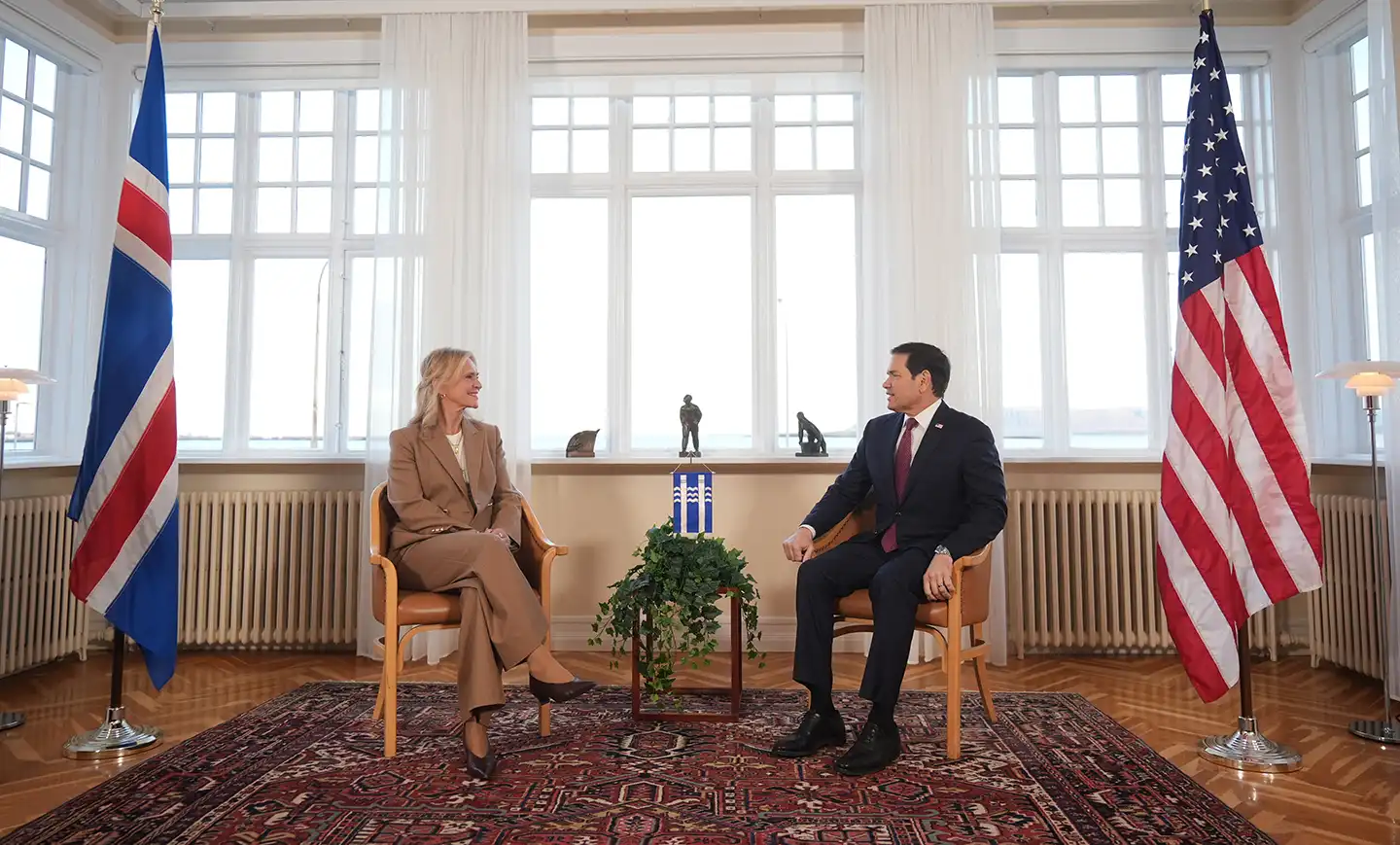
On a diplomatic visit to Iceland in early October, United States Secretary of State Marco Rubio reaffirmed the U.S. commitment to strengthening security in the High North, the Arctic and NATO’s northwestern flank, saying Iceland will play a critical role. “Iceland sits at the center of many of the questions surrounding the security and defense of our shared region,” he said. “Those threats are growing, which is why this focus on the Arctic in general and Iceland, in particular, is so critical.”
Standing alongside Iceland’s Foreign Minister Thorgerdur Katrín Gunnarsdóttir, Rubio said the strategically located NATO member is essential to the defense of North America and Europe. Asked whether the U.S. plans to increase its military presence or surveillance capabilities in Iceland after a U.S.-Denmark-Greenland defense agreement was announced in September, Rubio did not announce plans for a new permanent U.S. military base there but said Washington would work with Icelandic officials to consider what more can be done.
“I think there is a willingness to do more together,” he said. “And what Iceland contributes, really, is infrastructure and technology and the ability to have surveillance and opportunity of domain awareness.”
Rubio’s visit comes amid increasing Russian aggression in Europe, and as both Russia and China expand their ambitions in the Arctic region. “Our potential adversaries and real competitors already — and the predatory industries associated with them — are already acting … against our interests,” Rubio said. “And so, it’s important that we continue to cooperate in the security realm the way we are doing and continue to do.”
Gunnarsdóttir confirmed Iceland’s commitment to defense of the region and its NATO allies. “We are working closely together every day here in Iceland, especially to safeguard the security of the High North, North Atlantic and the Arctic,” she said. “For us, being a credible and responsible ally, we take this role very seriously here in Iceland, especially when it comes to the U.S. and the whole of NATO.”
Iceland is the only NATO member that has no army, navy or air force, mostly due to its small population and the cost of maintaining a modern military. But its location makes it an essential ally in defense of the High North and Arctic.
“What that means and has meant for a very long time is you welcoming NATO allies to come here and to operate jointly within Icelandic territory,” Rubio said. “And we want to continue to build upon that as a way to prevent conflict.”
The U.S. ended its permanent military presence at Keflavík in 2006, but NATO forces have retained a presence with exercises, maritime patrols and rotational deployments. More than 1,200 Americans participated with other NATO forces in the Northern Viking 2026 exercise in August and September 2026, a biennial event in and around Iceland. Later in September, Royal Danish Air Force fighters trained in Keflavík alongside a French tanker transport aircraft and NATO airborne warning and control aircraft during Operation Arctic Vanguard, a combined air defense training event in the region for North American Aerospace Defense Command (NORAD) and NATO forces.
Both events operate under the overarching strategic framework of the Nordic Bridge concept to align allied operations in the Arctic. Gen. Gregory M. Guillot, commander of U.S. Northern Command and NORAD, officially introduced the concept after strategic meetings with European defense partners.
Rubio said the strategic landscape has shifted since the U.S. withdrew from Iceland in 2006. “The world has changed over the last 20 years. Our focus has changed. There’s a lot of focus on the Arctic,” he said, arguing that Iceland is critical not only to NATO’s defense of Europe but also to the defense of the U.S. homeland.
Asked whether Iceland faces a direct military threat from Russia, Rubio cited irregular measures, covert activity, and threats to undersea cables and shipping lanes. “There are direct threats,” he said. “And those threats in the 21st century aren’t just military threats. They’re also economic and commercial threats that have implications on the national security of our respective countries.”
Rubio also talked about broadening the U.S.-Iceland relationship beyond defense, highlighting potential business opportunities. “Your expertise in geothermal energy and biotechnology and marine industries, those present incredible opportunities for greater commercial and technological cooperation,” he said.
But he stressed that military security remains the foundation for any business partnerships. “Security underpins everything else,” Rubio said. “If you’re not secure, you can’t be prosperous.”
Rubio’s visit included a stop at Höfdi House, the site of the 1986 Reykjavík Summit between U.S. President Ronald Reagan and Soviet leader Mikhail Gorbachev. Just days before the 40th anniversary of the historic meeting, Rubio and Gunnarsdóttir re-created the leaders’ famous handshake, emphasizing Iceland’s enduring role in a strategic alliance that binds North America, Europe and the Arctic.