

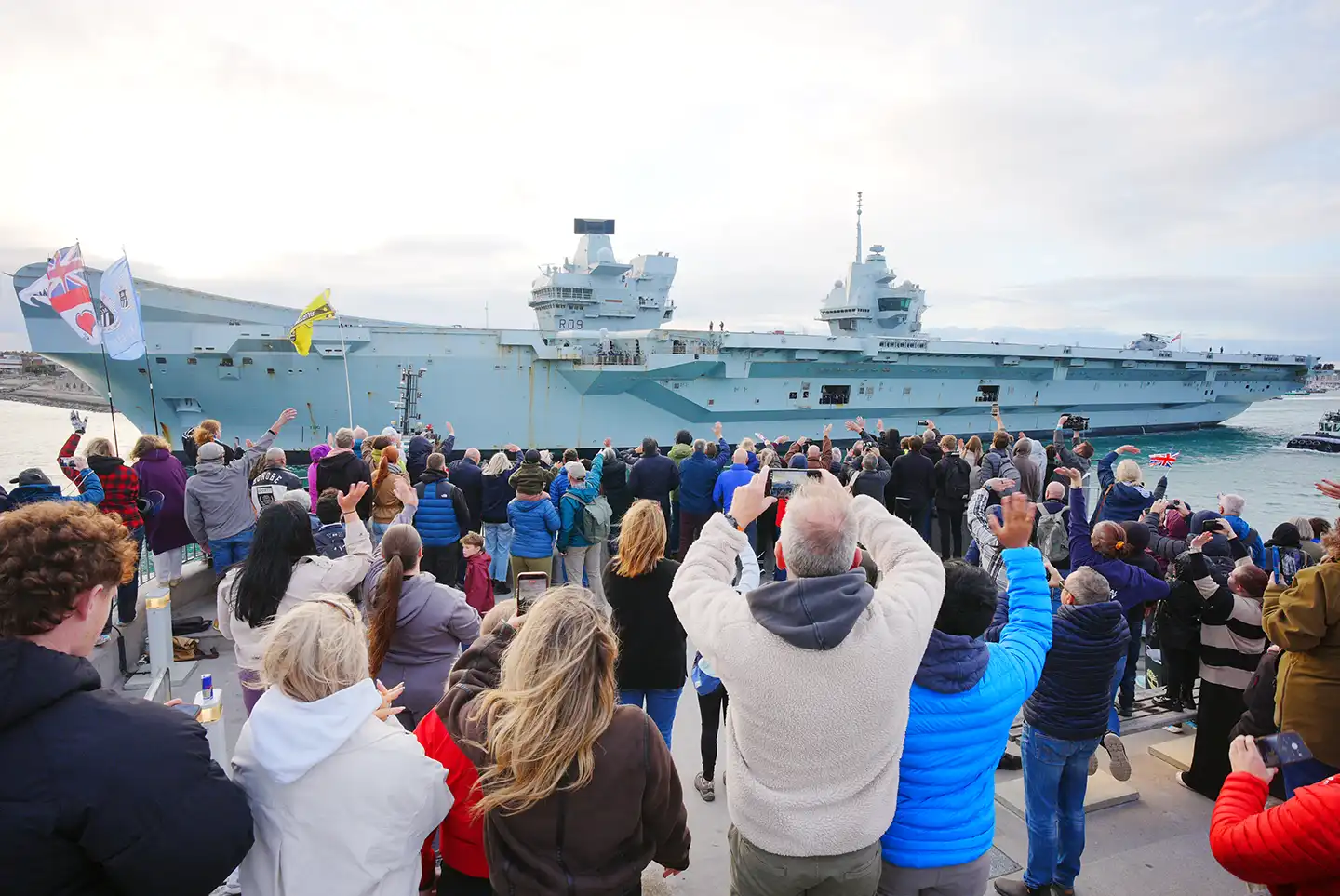
The United Kingdom’s largest warship, the HMS Prince of Wales, sailed from Portsmouth Naval Base on October 18 to lead a NATO-focused deployment to the Arctic and North Atlantic, beginning the second phase of Operation Firecrest as the alliance seeks to strengthen its defenses in a strategically important region.
Crowds gathered along the Portsmouth waterfront to watch the aircraft carrier depart with more than 1,200 British military personnel aboard the carrier strike group, Reuters and the Royal Navy said. The deployment is intended to improve operational readiness, strengthen cooperation among NATO allies and protect vital maritime routes and infrastructure amid growing concerns about Russian military activity in northern European waters.
The Royal Navy’s flagship was accompanied by the Type 45 destroyer HMS Dauntless and an air group that included F-35B Lightning stealth fighters, Merlin Mk2 anti-submarine helicopters, Merlin Mk4 Commando helicopters, Wildcat helicopters and Malloy uncrewed aircraft.
The strike group is operating under NATO command and working alongside allies including Denmark, Germany and Norway. Its activities include participation in the alliance’s Neptune Strike series of exercises, which tests the ability of multinational forces to conduct coordinated operations across the air, sea and land domains.
“The deployment of the HMS Prince of Wales and her air wing to the High North and the North Atlantic, operating under NATO leadership, is a clear demonstration of the U.K.’s commitment to the Alliance and contribution to the enduring security and stability of the North Atlantic,” Armed Forces Minister Louise Sandher-Jones said in a statement by the Royal Navy.
Operation Firecrest comes as the U.K. and its NATO partners pay increased attention to the security of the High North, where changing Arctic conditions are opening new maritime routes and increasing the region’s strategic importance.
In February, the British government said that Russian naval activity threatening U.K. waters had increased by 30% over the past two years. Officials have expressed concerns about the vulnerability of undersea cables and pipelines, as well as Russian operations around the Greenland-Iceland-United Kingdom gap, a maritime passage connecting the North Atlantic to the Arctic.
The deployment builds on the strike group’s first phase of Operation Firecrest, which concluded in July after about three months of operations with NATO and other European partners.
During that phase, the carrier strike group participated in NATO air policing missions around Iceland and the High North. British F-35B fighters launched from the HMS Prince of Wales to conduct air defense missions, marking the first time British F-35Bs had performed NATO air policing from a European aircraft carrier.
The fighters also intercepted a Russian Tu-142 maritime patrol aircraft over the Norwegian Sea. According to the Royal Navy, the Russian aircraft dropped sonobuoys, devices to detect underwater sounds, during the encounter and passed the carrier’s escort, the HMS Duncan.
The first phase involved cooperation with 19 allies from NATO and the Joint Expeditionary Force (JEF), a coalition of northern European countries led by Britain. The Royal Navy said those activities strengthened partnerships and demonstrated the strike group’s ability to contribute to NATO’s defense of its northern flank.
Commodore Richard Hewitt, commander of the U.K. Carrier Strike Group, said the second phase would build on those results. “I am delighted to return to the Arctic and North Atlantic as we build on the successes of the first phase of Operation Firecrest,” Hewitt said in a statement by the Royal Navy. “Led by the U.K. Flagship HMS Prince of Wales, the Strike Group will bring together a range of assets and capabilities, while taking every opportunity to train, operate and integrate with our NATO Allies and Partners.”
The deployment also has a diplomatic component. During a visit to Oslo, Norway, in November, the HMS Prince of Wales will host the Atlantic Future Forum and the International Sea Power Conference, bringing together military leaders, government officials, policymakers and industry representatives to discuss European and trans-Atlantic security.
The deployment comes as the U.K. seeks to demonstrate its commitment to NATO’s northern defenses. British officials have presented Operation Firecrest as a demonstration of the country’s ability to deploy a carrier strike group alongside allied forces and contribute to collective defense in the North Atlantic.
The Royal Navy said the second phase is intended to focus on maintaining readiness, improving interoperability and preparing the strike group to respond to challenges in the region. As the carrier and its escorts return to northern European waters, Hewitt said the deployment would provide opportunities to demonstrate the group’s capabilities alongside NATO partners.
During the first phase of the mission, the strike group demonstrated its ability to defend allied territory and contribute to regional deterrence, he said in a statement by the Royal Navy in July. “We have shown how we can generate, sustain and when called upon, defend our NATO and JEF allies against unwanted threats in the High North and North Atlantic.”