

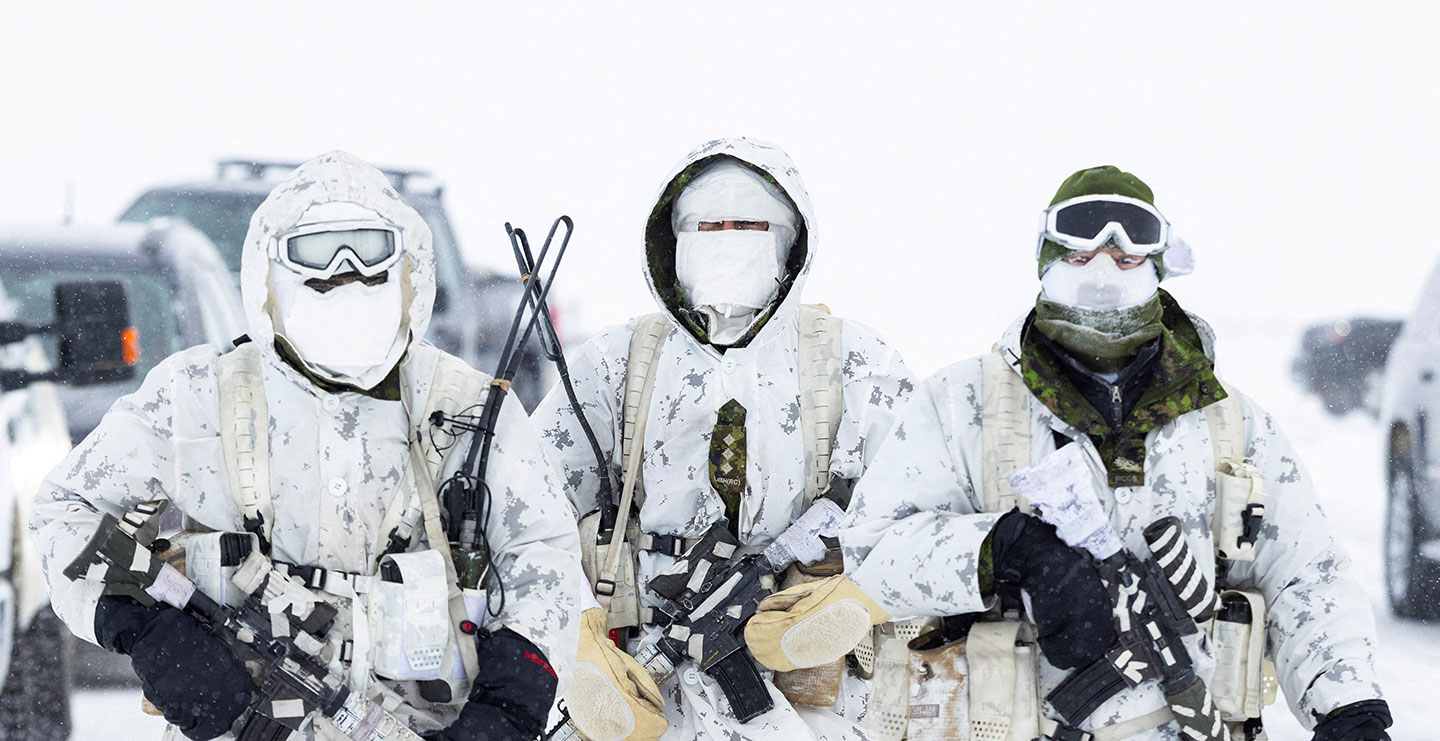
The Canadian Armed Forces (CAF) are expanding their focus on exercises across the Arctic and the North in 2026 to detect, deter and, if required, defend against threats. “Canadian sovereignty is inseparable from a strong and credible Arctic defence,” Minister of National Defence David J. McGuinty said in a CAF news release. “As strategic competition accelerates and adversaries expand their military reach across the circumpolar region, Canada is acting with purpose and resolve.”
Demonstrating its capability and capacity to protect Canadian sovereignty across the land, maritime, air, cyber and space domains, the CAF kicked off its 2026 exercises on February 14 with Operation Nanook-Nunalivut, which focuses on long‑range sustainment along the Northwest Passage and defensive activities throughout Yukon, the Northwest Territories and Nunavut. It’s the largest Nanook-Nunalivut in years and spanned thousands of kilometers.
“This is important because the Arctic is opening up, and we need to be more prepared to do things up in the North and internationally,” Col. Sean French of the 1 Canadian Mechanized Brigade Group told media company Postmedia. “We need to be prepared to reinforce the fact that Canada’s northern people need to be safe, secure and well defended, and this is part of that message.”
The CAF is deploying ships, aircraft, vehicles and personnel from the Canadian Army, Royal Canadian Navy, Royal Canadian Air Force and Canadian Special Operations Forces Command in coordinated training with the Canadian Coast Guard and allied forces, the CAF release said. Operations are supported by modern command and control, communications, real-time data collection and logistical support.
The exercises help the CAF strengthen its presence in the Arctic and the North to protect Canada’s sovereignty and contribute to North American defense. With recurring exercises, the CAF enhances its skills in detecting potential threats early, responding effectively, and operating cohesively with NATO and Arctic allies. The CAF also works closely with Inuit and Northern Indigenous governments and communities.
In addition to Operation Nanook-Nunalivut, other Operation Nanook exercises will be held throughout the year — sometimes concurrently. They are:
- Nanook-Nunakput: all‑domain activities along the Northwest Passage
- Nanook-Tuugaalik: maritime interoperability with the Canadian Coast Guard and NATO allies
- Nanook-Takuniq: air‑land integration, including Canadian Ranger patrols
- Nanook-Tatigiit: whole‑of‑government crisis response
- Nanook-Qimaavivut: military engineering and infrastructure tasks
The CAF also will continue to conduct Operation Limpid, Operation Boxtop and Operation Latitude, the release said. Operation Limpid is an all-domain surveillance-based mission to detect threats as quickly as possible. Operation Boxtop is a logistics mission to resupply Canadian Forces Station Alert in Nunavut to enable the year-round presence of CAF members. Operation Latitude is a maritime operation that focuses on detection, deterrence and defense against potential threats in the western Arctic and its approaches.
The events will run concurrently and in conjunction with other Arctic operations and exercises led by organizations of which Canada is a member, including NATO and the North American Aerospace Defense Command (NORAD), the world’s only binational command. “By strengthening domain awareness, modernizing northern capabilities, and deepening integration with allies and partners, the Canadian Armed Forces are enhancing deterrence and ensuring persistent presence in the North,” McGuinty said in the CAF release.
In testimony before the Senate Armed Services Committee on February 13, 2025, Gen. Gregory M. Guillot, commander of U.S. Northern Command (USNORTHCOM) and NORAD, said: “Defending North America is inherently linked to the ability of the Joint Force to operate effectively across the entire USNORTHCOM area of responsibility — to include the Arctic. … Arctic responsibilities are shared across multiple geographic and functional combatant commands, and as competition in the region increases, safeguarding Arctic access and freedom of maneuver will depend on Joint Force Arctic operational capabilities and build on the already strong ties between Arctic partners. USNORTHCOM places enormous value on the ability to conduct operations and exercises in the High North and to execute assigned missions in coordination with fellow combatant commands.”