

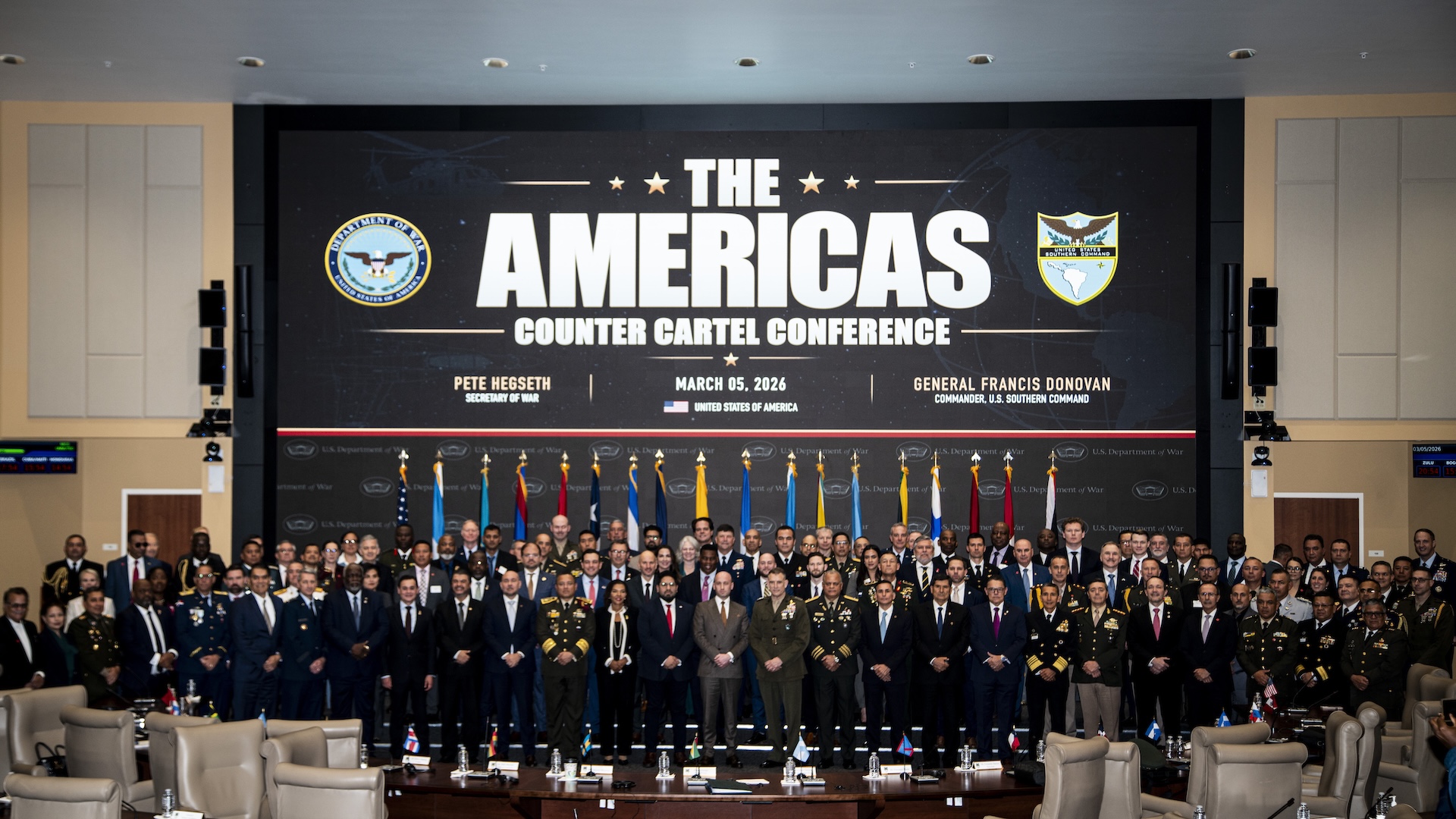
At the inaugural Americas Counter-Cartel Conference held on March 5, 2026, at U.S. Southern Command (SOUTHCOM) headquarters in Doral, Florida, military and security leaders from across the hemisphere delivered a blunt message to cartel networks: The region is prepared to confront them together. “This is not a conference with flags so we can pat ourselves on the back,” U.S. Secretary of War Pete Hegseth said. “This is an operational conference to bring our countries together to achieve a shared objective and do so aggressively.”
Representatives from across the hemisphere — including Argentina, The Bahamas, Belize, Bolivia, Chile, Costa Rica, the Dominican Republic, Ecuador, El Salvador, Guatemala, Guyana, Honduras, Jamaica, Panama, Paraguay, Peru, and Trinidad and Tobago — joined senior U.S. defense and national security officials at the conference. Throughout the day, participants emphasized a common theme: Narcotrafficking, narco-terrorism, arms trafficking, human trafficking and other criminal actors operate across borders, and no country can confront them alone.
Opening the conference, U.S. Marine Corps Gen. Francis L. Donovan, SOUTHCOM commander, warned that cartels and narcotraffickers are conducting “campaigns of terror, violence, and corruption” to expand their influence across the hemisphere.
“These sophisticated networks flood our streets with fentanyl, cocaine and other drugs that kill at a higher rate than any conventional war,” Donovan said, calling cartel activity “the single gravest threat to security in our region and across our hemisphere.”
Donovan emphasized that confronting those networks requires collective action among allies and partners through combined operations, intelligence sharing, training and coordinated security efforts. “Your participation here sends an unmistakable message to partners and adversaries alike,” he said. “We are taking the fight to the narco-terrorists and the cartels.”
Collective commitment
A central outcome of the conference was the signing of a joint security declaration, in which participating nations committed to expanding cooperation against narco-terrorist organizations and other transnational threats affecting the hemisphere.
The declaration calls for deeper intelligence sharing, stronger border and maritime security cooperation, expanded interoperability among security forces, and greater coordination to dismantle criminal networks that undermine democratic institutions and regional stability.
Joseph Humire, acting U.S. Assistant Secretary of War for Homeland Defense and the Americas, emphasized that the conference marked a shift toward a more coordinated regional strategy.
“If you do not control your borders, you do not have a country,” Humire said. “Border security and deterrence must be at the center of our strategy, and that means working together to dismantle the cartel networks that threaten our shared hemisphere.”
White House Deputy Chief of Staff Stephen Miller described the conference as part of a broader shift in hemispheric security priorities.
“Not a single one of your nations should tolerate the existence of a single square mile of territory under the control of terrorist or cartel organizations,” Miller said. “The cartels operating in this hemisphere must be treated as the terrorist threat that they are.”
Shared diagnosis of the threat
Defense and security leaders from across the region described cartel-linked violence and transnational organized crime as direct attacks on state authority, democratic governance and economic stability.
Ecuador Defense Minister Gian Carlo Loffredo Rendón said narco-terrorist organizations “not only traffic drugs; they challenge the legitimate authority of the state and affect the freedom and prosperity of our citizens.”
For Guatemala Defense Minister Henry Sáenz Ramos, cartels “are not just criminal organizations,” but structures that “erode the sovereignty, distort the economies [and] infiltrate the institutions of the state.”
Dominican Republic Defense Minister Lt. Gen. Carlos Antonio Fernández Onofre reiterated that transnational threats require a coordinated regional response. “These challenges do not recognize borders,” he said. “Our response must be joint as a region.”
Belize Minister of National Defence and Border Security Florencio Marin Jr. warned that criminal networks adapt quickly, “leveraging technology, exploiting institutional gaps and moving seamlessly across jurisdictions.”
For his part, Peru Defense Minister Luis Enrique Arroyo Sánchez described the threat as multidimensional, encompassing narcotrafficking, weapons trafficking, human trafficking, illegal mining and cybercrime. “These threats project simultaneously in land, maritime, air and cyber domains,” he said, requiring joint action across multiple sectors.
Panama Public Security Minister Frank Ábrego also stressed the need for stronger interoperability and information sharing across the region. “Security today is interconnected and multidimensional,” Ábrego said. “It requires greater cooperation, shared information and mutual trust among our nations.”
Support for regional cooperation
Participating countries also stressed the importance of expanding regional cooperation and strengthening partnerships with the United States.
Costa Rica Public Security Minister Mario Zamora Cordero said regional cooperation is essential to ensure that shared democratic values are protected throughout the continent. “What the United States is offering us today is to work together so that our shared values of democracy become a reality in the whole continent,” Zamora said.
Jamaica’s former Ambassador to the United States Audrey Marks said transnational crime networks operate across borders and require regional cooperation. “We acknowledge that this must be a collaborative effort, multiagency, and across the wider region,” she said.
Trinidad and Tobago Defense Minister Wayne Sturge underscored his country’s role in the fight. “We are not observers in this fight,” he said. “We are on the front line with you.”
Guyana Prime Minister Mark Phillips also highlighted the importance of cooperation for countries located along major maritime trafficking corridors. “These threats demand coordinated intelligence sharing, enhanced operational cooperation, and strengthened defense capabilities across the hemisphere,” Phillips said.
Bolivia Defense Minister Raúl Marcelo Salinas Gamara called for “mutual trust and combined actions” among neighbors and partners, while Paraguay Foreign Minister Rubén Ramírez Lezcano said no nation can confront threats “that are transnational in nature” alone.
For Honduras Secretary of National Defense Enrique Rodríguez Burchard, the conference underscored the need for permanent regional cooperation. “The fight against cartels and transnational organized crime cannot be addressed in isolation,” Rodríguez said. “It is a hemispheric threat that requires joint response and a shared strategic vision.”
Diálogo Américas is a publication of U.S. Southern Command.