

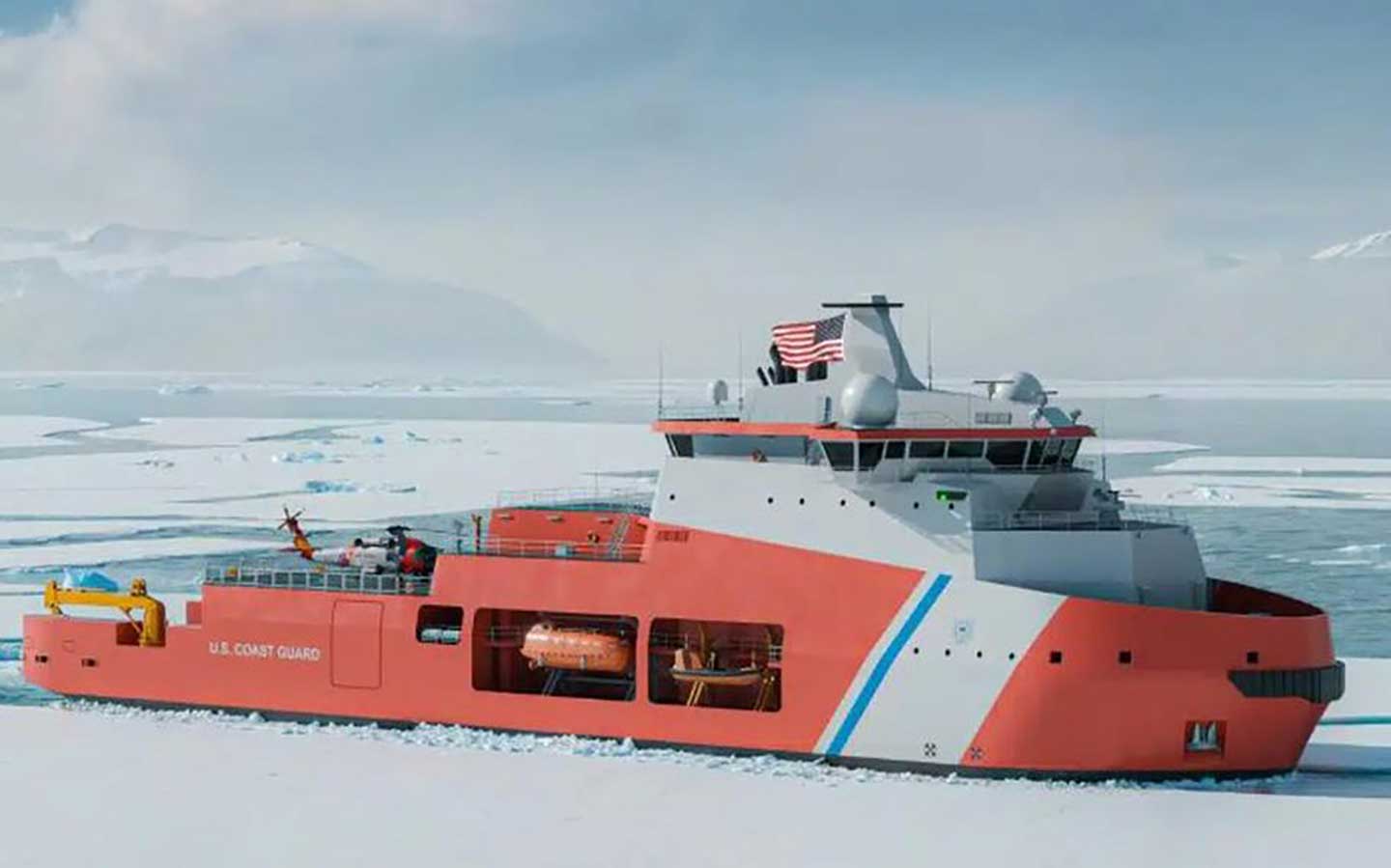
The United States Coast Guard announced plans in April 2026 to homeport two icebreakers in Alaska, the latest move to bolster domain awareness and security in the western Arctic. Department of Homeland Security Secretary Markwayne Mullin said two Arctic Security Cutters would be based in Alaska by the end of 2028. “Homeporting these two Arctic Security Cutters in Alaska is a decisive step forward in securing America’s Arctic frontier,” Mullin said in an April 16 Coast Guard news release. “These vessels will deliver the enduring operational presence our nation needs to protect sovereignty, deter foreign adversaries, and safeguard vital resources for the American people.”
The Arctic Security Cutters will be the first two of 11 planned icebreakers added to the Coast Guard’s fleet following contracts awarded in 2025 worth $3.5 billion. The ships will be built in partnership with Finland, which reached an agreement with the U.S. in October to rapidly deliver the first vessels. “Homeporting Arctic Security Cutters in Alaska underscores the United States’ leadership as a maritime power in the Arctic,” said Adm. Kevin E. Lunday, commandant of the Coast Guard. “By strategically positioning these state-of-the-art icebreakers in Alaska, the Coast Guard will maximize our ability to defend our northern border and approaches, while reinforcing America’s maritime dominance in a crucial region of strategic importance.”
The ICE Pact, signed in 2024, also involves Canada, which has pledged to boost production of the ships. Finland will build four Arctic Security Cutters, and U.S. shipyards will deliver an additional seven icebreakers. The ships will dramatically increase U.S. presence in the Arctic and aid in defending U.S. sovereignty in the region, which is increasingly contested by adversaries, including the Chinese Communist Party (CCP) and Russia. “A robust icebreaker fleet will enable the Coast Guard to control, secure and defend U.S. Alaskan borders and Arctic maritime approaches, facilitate maritime commerce vital to economic prosperity and strategic mobility, and respond to crises and contingencies in the region,” the release stated.
The collaboration involving Canada, Finland and the U.S. in building out a robust icebreaker fleet demonstrates the strategic importance of the region. Finland, which borders Russia in the eastern Arctic and straddles the Baltic region, has an interest in thwarting any plans by Moscow to move military assets through the Bering Strait and east through the Arctic Ocean. Canada and the U.S., fellow NATO members, have responsibilities to secure the western Arctic as well as defend the European Arctic.
In March 2026 testimony at a joint hearing of the House Homeland Security subcommittees on Transportation and Maritime Security and Counterterrorism and Intelligence, Heather Conley, a nonresident senior fellow at the American Enterprise Institute, said the new icebreakers symbolized the change in the region’s strategic importance. “The United States has moved away from its post-Cold War concept of the circumpolar Arctic as a separate and distant region where long-term security challenges and new economic opportunities are managed cheaply. Washington has returned ‘home’ to the Arctic as it centers the region within homeland defense as part of an integrated defense strategy for the Western Hemisphere.”