

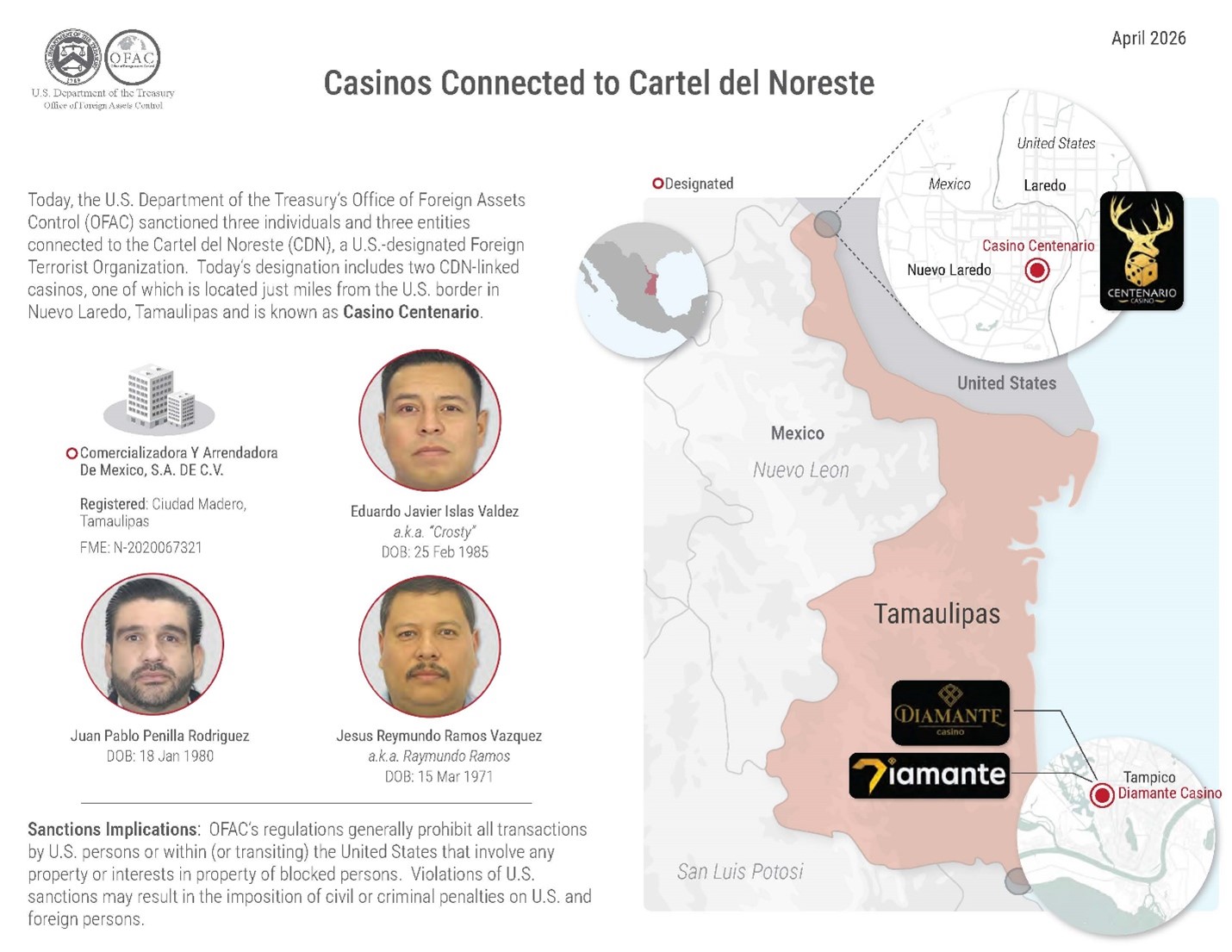
The United States sanctioned three people accused of money laundering and cash smuggling for the Cartel del Noreste (CDN), a foreign terrorist organization (FTO), in April 2026 after an extensive investigation by the Homeland Security Task Force and Drug Enforcement Administration. The U.S. Treasury’s Office of Foreign Assets Control (OFAC) also sanctioned two Mexican casinos.
“As President Trump has made clear, Treasury will use all tools to protect our nation from violent cartels looking to reign terror on innocent Americans,” Treasury Secretary Scott Bessent said in a news release. “Treasury will continue to target the diverse revenue streams that cartels rely on to sustain their operations, which include trafficking fentanyl and illegal aliens into the United States.”
CDN, formerly known as Los Zetas, is one of Mexico’s most violent cartels. It is entrenched along the U.S.-Mexico border near Laredo, Texas, the busiest land port of entry on the southern border. The sanctioned individuals “play central roles in advancing CDN’s criminal dominance over the Nuevo Laredo plaza in Tamaulipas, Mexico, supporting the cartel’s broader illicit operations, which include fentanyl trafficking, human smuggling, money laundering, and extortion,” the April 14 release stated.
Eduardo Javier Islas Valdez (Islas), also known as Crosty, is accused of running the cartel’s human smuggling operations in Nuevo Laredo. He was sanctioned for allegedly operating a series of stash houses along the border and controlling the smuggling operations.
Raymundo Ramos, described by Reuters as a well-known human rights activist, was sanctioned for filing false complaints against the military, paying people to attend protests and spreading misinformation about CDN members and activities. Identified as a CDN associate, Ramos “engages in these activities with the goal of boosting the public opinion of CDN and discrediting Mexican authorities’ law enforcement initiatives against the cartel,” the release stated.
Defense attorney Juan Pablo Penilla Rodriguez (Penilla) provides illegal services to the cartel by representing Miguel Angel “Z-40” Trevino Morales to the cartel and other criminal groups, according to the U.S. government. Morales is in a U.S. prison, so “this facilitation has enabled Miguel Trevino to maintain his leadership role in the cartel despite his incarceration. The criminal operations of Miguel Trevino, and CDN as a whole, rely directly on Penilla,” the release stated.
Two casinos, one just two miles from the U.S. border, also were sanctioned. Casino Centenario in Nuevo Laredo is used as a cartel stash house for fentanyl and cocaine as well as money laundering, the government alleged. The investigation also found that the cartel uses the casino’s backrooms to torture and intimidate cartel enemies. The same front company also operates Diamante Casino in Tampico, which also was sanctioned. U.S. citizens are now barred from patronizing either casino or their online platforms, the release stated.