
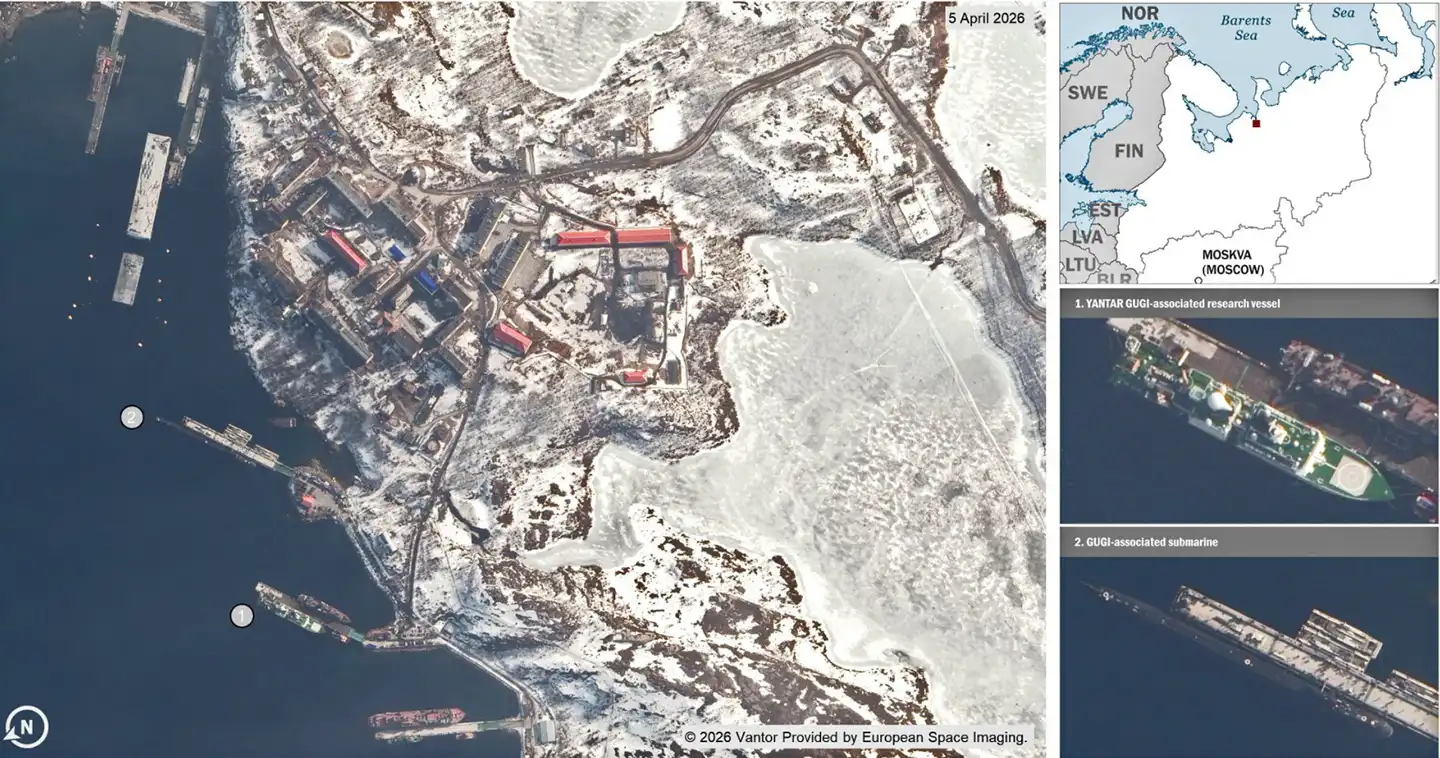
Deep in Arctic waters near the remote Svalbard archipelago, NATO allies in early 2026 caught Russian subs training to unleash a secret weapon designed to disable critical undersea cables without leaving any fingerprints. The clandestine Russian operation, described to Reuters by two Western officials, was carried out by Moscow’s GUGI undersea warfare directorate, which used deep-sea submersibles to simulate the deployment of the sophisticated and destructive technology.
A joint operation involving Norway, the United Kingdom and the United States tracked and confronted the Russian vessels at sea, said the two officials, speaking on condition of anonymity. The vessels were prevented from completing their exercise and eventually left the area.
Norway and the U.K. disclosed in April that they had uncovered a covert Russian operation in Arctic waters. But the discovery of the new weapon, the location of the operation and the U.S. involvement had not been reported.
The deep-sea face-off comes at a time when some Western intelligence officials fear the Kremlin is ramping up sabotage operations in Europe and preparing for a conflict with NATO. Destroying subsea cables could be a critical part of that effort, the Western officials said. Cables no thicker than a garden hose, lying on the seabed or buried just below, are critical to global internet connectivity and financial transactions. Their economic and strategic importance has made them targets in past conflicts, including in World War I and World War II, when they were critical in delivering orders by telegraph or telephone.
Two 1,400-kilometer subsea fiber-optic cables linking Svalbard to mainland Norway lie as deep as 2,700 meters below the sea’s surface. They carry vast amounts of satellite data downloaded at the SvalSat satellite ground station, the world’s largest and part of NASA’s Near Space Network.
Russia’s Defence Ministry didn’t respond to a request for comment on the incident. The Kremlin consistently denies conducting sabotage operations in NATO countries or plotting any confrontation.
Some Western officials argue that Moscow’s targeting of European states has increased in recent months as the front line in Ukraine has become largely static. Countries including Lithuania, Poland and Romania have confirmed violations. Most recently, an attempted August drone attack on the Leipzig/Halle Airport in Schkeuditz, Saxony, Germanytriggered a series of responses from Germany, including the closure of a Russian consulate in Bonn and a cultural center in Berlin.
In August, Central Intelligence Agency Director John Ratcliffe visited intelligence counterparts in Moscow, in part to warn Russia against escalating sabotage operations in Europe, said two people familiar with the matter.
Arctic exercise
At the same time as the confrontations at sea, British and Norwegian officials took their findings to Moscow to show they were aware of the new technology — hoping it might make Russia hesitate to use it. Russia didn’t damage any cables. The exercise focused on simulating the deployment of the technology in the event of a conflict with NATO, the officials said. They declined to detail how the technology works.
“Through our joint operation, we sent a clear message to Russia that they cannot operate covertly,” Norway’s Defence Minister Tore Sandvik said in a statement. “We have made it unequivocally clear to Russian authorities that any attempt to target our critical infrastructure will be detected and met with consequences,” he said. “It is in no one’s interest to escalate tensions in the High North.”
The U.K. Defence Ministry pointed to April 9 statements acknowledging attempted covert activities in and near Norwegian and British waters by Russia’s Main Directorate of Deep-Sea Research, known by its Russian acronym GUGI. Washington and London both have imposed sanctions on the secretive directorate.
Any escalation between Russia and NATO could quickly underscore the strategic importance of an icy expanse of water between the southern tip of the Svalbard archipelago and mainland Norway known as the Bear Gap, one of the Western officials said.
To reach the Atlantic, Russian nuclear submarines based in the Kola Peninsula would cross the 644-kilometer wide stretch of water before passing Norway’s remote volcanic island Jan Mayen.
U.K. officials said they deployed forces to Jan Mayen in August alongside Norwegian and U.S. allies for an exercise to demonstrate NATO’s ability to operate jointly in the High North. Norway plans to have new fiber-optic cable linking Svalbard and Jan Mayen to the mainland by 2028.