

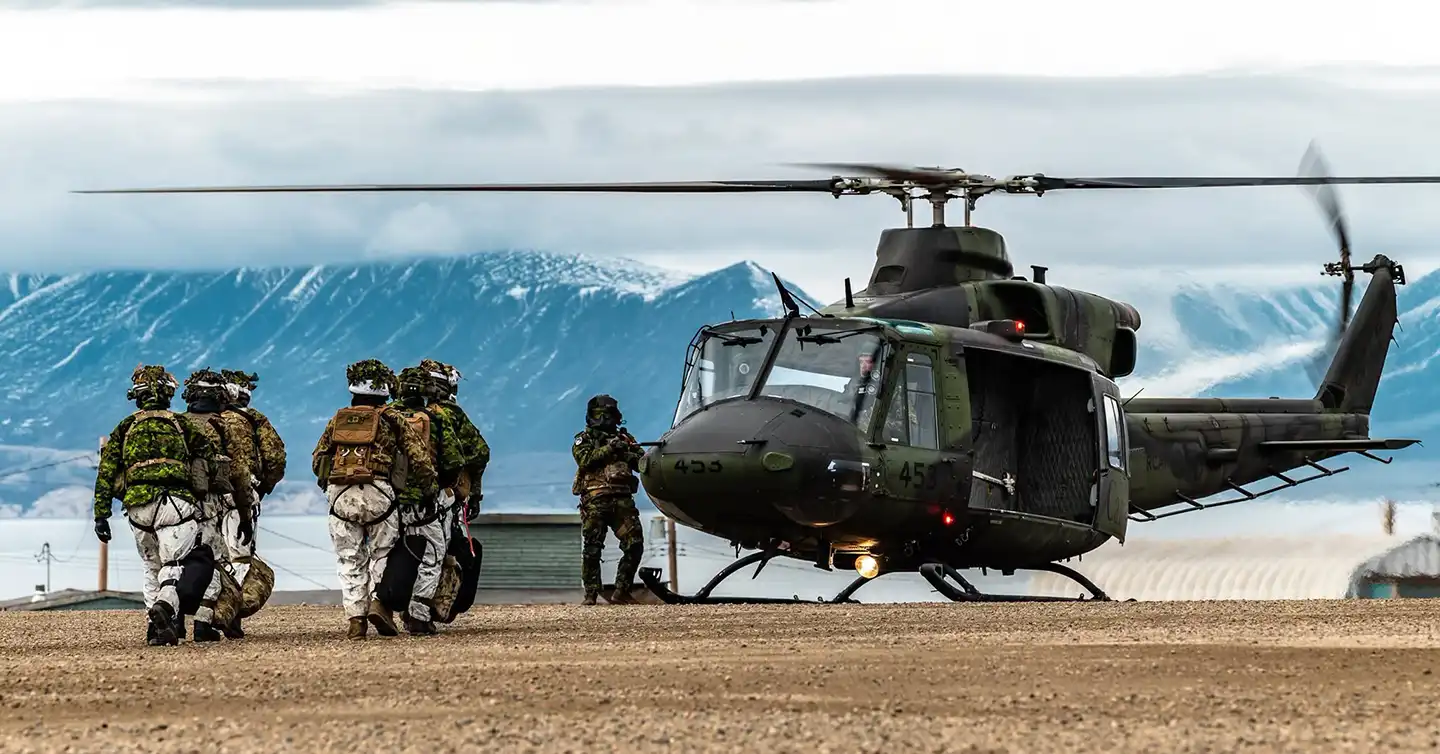
Canadian Armed Forces (CAF) engineers fanned out across the High North in July 2026 to assess the military readiness for key infrastructure in a remote, often inhospitable region as part of the summerlong Nanook-Qimaavivut exercise. Teams of military engineers traveled to Nunavut, Labrador and far-flung airfields across the Arctic to evaluate the logistical viability of key assets. Their work will inform military planning decisions as Canada continues to ramp up its investment in Arctic defense.
“Operation NANOOK-QIMAAVIVUT strengthens the practical foundations that enable effective Arctic operations,” said Lt. Gen. Steve Boivin, commander of Canadian Joint Operations Command, in a July 30 Department of National Defence news release. “By improving mobility, sustainment, and operational support, we ensure the Canadian Armed Forces can operate effectively across Canada’s Arctic and North, in all seasons.”
The goal of the exercise — one of several components of an overarching training framework known as Operation Nanook — was to optimize military planning on the effective movement of troops and equipment across the High North during prolonged deployments while safeguarding supply lines. Through reconnaissance and infrastructure assessments, CAF engineers determined whether conditions near Resolute Bay, Nunavut, at airfields across the Arctic and at militarily important sites along the Labrador coast met necessary benchmarks to sustain continuous operations, the release stated.
Small teams of CAF military engineers were supported by Canada’s Joint Task Force North, the Royal Canadian Air Force, the Canadian Army and the CAF’s Joint Operations Support Group. An important component of the exercise was the evaluation of remote High North airfields and airstrips, essential for military operations and emergency response efforts. The ground-level work was a key part of Operation Nanook, an annual exercise that is considered Canada’s signature training operation. This year, the engineering operation began in July and is scheduled to end in September. Nanook-Qimaavivut contributes “to awareness, readiness and defence across the Arctic while supporting Canada’s sovereignty, security and continental defence objectives,” the release stated.
Operation Nanook began in 2007, and in 2018 it was divided into several components that take place throughout the year in a coordinated approach spanning all four seasons across the High North. The 2026 iteration included the largest participation of CAF forces to date. They conducted land, air and joint activities, including a long-range patrol of more than 5,000 kilometers from Inuvik, Northwest Territories, to Churchill, Manitoba.
Enhancing interoperability with other NATO forces is a priority. This year, troops from Belgium, Denmark, France and the United States participated. Canadian partners, like the Royal Canadian Mounted Police and Parks Canada, also took part.
Regular and Reserve Force personnel from the following CAF units participated in at least part of the operation:
- Joint Task Force North
- 3rd Canadian Division, including the 1 Canadian Mechanized Brigade Group and 1st Regiment, Royal Canadian Horse Artillery
- Primary Reserve units under 38 Canadian Brigade Group (CBG), headquartered in Winnipeg, Manitoba, and 41 CBG, headquartered in Calgary, Alberta
- 1st Canadian Ranger Patrol Group
- 417 Combat Support Squadron, from Cold Lake, Alberta
- 439 Combat Support Squadron, from Bagotville, Quebec
- 440 Transport Squadron, from Yellowknife, Northwest Territories
- 450 Tactical Helicopter Squadron, from Petawawa, Ontario
Operation Nanook-Qimaavivut’s contribution to the overall operation lies in facilitating better force projection and sustainability. “QIMAAVIVUT is about enabling operations today and into the future,” said Brig. Gen. Marc Parent, commander of Canada’s Joint Task Force North. “By improving access, mobility, and sustainment in challenging environments, we are improving how the CAF supports operations across the North while respecting local conditions and communities.”