

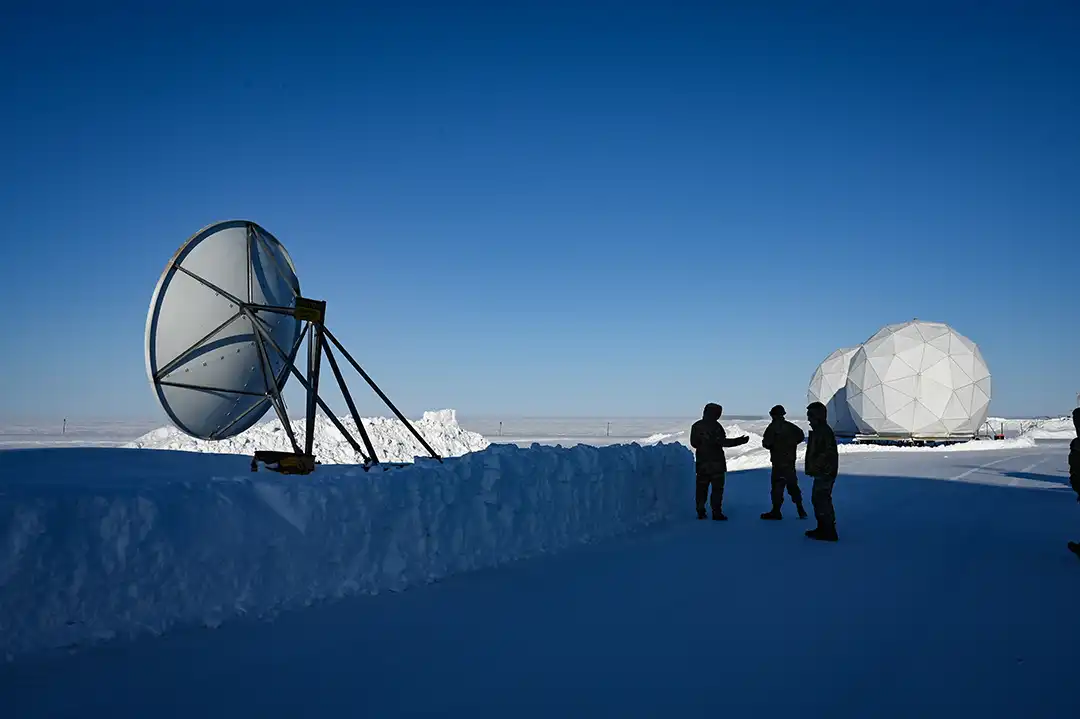
Canada has awarded global satellite operator Telesat a $1.6 billion contract to provide secure military communications in the Arctic region, the government announced in August. “Strengthening Northern and Arctic sovereignty is essential to our national security and is a priority,” Secretary of State for Defence Procurement Stephen Fuhr said in a Defence Investment Agency (DIA) news release.
As part of the Enhanced Satellite Communications Project — Polar (ESCP-P), Ottawa-based Telesat will deliver military Ka-band connectivity for five years, with two additional five-year options valued at about $155 million each, the company said in a news release. The deal expands the company’s Telesat Lightspeed Low Earth Orbit (LEO) network by 69 satellites, from the 156 in production today to 225. Ontario-based MDA Space will manufacture the additional satellites, Telesat said.
Telesat Lightspeed is a dual-use project, designed to serve both commercial customers and the military. Secure military satellite communications services to the Canadian Armed Forces (CAF), with coverage ranging from 65 to 90 degrees North latitude, are scheduled to begin in the first quarter of 2028. This critical capability will support a broad range of CAF operations, including defending Canada and North America through the North American Aerospace Defense Command (NORAD), supporting operations with allies, enhancing Arctic situational awareness, and supporting search and rescue missions.
“By investing in the Enhanced Satellite Communications Project — Polar, we are giving the Canadian Armed Forces next-generation military satellite communications, so our personnel have secure, resilient, and reliable connectivity in the Arctic and other high-latitude regions where they need it most,” National Defence Minister David McGuinty said in the DIA news release. “Through this project, we are accelerating the delivery of critical capabilities, defending Canada’s sovereignty and security, and strengthening our domestic defence industrial base to deliver for Canadians for years to come.”
Fuhr emphasized the project’s value amid increasing global competition. “The contract awarded today as part of the ESCP-P initiative will provide enhanced situational awareness and a strong presence in the North while empowering Canada to respond to evolving threats amid a shifting geopolitical environment,” he said in the release.
Establishing secure communications networks for military forces presents extraordinary challenges in the Arctic. Harsh weather conditions obstruct traditional fiber-optic cable and cell networks. Satellites in geosynchronous Earth orbit have their own obstacles, as rugged terrain can block signals and limit polar coverage.
Telesat’s Lightspeed network can overcome those issues because it operates as “a global, low-latency mesh network leveraging optical intersatellite links,” a company spokesperson told the Breaking Defense news website. In addition, the spokesperson said, Telesat Lightspeed “is the perfect solution to provide backup connectivity in the case of an undersea fibre cut, which is becoming an increasingly common event.”
“Secure, sovereign communications are essential to the Canadian Armed Forces’ ability to operate across Canada’s North, work seamlessly with our allies and partners, and contribute to continental defence,” Lt. Gen. Jamie Speiser-Blanchet, commander of the Royal Canadian Air Force, said in the DIA release. “The Enhanced Satellite Communications Project — Polar will strengthen our ability to connect, command and coordinate in the Arctic and other high-latitude regions, while supporting NORAD modernization and ensuring our personnel have the capabilities they need to meet today’s threats and those of the future.”
For the next step of ESCP-P, the government is negotiating with Telesat and MDA Space to develop a secure ultrahigh frequency (UHF) and X-band constellation in medium Earth orbit. MDA Space will serve as the prime contractor “responsible for end-to-end mission delivery,” the DIA release said.
In testimony before the United States Senate Armed Services Committee in March, Gen. Gregory M. Guillot, commander of U.S. Northern Command (USNORTHCOM) and NORAD, discussed the importance of the Arctic region and the need to continue upgrading military infrastructure there. “As a necessary element of sustained joint operations in the Arctic, USNORTHCOM and NORAD remain focused on infrastructure improvements in Alaska, Canada, and Greenland that will enhance the operational flexibility and capability necessary to train, fight, and win in the High North.”
He went on to praise the CAF and the Canada-U.S. partnership in guarding North America. “Defense cooperation between USNORTHCOM and the Canadian Armed Forces remains a cornerstone of continental defense. The Government of Canada’s commitment to modernization efforts that will directly benefit NORAD missions, coupled with outstanding collaboration between USNORTHCOM and the command’s counterparts in the Canadian Joint Operations Command (CJOC), plays a key role in multinational operations to detect and monitor potential threats to the homeland, and the partnership between CJOC and USNORTHCOM is vital to deterring and defending against all-domain threats to North America.”