

The waters north of Alaska became a testing ground in September for a military partnership designed to protect one of North America’s most remote and strategically important approaches. From September 18-22, U.S. and Canadian forces conducted a joint maritime strike scenario in the Bering Sea as part of Operation Tundra Merlin, an enduring campaign intended to strengthen the defense of the Arctic and prepare U.S. and allied forces to respond rapidly to potential threats.
The exercise brought together aircraft, surface ships and a submarine under the command and control of U.S. Northern Command (USNORTHCOM) and Alaskan Command. About 100 nautical miles north of Dutch Harbor, Alaska, the forces practiced a simulated maritime engagement, testing whether information collected by one military service or nation could quickly be turned into targeting information for another.
A Royal Canadian Air Force CP-140 Aurora and Royal Canadian Navy submarine HMCS Corner Brook tracked the U.S. Coast Guard Cutter Aspen. Canadian crews then relayed real-time information through multiple communications pathways to support a simulated strike, USNORTHCOM said in a September 23 news release.
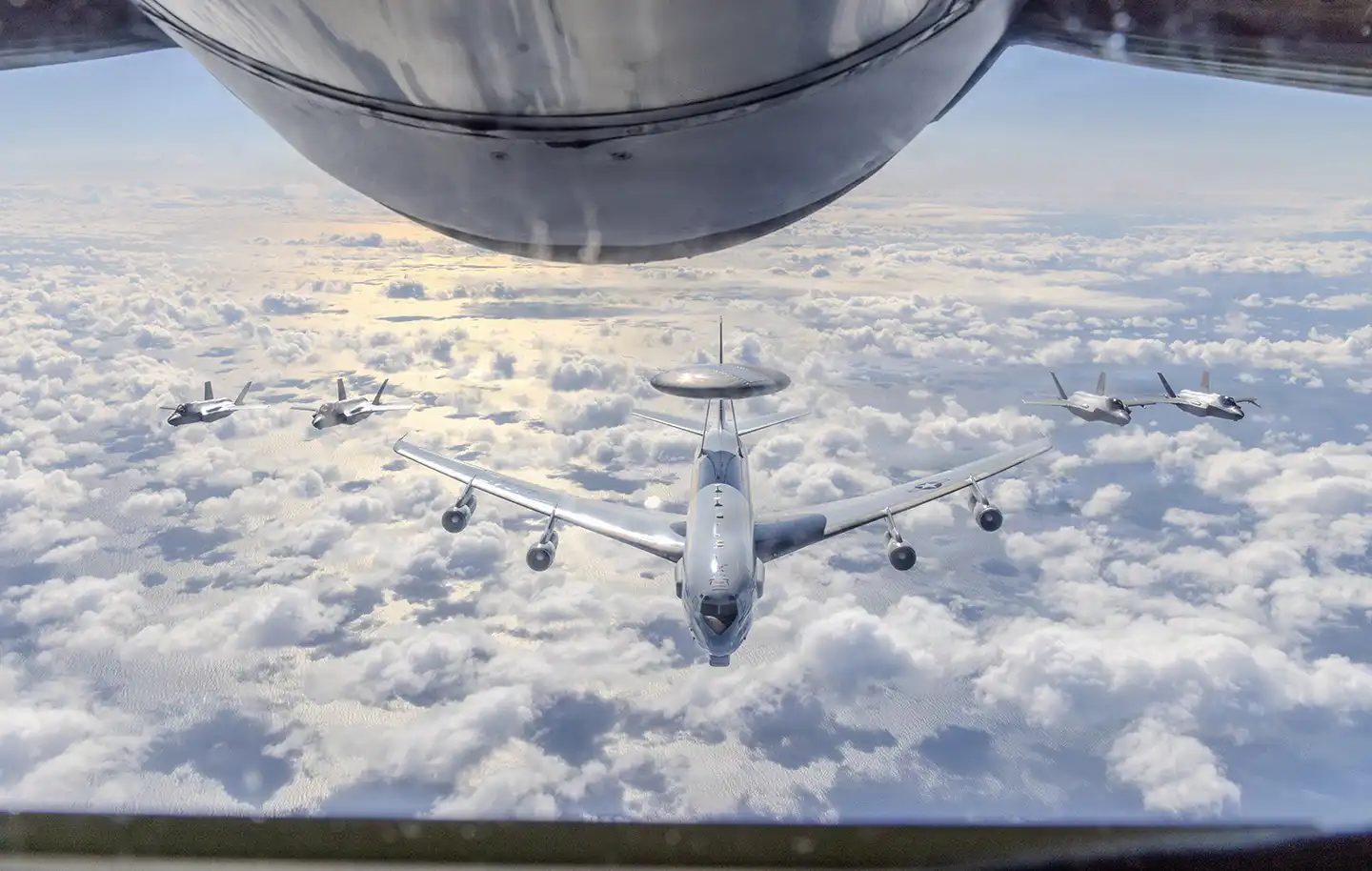
The U.S. Coast Guard Cutter Stratton also supported the Royal Canadian Navy frigate HMCS Ottawa during additional simulated engagements involving F-35A Lightning II fighters from the U.S. Air Force’s 354th Fighter Wing at Eielson Air Force Base, southeast of Fairbanks. An E-3 Sentry aircraft provided airborne warning and control, while an Alaska Air National Guard KC-135 Stratotanker supplied aerial refueling.
The objective was less about any individual weapon than about making the entire force work as one. “This scenario showcases our ability to hold simulated adversarial maritime activity at risk through a seamless kill chain involving air and maritime forces,” U.S. Air Force Lt. Gen. Robert D. Davis, commander of Alaskan Command, the Alaskan North American Aerospace Defense Command Region and 11th Air Force, said in a September 23 Alaskan Command news release. “Integrating operations from two Air Forces, the Royal Canadian Navy, and the U.S. Coast Guard demonstrates our collective capability and our will to defend the homelands in the Arctic.”
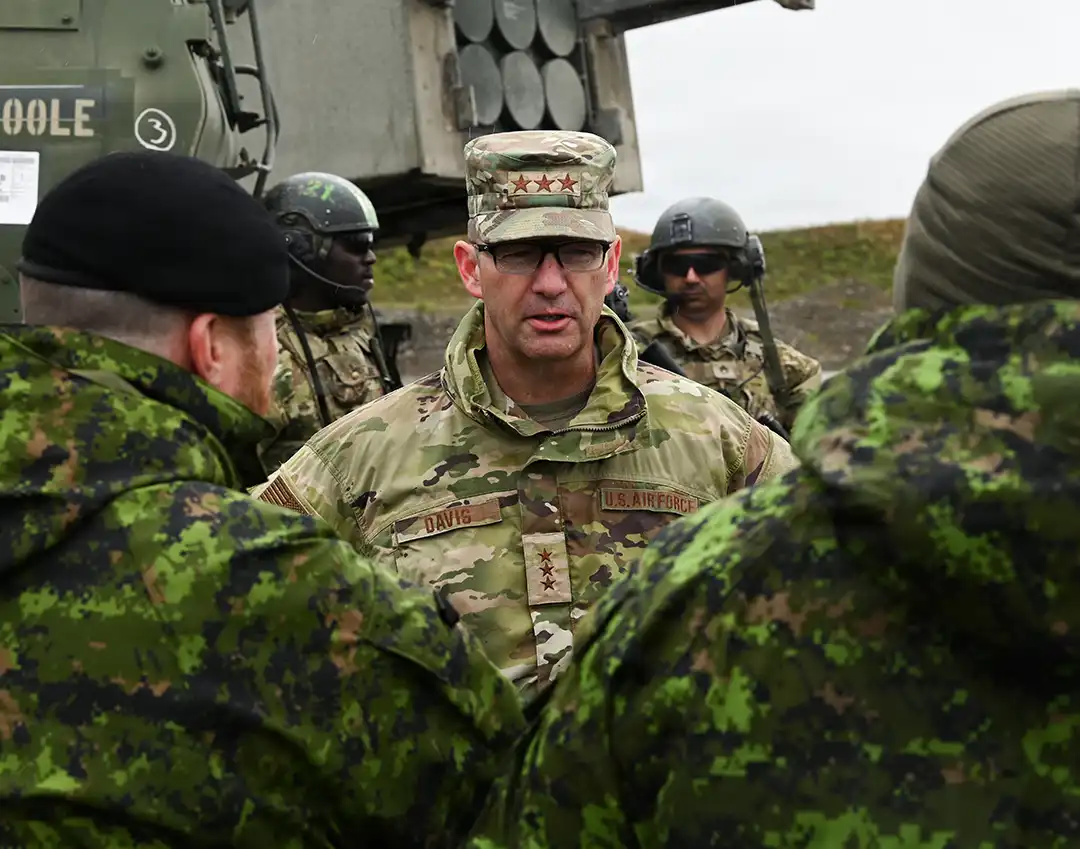
In an interview with Fox News Digital, Davis said the changing Arctic security environment is being driven in part by the region’s increasing accessibility. “I think what’s changed is primarily two things,” he told the outlet. “One is that the melting sea ice has made the Arctic more accessible. And we’re seeing increased activity both commercially and militarily in the Arctic, particularly during the summer months.
“The other factor is that China and Russia and others are continuing to advance their military capabilities and capacity with an interest in showing that they can use them in the Arctic as well,” Davis said.
To adapt to the changing scenario, Tundra Merlin functions as a continuing campaign in which individual events test different pieces of a larger defense plan. Earlier in the summer, U.S. and Canadian maritime forces conducted a 1,300-kilometer combined sail through the Bering Sea and Bering Strait. U.S. Coast Guard cutters Munro, Storis and Fir operated alongside the Royal Canadian Navy vessel HMCS Max Bernays, according to an August report in weekly news outlet The Nome Nugget.
In another demonstration, a U.S. Army M142 High Mobility Artillery Rocket System, or HIMARS, was moved from Joint Base Lewis-McChord in Washington to Nome, Alaska, aboard a Royal Canadian Air Force C-17 Globemaster III, USNORTHCOM said in July. The aircraft also transported Soldiers from the 11th Airborne Division after stopping at Fort Wainwright.
The deployment demonstrated that combat equipment and troops could be moved rapidly into remote Arctic locations, where distance, weather and limited infrastructure can complicate military operations.
“This deployment under Operation Tundra Merlin demonstrates our ability to rapidly deploy forces and seamlessly integrate joint capabilities across the Arctic,” U.S. Army Maj. Gen. John Cogbill, commander of the 11th Airborne Division, said in a July 31 USNORTHCOM release.
“By deploying alongside the HIMARS, we are proving our readiness to deter adversaries by demonstrating lethal, long-range precision capabilities that can hold their assets at risk,” Cogbill said.
The September maritime exercise brought that same concept into a multinational, multidomain environment. Rather than simply moving a weapon or aircraft into position, the forces had to connect sensors, communications systems, commanders and weapons across national and service boundaries.
That is particularly important in the Arctic, where enormous distances can make reinforcement difficult and where military forces may have to operate far from established infrastructure.
The latest campaign season involved roughly 1,300 personnel from two nations and eight military services, along with 30 U.S. and Canadian aircraft, eight naval vessels, a HIMARS and an AN/TPQ-53 radar system, according to Alaskan Command’s September 25 recap.
For Canada, participation provides a direct role in defending approaches that affect both countries. The relationship also builds on the binational structure of NORAD, allowing Canadian and U.S. forces to develop familiarity with one another before a real crisis occurs.
For the United States, the partnership provides additional surveillance, maritime and air capabilities while demonstrating that North American forces can operate together across a theater where national boundaries are less meaningful than geography.
Davis emphasized that point in an Alaskan Command announcement previewing the Bering Sea exercise. “Every Tundra Merlin event prepares the force to fight and win in the Arctic, strengthens command and control, and improves our ability to operate seamlessly across services and nations, reinforcing the credibility of our collective defense,” he said.
The campaign also serves a deterrent purpose. Military planners hope that demonstrating the ability to detect, track, target and respond to threats will make potential adversaries think twice before testing the northern approaches to the continent.
At the same time, commanders gained assurance that their forces can operate in a region where severe weather, vast distances and sparse infrastructure can challenge even hardened military systems. The September scenario offered practical demonstrations of what that readiness can require. In addition to collaboration between U.S. and Canadian forces, the exercise tested coordination between various aircraft and maritime components.
“Integrating operations from two Air Forces, the Royal Canadian Navy, and the U.S. Coast Guard demonstrates our collective capability and our will to defend the homelands in the Arctic,” Davis said.