

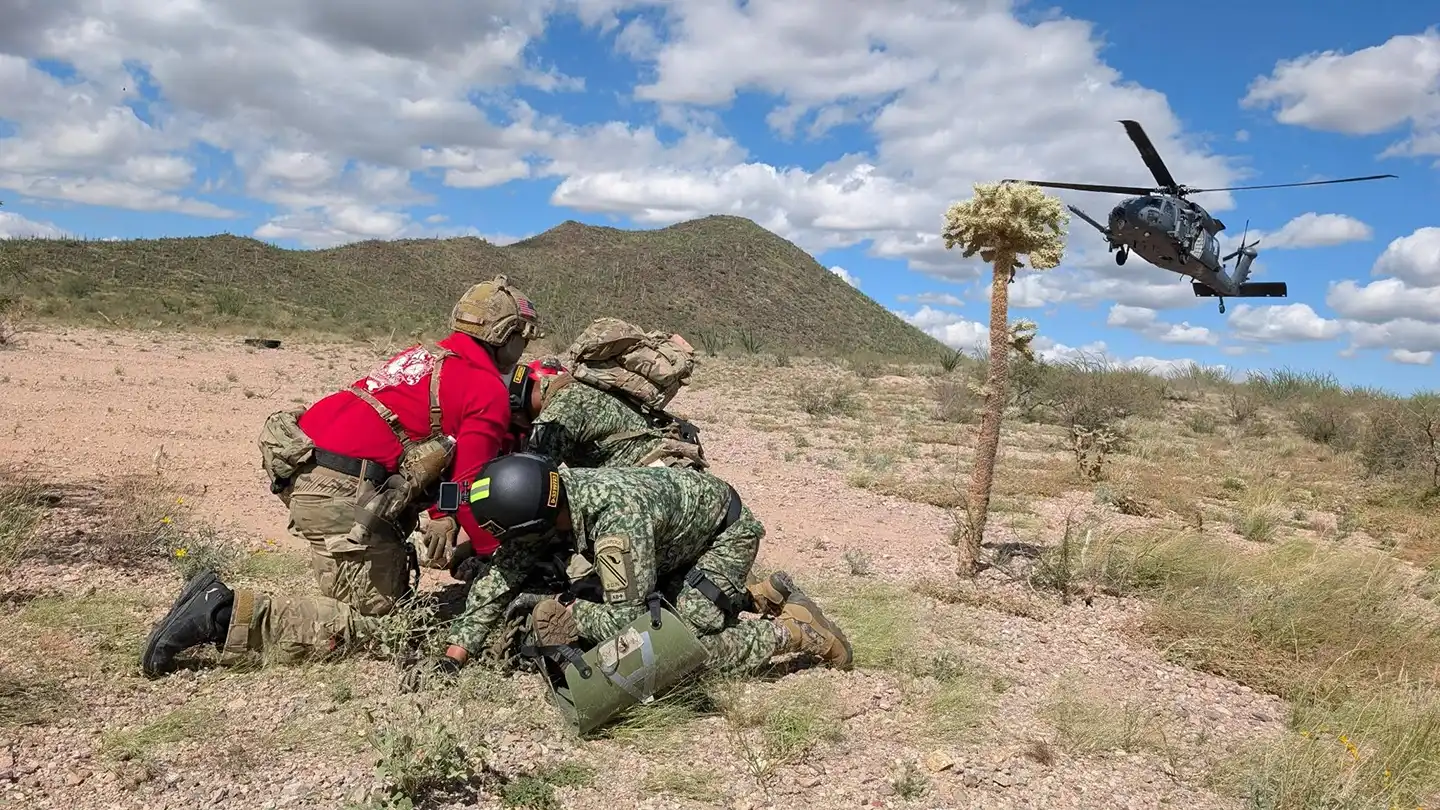
Amalgam Eagle is an annual military exercise that emphasizes collaboration and compatibility between the Mexican and United States militaries. The exercise’s latest iteration on the southern border included the first joint training with a Mexican Black Hawk helicopter in the U.S. as medics practiced providing critical intravenous care amid the noise, jostling and unexpected challenges of flight.
Mexican airmen flew a UH-60M Black Hawk to Davis-Monthan Air Force Base in Arizona for the first combined live Tactical Combat Casualty Care exercise, which began at the end of September 2026. The keystone of the training was intravenous access procedures aboard both a Mexican Black Hawk and a U.S. HH-60W Black Hawk variant helicopter, according to U.S. Air Forces Northern (AFNORTH), the air component of U.S. Northern Command. The crews and medical personnel demonstrated the crucial step of evacuating an injured Soldier and providing life-sustaining care while in flight. “Search and rescue does not end when a survivor reaches the helicopter, rather it begins another critical phase: assessment, treatment and transport,” AFNORTH stated.
Mexican medical personnel and U.S. pararescuemen, known as PJs, trained together aboard the helicopters of both nations, integrating rescue operations with medical skills needed to keep injured combatants alive on their flight to a military hospital. Providing intravenous care while managing turbulence, noise and confined cabin space gave participants the chance to experience battlefield conditions and practice employing their skills under pressure.
Combined medical training depends on trust and professional confidence. “Participants depend on each other’s preparation, communication and clinical discipline. They also gain opportunities to compare techniques, ask questions and learn through direct experience,” AFNORTH said. “U.S. and Mexican personnel trained together through the transition from recovery to airborne care, strengthening a relationship through tasks that demand both competence and trust.”
Amalgam Eagle also included the Mexican and U.S. Air Forces. They jointly tracked a King Air plane as it entered Mexican airspace. Mexican Cessna Citation Eagle II surveillance aircraft first detected the target, then handed off tracking responsibilities to a Mexican Air Force T-6C+ plane that shadowed the King Air as it approached Hermosillo, the capital of Sonora state. The King Air then changed course back toward the U.S., where U.S. Air Force F-16C warplanes joined the Mexican T-6C+ in tracking the target until it landed at Marine Corps Air Ground Combat Center Twentynine Palms in California. “The objective was to coordinate the detection, surveillance and interception of the target and strengthen coordination and response capabilities in each country,” according to InfoDefensa, a Spanish military affairs news website.
“For military leaders, this is a concrete expression of information sharing and operational compatibility: personnel developing the familiarity needed to work together across national and organizational boundaries,” AFNORTH stated. “A common mission provides the starting point. Repeated practical contact helps turn that common purpose into an effective working relationship.”