

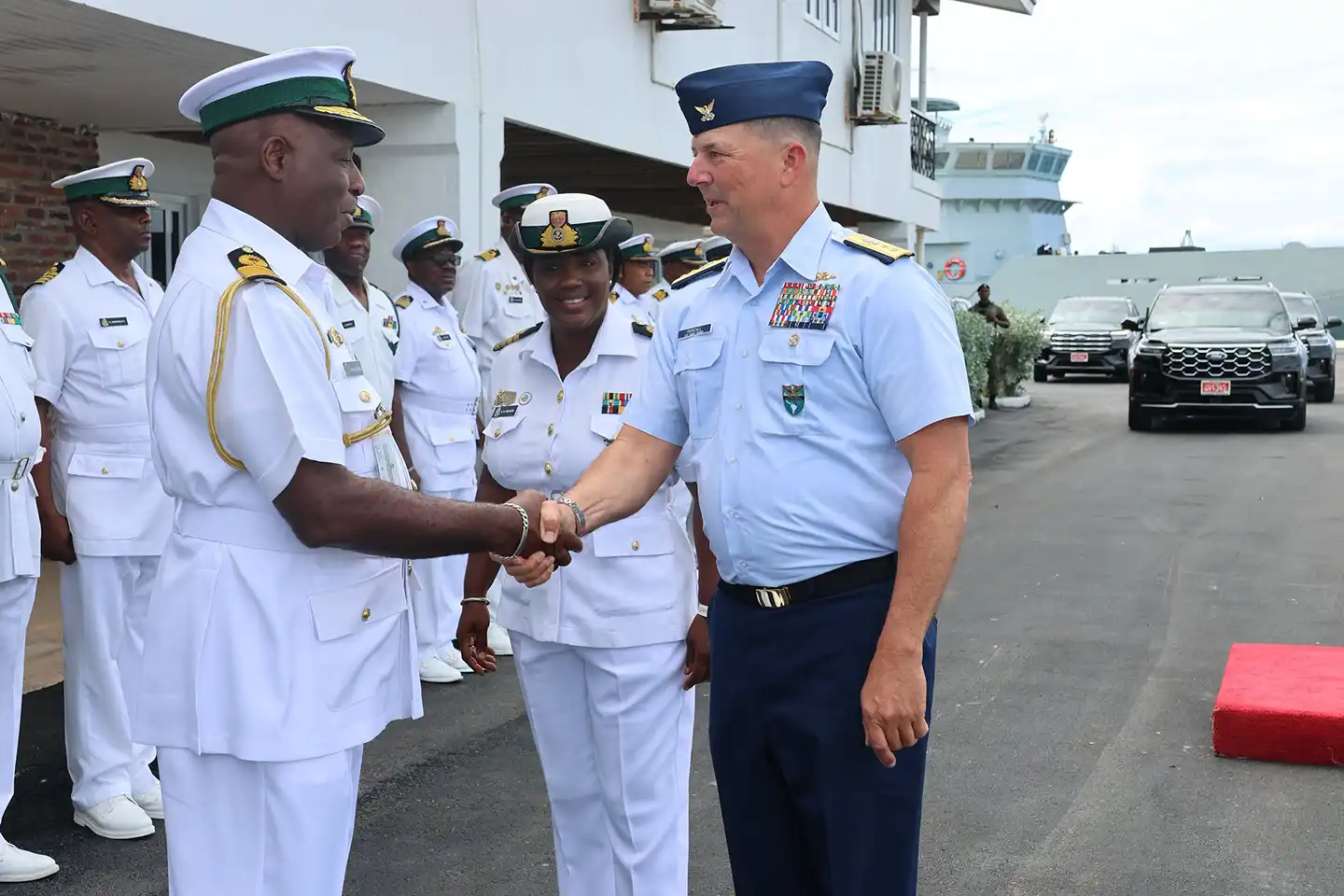
U.S. Coast Guard Rear Adm. Jeffrey K. Randall, director of Joint Interagency Task Force South, visited The Bahamas in September 2026 for talks with senior Bahamian defense officials, underscoring efforts to strengthen maritime security cooperation with a key Caribbean partner.
Randall paid a courtesy call to Commodore Floyd Moxey, commander of the Royal Bahamas Defence Force (RBDF), on September 21 at HMBS Coral Harbour, the force’s headquarters, the RBDF said in an October 8 news release. Following discussions, which included Moxey’s executive staff, Randall toured the facility to learn about the force’s operational capabilities and modernization efforts.
The meeting reinforced cooperation between the RBDF and Joint Interagency Task Force South, or JIATF South, which coordinates efforts to detect and monitor illegal narcotics movements across the Caribbean and parts of the south Atlantic. Randall oversees detection and monitoring activities covering roughly 109 million square kilometers, working with U.S. agencies and international partners.
His visit came as the two countries have continued to work against drug smuggling, irregular migration and other maritime threats across the Caribbean and approaches to South Florida.
Countering drug trafficking
Counter-narcotics operations remain central to the partnership. U.S. Coast Guard crews and Bahamian defense forces often cooperate to identify smuggling vessels, conduct interdictions and seize illegal drugs before they reach regional and international markets. This cooperation includes Operation Bahamas, Turks and Caicos (OPBAT), a 44-year-old multinational initiative combining maritime and aviation resources from U.S. and regional agencies to disrupt drug trafficking.
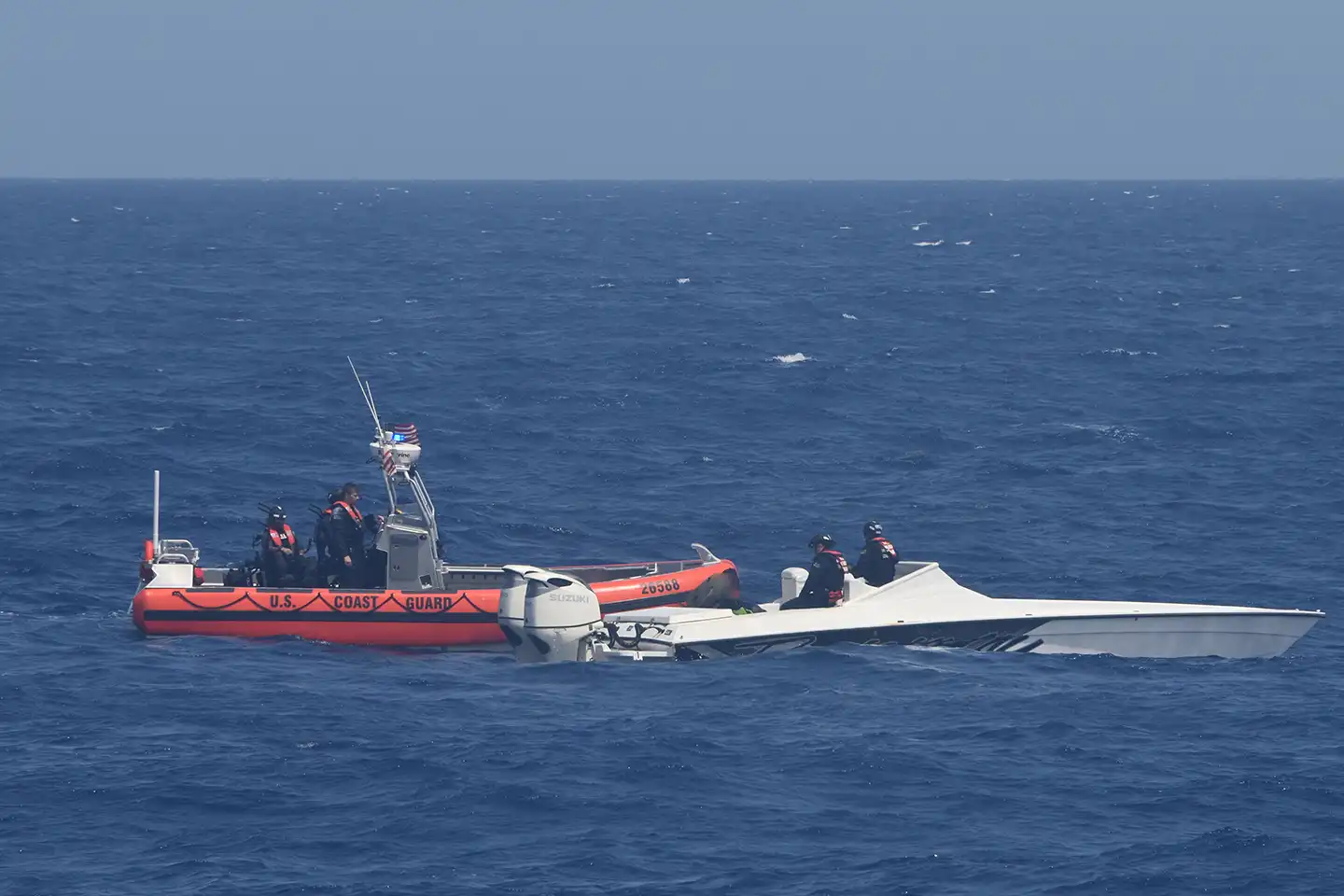
One such recent operation on July 27 resulted in the seizure of 1,080 kilograms of suspected marijuana worth an estimated $2.8 million. Coast Guard cutter Charles Sexton intercepted the alleged smuggling vessel 80 miles southwest of Great Inagua in The Bahamas.
Working with the Bahamian government and receiving logistical support from the Coast Guard’s Homeland Security cutter Ocean, the Charles Sexton crew and RBDF personnel boarded the vessel. Three people aboard were detained, and the suspected narcotics were transferred to Bahamian authorities.
“This interdiction highlights the strength of our partnership and our shared commitment to combating transnational organized crime in the region,” Lt. Peter Fager, commanding officer of the Charles Sexton, said in a Coast Guard release.
Migration and search-and-rescue missions
The partnership also addresses irregular migration and safety at sea. The Coast Guard and Bahamian authorities coordinate responses to migrant vessels, missing-person cases and maritime emergencies while working to prevent dangerous journeys across the Florida Straits.
On September 28, the Coast Guard announced that the crew of the cutter Margaret Norvell had transferred 10 people to the Bahamas following an interdiction involving a 9-meter sailboat about 64 kilometers east of Fort Lauderdale. The operation followed a boarding by the cutter Robert Yered, whose crew discovered the people aboard.
Under OPBAT and Operation Vigilant Sentry, the Coast Guard and its partners maintain a presence across the Florida Straits, Windward Passage, Mona Passage and Caribbean Sea. The effort aims to protect lives at sea while preventing unlawful maritime entry into the United States and its territories.
Training and interoperability
Training helps U.S. and Bahamian personnel operate safely and effectively during joint missions. In September 2025, Coast Guard rescue swimmers from the Aviation Training Center in Mobile, Alabama, traveled to Nassau to train RBDF and Royal Bahamas Police Force (RBPF) members in water-survival skills.
The multiday exercise included shallow-water egress training, which prepares personnel to escape from aircraft that enter the water. The training was particularly relevant to Bahamian personnel who routinely fly aboard Coast Guard helicopters during OPBAT missions.
According to a report from the U.S. Embassy in The Bahamas, 31 participants received hands-on instruction. “We were excited and proud to have the opportunity to share our expertise with our Bahamian partners. Not only did RBDF and RBPF perform exceptionally well, they exceeded the standards we set for the event,” Coast Guard Petty Officer 2ND Class Cole Johnson said in the embassy’s release.
A partnership built for the region
Randall’s visit highlighted the importance of continued engagement as the RBDF modernizes and strengthens its ability to protect the country’s territorial waters and maritime interests. In its October 8 release, the Bahamian force said it remained committed to expanding cooperation through continued engagement, information sharing, joint initiatives and professional exchanges.
The goal of the partnership, as stated by U.S. Embassy Nassau Chargé d’affaires Kimberly Furnish in a September 12, 2025, embassy report about OPBAT, is broader than any single interdiction or training exercise. “Since 1982, OPBAT has worked to stop the flow of illicit narcotics through the Caribbean, destined for the United States or other jurisdictions,” Furnish said. “This is international cooperation at its best.”