

United States Northern Command (USNORTHCOM), scientists and international partners completed a three-year series of experiments in September 2026 that could help the Northern Warning System detect potential airborne threats at longer distances across Alaska and northern Canada. Initial results during live-fly testing showed the radar system achieved “full skywave (beyond line of sight) detections” of U.S. military aircraft that served as exercise targets, the Air & Space Forces Magazine website reported.
The most recent testing explored how an existing high-frequency transmitter — paired with a newly developed, low-cost receiver array — could expand current surveillance capabilities, according to an October 19 news release from Alaskan Command, a subordinate command under USNORTHCOM. The effort focused on closing surveillance gaps in a region where vast distances, harsh weather and sparse infrastructure can complicate detection.
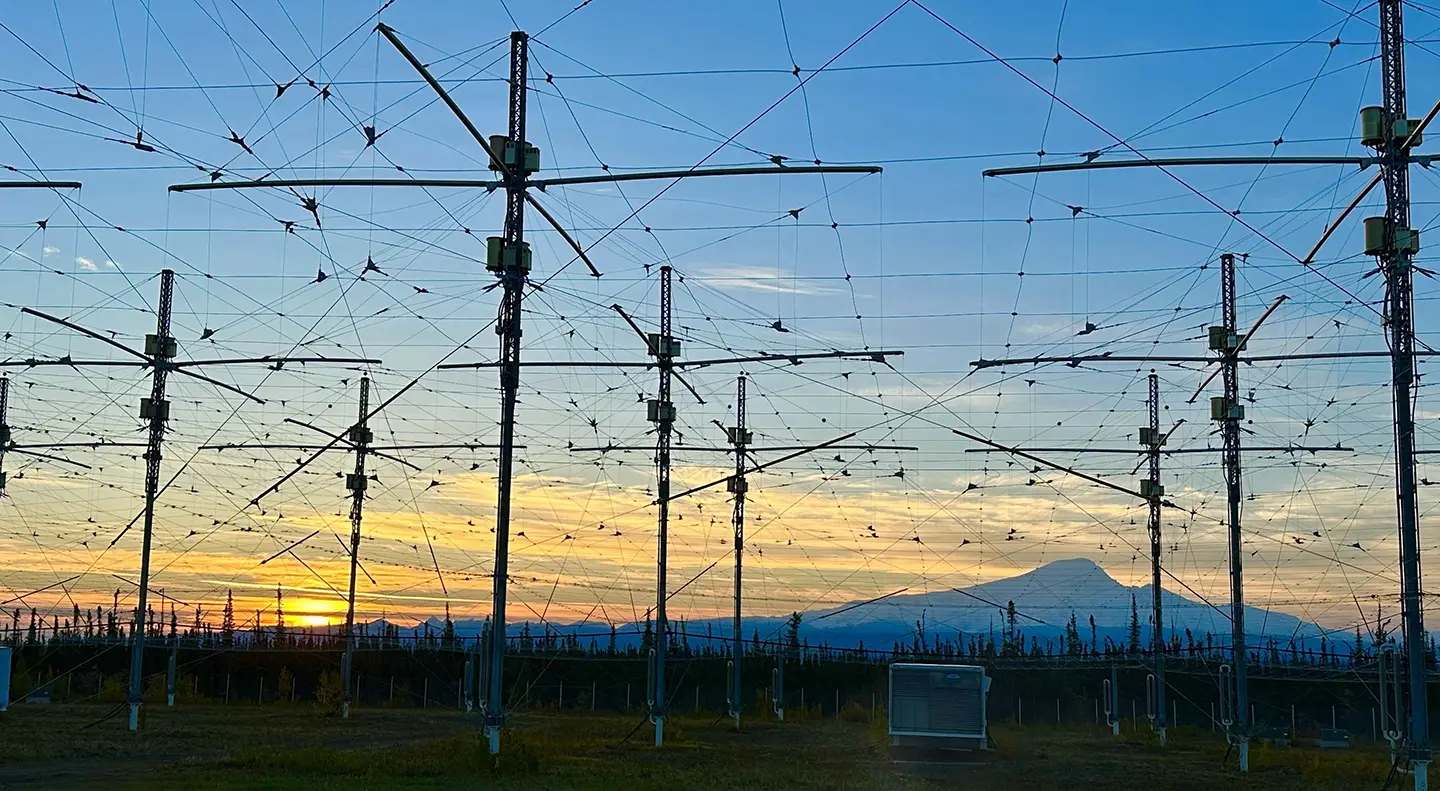
Researchers used the University of Alaska Fairbanks’ High Frequency Active Auroral Research Program (HAARP) facility and a receiver array in Cold Bay, Alaska, developed by industry partners to gather data on participating military aircraft over the Gulf of Alaska and the Bering Sea. Industry partners designed and executed the field experiment along with government, scientific and allied participants, the release said.
An E-3 Sentry from the 962nd Airborne Air Control Squadron, HC-130J Combat King IIs from the 211th Rescue Squadron and KC-135 Stratotankers from the 168th Air Refueling Wing served as exercise targets. Each aircraft provided its position, and researchers compared that with the experimental data.
“Understanding what this technology can do in the Arctic starts with collecting data under real operating conditions,” said Carolyn Stwertka, Alaskan Command chief scientist. “Working with operational units allows us to compare the experimental observations with known aircraft positions and assess where this approach could help address gaps in air surveillance.”
The team met or exceeded its objectives. Initial results show the system successfully detected aircraft beyond visual line of sight and correlated them with the targeted flights. Data analysis is continuing.
The live-fly experiment combined the efforts of USNORTHCOM, Alaskan Command, the Air Force Research Laboratory, Defence Research and Development Canada, and scientific and operational partners. For Alaskan Command, the effort supports the larger goal of enhancing Arctic defenses through scientific collaboration. Improving the ability to detect and track aircraft helps military leaders determine potential threats and make credible decisions in defense of the nation.
The experiment occurred as the North American Aerospace Defense Command (NORAD) is constructing high-frequency systems to track hypersonic missiles with over-the-horizon radar (OTHR). NORAD also is building a polar over-the-horizon radar network and updating its Northern Warning System, a joint U.S.-Canadian early warning radar network. The Homeland Defense OTHR, a land-based, high-frequency radar system funded by the U.S. and Canada, was initiated in 2022. It is set to begin operation in 2028-29 and be fully functional in 2031.
HAARP, a 13.4-hectare facility near Gakona, Alaska, has 180 high-frequency crossed-dipole antennas that can transmit 3.6 megawatts of radio energy. HAARP initially was funded by the U.S. Air Force, the U.S. Navy and the Defense Advanced Research Projects Agency to study the ionosphere, with a focus on improving long-range surveillance and communications, including ways to communicate with submerged submarines.
It has been operated by the University of Alaska Fairbanks as a civilian research facility since 2015. During the testing in September, HAARP acted as a high-power illuminator, beaming signals toward the ionosphere, which then were reflected down to support the detection of airborne targets over Alaska’s maritime approaches.