

U.S. STRATEGIC COMMAND
A team of Norwegian and American scientists launched a Black Brant XII four-stage sounding rocket on January 25, 1995, from the Andøya Rocket Range off the coast of Norway to study the aurora borealis. Even though information about the launch was shared with other countries, including Russia, the information never reached the appropriate authorities. As soon as the rocket launched, Russian early warning radar picked it up and followed it to an altitude of over 1,450 kilometers. The radar image resembled a U.S. Navy Trident submarine-launched ballistic missile (SLBM).
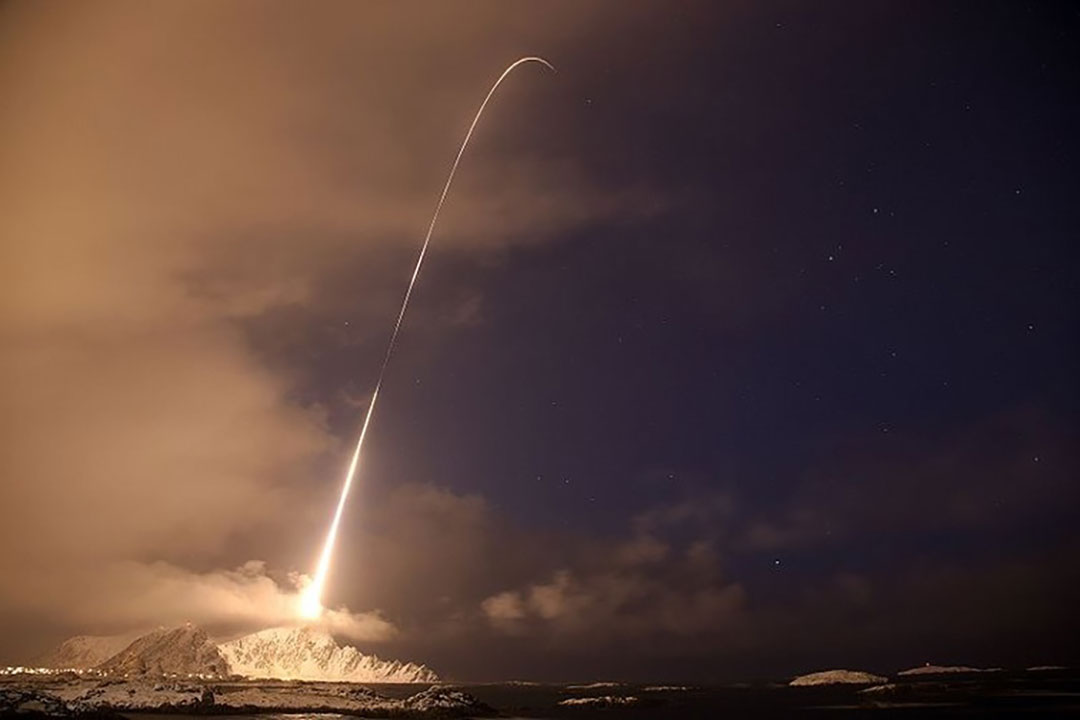
Russia’s military, suspicious of NATO intentions, sent an alert through its chain of command, eventually reaching then-Russian President Boris Yelstin. It led to the first (and only) activation of the Cheget, Russia’s nuclear command and control briefcase. Russia’s internally established deadline to assess a threat after launch detection and reach a decision on retaliation was only 10 minutes. Luckily, Yelstin and his team correctly concluded that it was a false alarm, and the rocket splashed down harmlessly into the sea. Unlike the Cuban missile crisis, which evolved over days, this incident was a rapid event. Now known as the Norwegian rocket incident, it is regarded by many as the closest the world has come to full-scale nuclear war. (Pictured: A Black Brant XII rocket launches from the Andøya Rocket Range in 2010, some 15 years after the Black Brant XII launch from that range started the Norwegian rocket incident.)
Fast forward to January 2022. While Russia has notified many countries, including the United States, of its intentions to exercise its strategic nuclear forces, it is doing so against the backdrop of a historically high period of tension between NATO and Russia due to Russia’s buildup of its armed forces around Ukraine. As the Norwegian rocket incident demonstrated, even clear notifications of a science experiment or military exercise do not prevent miscalculation.
Since 2012, Russia has regularly exercised its strategic nuclear forces. Typically, within the framework of these drills, a subsurface missile carrier of the Russian Northern Fleet launches an SLBM against a target at the Kura proving ground on the Kamchatka Peninsula in Russia’s far northeast, and a nuclear submarine of the Pacific Fleet launches an SLBM against a target at the Chizha proving ground in northern Russia, according to Russian News Agency TASS. Also, as reported by NBC News, past exercises have included a ground-based intercontinental ballistic missile (ICBM) launch from the Plesetsk facility in northwestern Russia and Tu-160 and Tu-95 strategic bombers firing cruise missiles at test targets.
Normally, these command-and-staff exercises take place in October. The exercises did not occur in October 2021; they were delayed until early 2022. There has been no official reason given for the delay. It leaves open the possibility that Russia planned this iteration of its strategic nuclear exercises to coincide with its potential invasion of Ukraine. Russia may label its nuclear force exercises as defensive in nature, but the message is lost when it also amasses an invasion-size force along the borders of a sovereign neighbor. Holding strategic nuclear forces exercises at this time changes the use of nuclear weapons as a tool of deterrence into a tool of coercion.
It would not be the first time that Russia has used large military exercises to obfuscate its intentions. In 2013, the large Russian Zapad exercise came shortly before Russia’s 2014 forced annexation of Ukraine’s Crimean Peninsula. Russia has expanded its military drills in recent years as its relations with the U.S., NATO and other western democracies have deteriorated. During Russia’s 2013 drills, then-Lithuanian Defence Minister Raimundas Karoblis told Reuters, “We can’t be totally calm. There is a large foreign army massed next to Lithuanian territory.”
It was because of tension and mistrust between the U.S. and Russia that a science rocket could put a country on high alert and the world on the brink of disaster. Increasing tensions by amassing troops at Ukraine’s borders while simultaneously firing potentially nuclear-tipped ICBMs in an exercise is irresponsible and potentially dangerous. Nuclear coercion has no place in the world, by any nation, rogue or great power.
IMAGE CREDIT: NASA GODDARD SPACE FLIGHT CENTER