

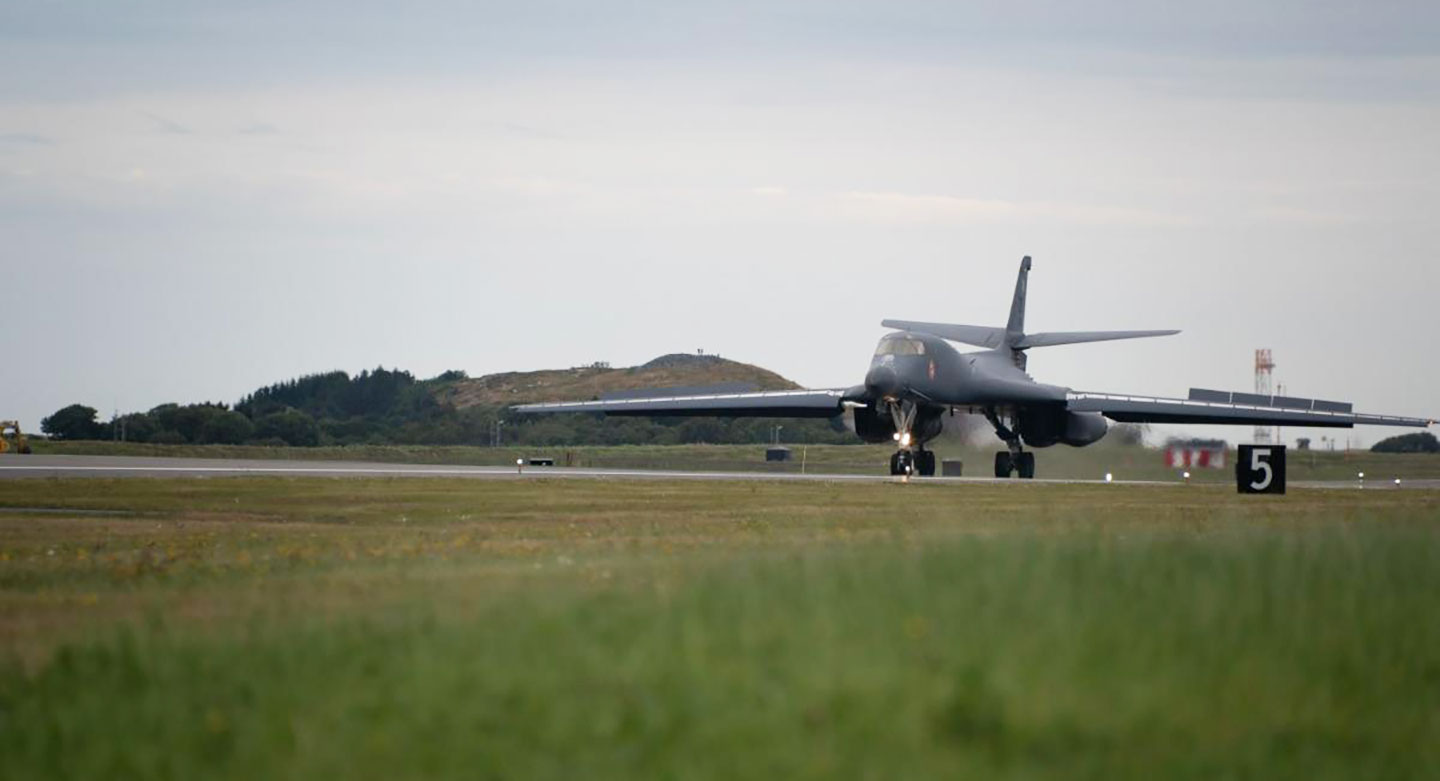
U.S. Air Force B-1B Lancer bombers traveled to Iceland in August 2025, the fifth Bomber Task Force Europe deployment of the year. The bombers, from Dyess Air Force Base in Texas, then were escorted to the Ørland Air Base in Norway on August 9 by Spanish Air and Space Force warplanes and deployed on their first air security mission in the Nordic country.
The three bombers from the 345th Bomb Squadron arrived to integrate with NATO allies for advanced training in warfighting capabilities and readiness. The U.S. bombers (nicknamed BONES) were escorted by Spanish Air and Space Force EF/A-18M Hornets operating from Keflavik Air Base, Iceland. The six Hornets in the Spanish NATO deployment provide air security and patrol Iceland’s airspace under a longstanding NATO agreement to provide air security to the North Atlantic island nation. The Spanish Hornets arrived at Keflavik in late July, according to NATO.
While at Norway’s Ørland Air Base, the B-1Bs long-range bombers trained with other NATO aircraft, including Royal Norwegian Air Force F-35s. Notably, Ørland Air Station is the main operating base of the Royal Norwegian Air Force F-35 fleet, reported The Aviationist, a Rome-based military aviation news website. The bombers and accompanying warplanes practiced high-threat operations. Crews also refined their skills in the “find, fix, track and target” process, according to a NATO news release. The pilots and airmen also trained “to counter air and ground-based threats designed to deny their freedom of maneuver, enhancing the alliance’s readiness to secure air superiority,” according to the release.
Live exercises with allies and partners offer rare training opportunities to hone battle skills and increase interoperability, the 345th’s commander, Lt. Col. Eric Alvarez, said in the release. “This deployment allows us to train the way we fight — integrated with our NATO allies, ready and adaptive.”
The Norwegian hosts of the U.S. bomber detachment said their presence would increase NATO preparedness. “It’s about building experience and trust together, enhancing readiness, and staying sharp in dynamic environments,” Royal Norwegian Air Force Lt. Col. Tom Christiansen, acting chief of the 132 Air Wing at Ørland, said in the release. “This type of training makes us better equipped to handle any challenges.”
As the Bomber Task Force Europe’s fifth deployment in 2025, the B-1B Lancers’ presence in NATO’s contested northern flank demonstrates the U.S.’s force projection and capabilities. “NATO’s bomber integration missions underscore the alliance’s ability to operate across a range of domains, strengthen interoperability, and deter potential aggression. By combining strategic bomber capabilities with Allied fighter escorts and operating in complex scenarios, NATO continues to reinforce its defensive posture, ensuring it can respond decisively to any threat to the alliance,” the release stated.
Norway has become a flashpoint in Europe and the Arctic as Russia’s war in Ukraine nears its fourth year. In recent years, Russian-linked sabotage in and around sensitive Norwegian military installations and Arctic infrastructure as well as Baltic Sea sabotages from ships linked to Russia’s shadow fleet have rattled Norway and other Nordic nations, all of which have rapidly increased defense spending.