

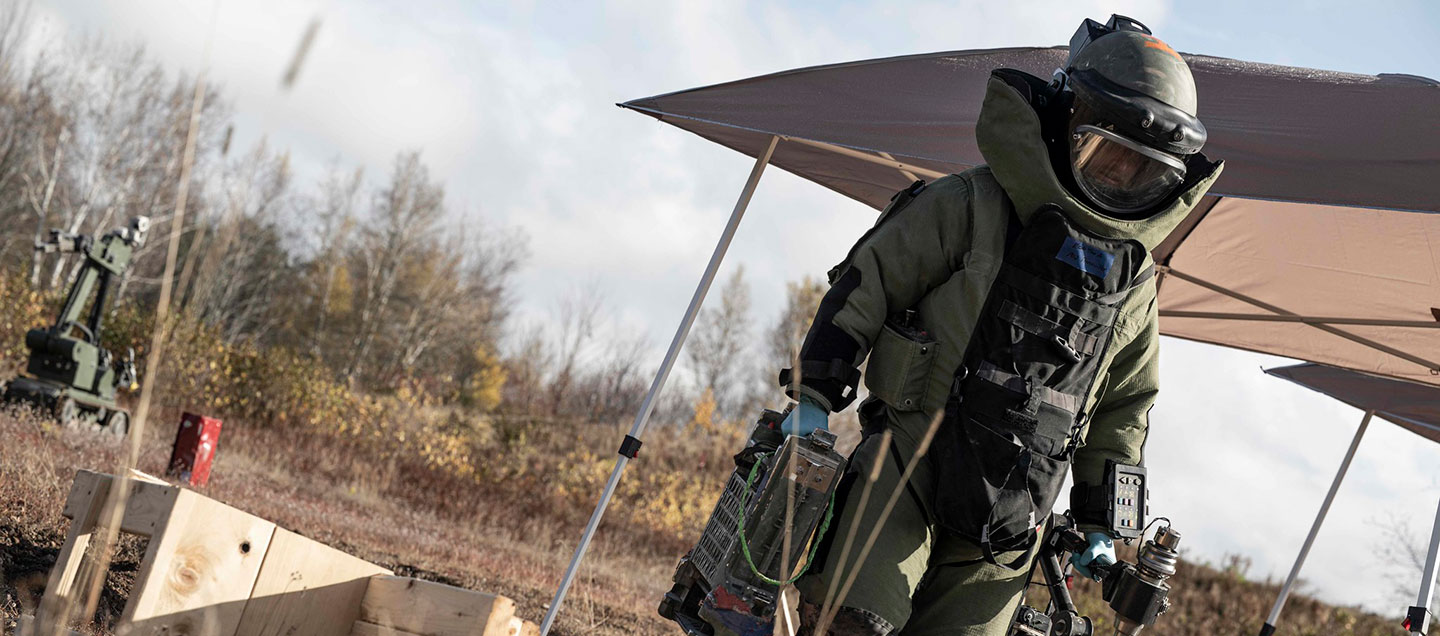
Soldiers from across Canada and allied nations tested their skills detecting and defeating explosive threats at the 2025 iteration of Exercise Ardent Defender in October. Their goal: stay ahead of technology that is quickly changing how explosives are deployed on the battlefield. “The threat evolves rapidly; technology advances even faster,” said Maj. Vincent Dupont of the Canadian Armed Forces (CAF), this year’s exercise director.
The exercise, hosted by the CAF’s Explosive Ordnance Disposal Organization, welcomed nearly 300 participants from countries around the world, including Australia, Austria, Belgium, Czechia, Germany, the Netherlands, New Zealand, Slovakia, Sweden and the United Kingdom. “It is very much an integrated allied activity, where we’re learning how to deal with threats in current and other battle spaces … to keep apprised of what’s going on,” Brig. Gen. Paul Lockhart, chief of staff operations for the Canadian Army, told CBC News.
Soldiers learned how to deactivate explosives and about the latest technology. The war in Ukraine has been a showcase for aerial improvised explosive devices used in drone warfare. Their low cost and adaptability make them an asymmetric threat and have led defense contractors and militaries around the world to invest in their own drone and counter-drone technologies.
“Drones are a threat in the modern battle space because there can be a lot of them and they come from directions that you may not expect,” Lockhart told CBC News. “You can modify things to go on them, and they can arrive singularly or in large numbers in unexpected ways.”
The exercise was held at the 5th Canadian Division Support Base Gagetown in New Brunswick. The Gagetown base “offers a wide and vast training area, allowing us to bring multiple nations, multiple teams to train in a joint environment,” Dupont told CBC News. “It really is one of the premier bases to do so.”
Dupont said technology used at Ardent Defender is more advanced this year. “This challenges the operators but also prepares them in a relevant way for the threats that we’re facing right now,” he told CBC News. “The threat evolves rapidly; technology advances even faster.”
Some of the drills focused on explosive devices found on the ground, including bombs that have been dropped from a drone or are still attached to a fallen drone. Soldiers learned how to get rid of those explosives properly.
“You need to be able to deal with the threat while it lays, because we don’t decide what threatens us, we decide how we deal with it,” Lockhart told CBC News. He said 3D printers would be used in collaboration with Defence Research and Development Canada to build tools that can “render safe” the explosive devices.
The high-tech efforts to mitigate explosive threats support the Canadian Army’s modernization program. “The Canadian Army is modernizing to ensure we can confront emerging threats,” Lt. Gen. Michael Wright, commander of the Canadian Army, said in a news release. “By investing in our people, technology, and partnerships, we’re strengthening readiness and ensuring that Canada remains a reliable ally and a credible force for good around the world. Exercise Ardent Defender provides an opportunity to build trust and enhance interoperability where it matters most — on the ground, working side by side.”
Ardent Defender is the CAF’s premier multinational Counter-Improvised Explosive Device exercise. It has been held every year since 2013.