

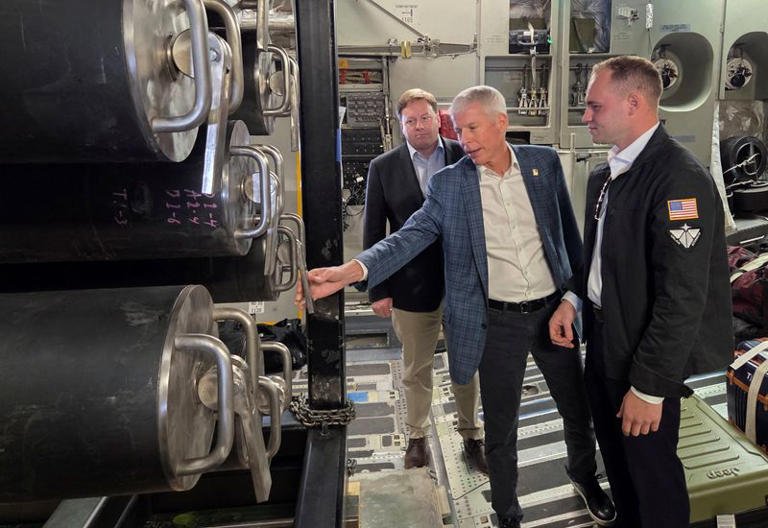
The United States Departments of Energy and Defense for the first time transported a small nuclear reactor on a cargo plane from California to Utah to demonstrate the potential to quickly deploy nuclear power for military and civilian use. The agencies partnered with California-based Valar Atomics to fly one of the company’s Ward microreactors on a C-17 aircraft — without nuclear fuel — to Hill Air Force Base in Utah on February 15, 2026.
Energy Secretary Chris Wright and Under Secretary of War for Acquisition and Sustainment Michael Duffey were on the C-17 flight with the reactor and its components and hailed the event as a breakthrough for U.S. nuclear energy and military logistics. “This gets us closer to deploy nuclear power when and where it is needed to give our nation’s warfighters the tools to win in battle,” Duffey said.
The U.S. sees small nuclear reactors as one of several ways to expand U.S. energy production. President Donald J. Trump in May 2025 issued four executive orders aimed at boosting domestic nuclear deployment to meet growing demand for energy for national security and competitive AI advancements.
The Energy Department plans to have three microreactors reach “criticality” — when a nuclear reaction can sustain itself — by July 4, Wright said. The microreactor in February’s event, a little larger than a minivan, can generate up to 5 megawatts of electricity, enough to power 5,000 homes, according to Valar CEO Isaiah Taylor. It will start operating in July at 100 kilowatts and peak at 250 kilowatts this year before ramping up to full capacity, he said.
Valar hopes to start selling power on a test basis in 2027 and become fully commercial in 2028. Although private industry funds its own development of nuclear technology, it also needs the federal government “doing some enabling actions to allow fuel fabrication here and uranium enrichment here,” he said. Fuel for Valar’s reactor will be transported from the Nevada National Security site to the San Rafael facility, Wright told reporters.