

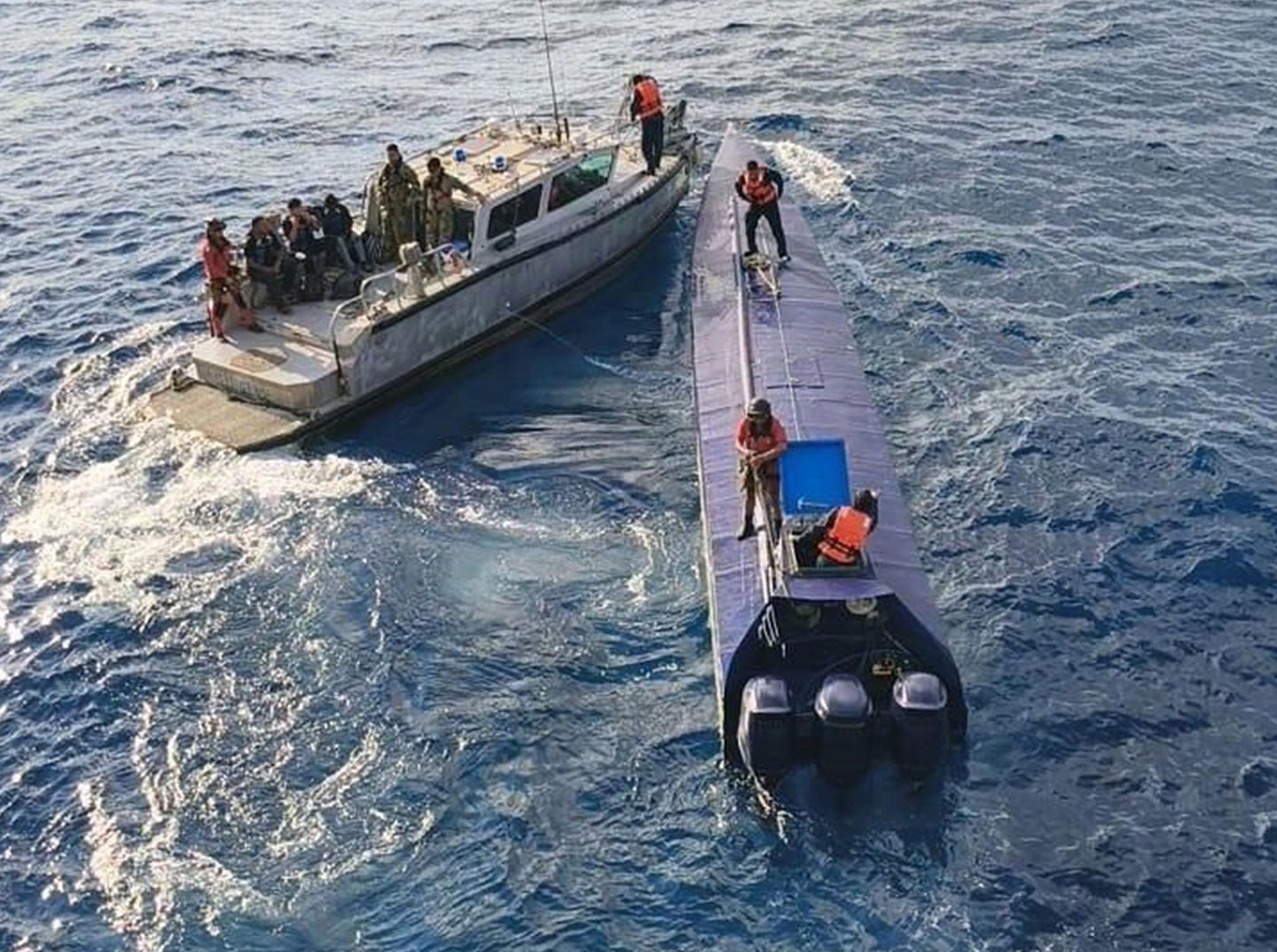
In a complex sea and air operation, the Mexican Navy seized a semisubmersible “narco sub” and about 4 metric tons of cocaine off the coast of Manzanillo, Colima, Mexico, in February 2026. Authorities apprehended three people during the mission, which involved an ocean patrol, two fixed-wing aircraft, two mobile-wing aircraft and two interceptor patrols.
“In the last week, maritime operations have made it possible to seize nearly 10 tons of this drug,” Secretary of Security and Citizen Protection Omar García Harfuch said February 19 in a post on the social platform X. “This represents a direct and multimillion-dollar blow to the financial structures of organized crime, by preventing millions of doses from reaching the streets and protecting the safety of Mexican families.”
The seizure was carried out more than 250 nautical miles southwest of the port of Manzanillo as part of Mexico’s efforts to combat illicit activities at sea. The operation was led by forces of the Secretariat of the Navy in coordination with the Ministry of National Defense, Attorney General’s Office, National Guard and Secretariat of Security and Citizen Protection. The United States supported the mission with intelligence information from U.S. Northern Command (USNORTHCOM) and the Joint Interagency Task Force South.
Semisubmersibles can’t go underwater completely but are more adept at eluding detection and capture than a conventional ship. This was the third narco sub seized during the administration of President Claudia Sheinbaum.
The first narco sub seized during her administration was in the Pacific Ocean, southwest of Lazaro Cardenas, Michoacán,in October 2024 when the Mexican Navy intercepted the vessel, which was carrying about 2.2 metric tons of illegal narcotics. The second low-profile vessel was interdicted in the Pacific off the coast of Guerrero in June 2025 and was carrying more than 3.5 metric tons of cocaine. Mexico’s biggest drug bust came in November 2007, when 23 metric tons of cocaine was intercepted at the Pacific port of Manzanillo aboard the Hong Kong-registered ship Esmeralda, which had sailed from Colombia.
In testimony before the Senate Armed Services Committee in February 2025, Gen. Gregory M. Guillot, commander of USNORTHCOM and North American Aerospace Defense Command, cited transnational criminal organizations in Mexico as a regional security threat. “Transnational criminal organizations based in Mexico continue to threaten U.S. sovereignty and territorial integrity through the production and trafficking of fentanyl and other illicit drugs and the facilitation of unlawful mass migration toward the U.S. southern border,” he testified. “Drug-related violence has escalated in recent years as rival cartels fight for control of lucrative drug and migrant smuggling routes and demonstrate a growing willingness to directly engage Mexican security forces, increasing the risk of spillover violence into the United States.”
Guillot added that “USNORTHCOM’s regional security cooperation relationships remain a critical element of the command’s missions. USNORTHCOM’s military partnerships with Canada, Mexico, and The Bahamas enhance our own homeland defense while building the capacity of those partners to operate and communicate with U.S. forces. Those relationships are vital to countering competitor influence and presence in the Western Hemisphere while improving intelligence sharing, border security, and domain awareness.”