

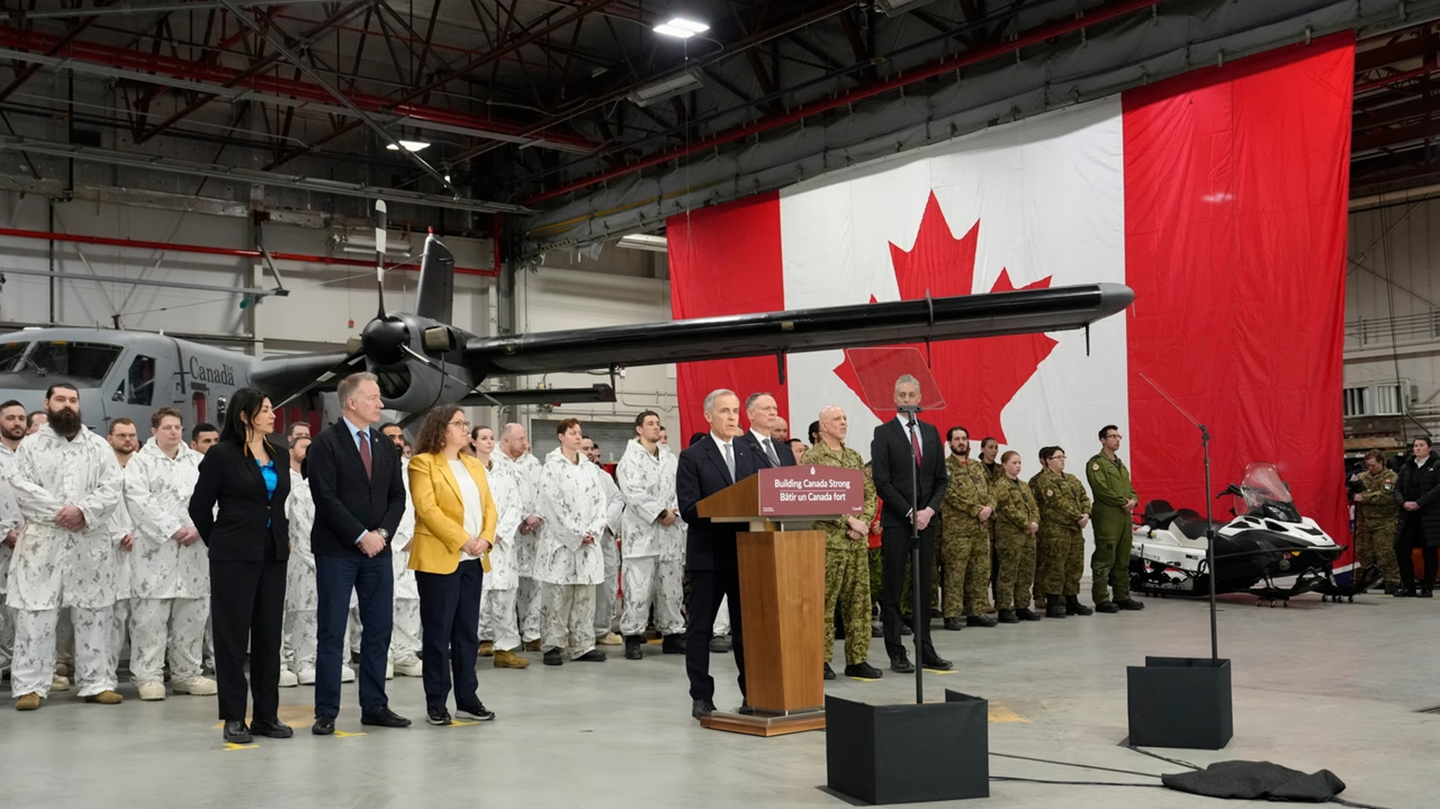
Prime Minister Mark Carney of Canada announced a multibillion-dollar plan in March to substantially expand the country’s military capacity in the Arctic, building three military bases in the northern territories, making improvements at another base, and strengthening related infrastructure to assert sovereignty over the increasingly contested region. “With this plan, we are taking control of our future,” Carney said.
“We are taking full responsibility for defending our sovereignty,” Carney, surrounded by troops, said at an airplane hangar in Yellowknife, Northwest Territories, on March 12, 2026. “The government’s first job is to keep you safe.”
The highlight of the plan will be spending about $23.3 billion to build three forward operating locations in the northern territories — in Yellowknife; Inuvik, Northwest Territories; and Iqaluit, Nunavut — and make improvements at an existing base at Goose Bay in Labrador. The bases are designed to support F-35 fighter jets but also could house Gripen fighters, CTV News reported. Canada committed to buying 88 American F-35s in 2023, but the government has considered a mixed fleet.
Two operational support nodes will be built for an additional $1.95 billion. They are designed to provide logistics, transportation and infrastructure support for military operations.
The government also is setting aside hundreds of millions of dollars to improve two Arctic airports and roads that can support military aircraft and vehicles. This includes money for the 800-kilometer-long Mackenzie Valley Highway, which will connect Yellowknife and Inuvik.
While the overall plan is new, the money is not. The funding was announced in 2022 as part of a North American Aerospace Defense Command (NORAD) modernization strategy. With the military expansion and update, the government will “defend fully Canada’s Arctic and North, deter new threats, and support NATO allies and NORAD continental defence,” a news release from the prime minister’s office said.
Calls for improving Canada’s Arctic security have been intensifying as warmer waters increase the expectation that the Northwest Passage will become a shortcut for shipping from Asia to Europe. Countries and corporations also have a growing interest in Arctic mineral resources, though current conditions make extraction too costly, critics say.
Defense officials say construction contracts are going out for bid already, and the government is actively looking for builders in the private sector to help it expand its air bases, CTV News reported.
“After decades of limited and piecemeal investments in the North, Canada’s new government is acting with a scale of ambition worthy of this vast region and its peoples,” Carney said in the news release. “We are securing every corner of this terrain, unlocking its vast resources, and delivering the strong, connected network of communities that Northerners deserve.”
Minister of National Defence David McGuinty reiterated Canada’s commitment to NORAD and NATO in the news release, saying: “These investments will continue to build the Defence team’s presence and responsiveness across the Arctic and the North, reinforce our ability to assert Canadian sovereignty, support community benefits where feasible, and contribute to NATO’s deterrence and defence priorities. Furthermore, Canada’s efforts to modernise our continental defences demonstrate our commitment to enabling the North American Aerospace Defense Command and the Canadian Armed Forces to defend against emerging threats to North America.”
In testimony before the Senate Armed Services Committee on March 19, 2026, Gen. Gregory M. Guillot, commander of U.S. Northern Command (USNORTHCOM) and NORAD, said: “NORAD has stood as the world’s only bi-national command for more than 68 years as American and Canadian personnel serve side by side in the defense of North America. … USNORTHCOM and NORAD remain focused on infrastructure improvements in Alaska, Canada, and Greenland that will enhance the operational flexibility and capability necessary to train, fight, and win in the High North. Expanded presence and forward operating locations along the northern approaches will provide commanders at every level with greater operational flexibility, efficiency, and effectiveness while improving deterrence and survivability.”