
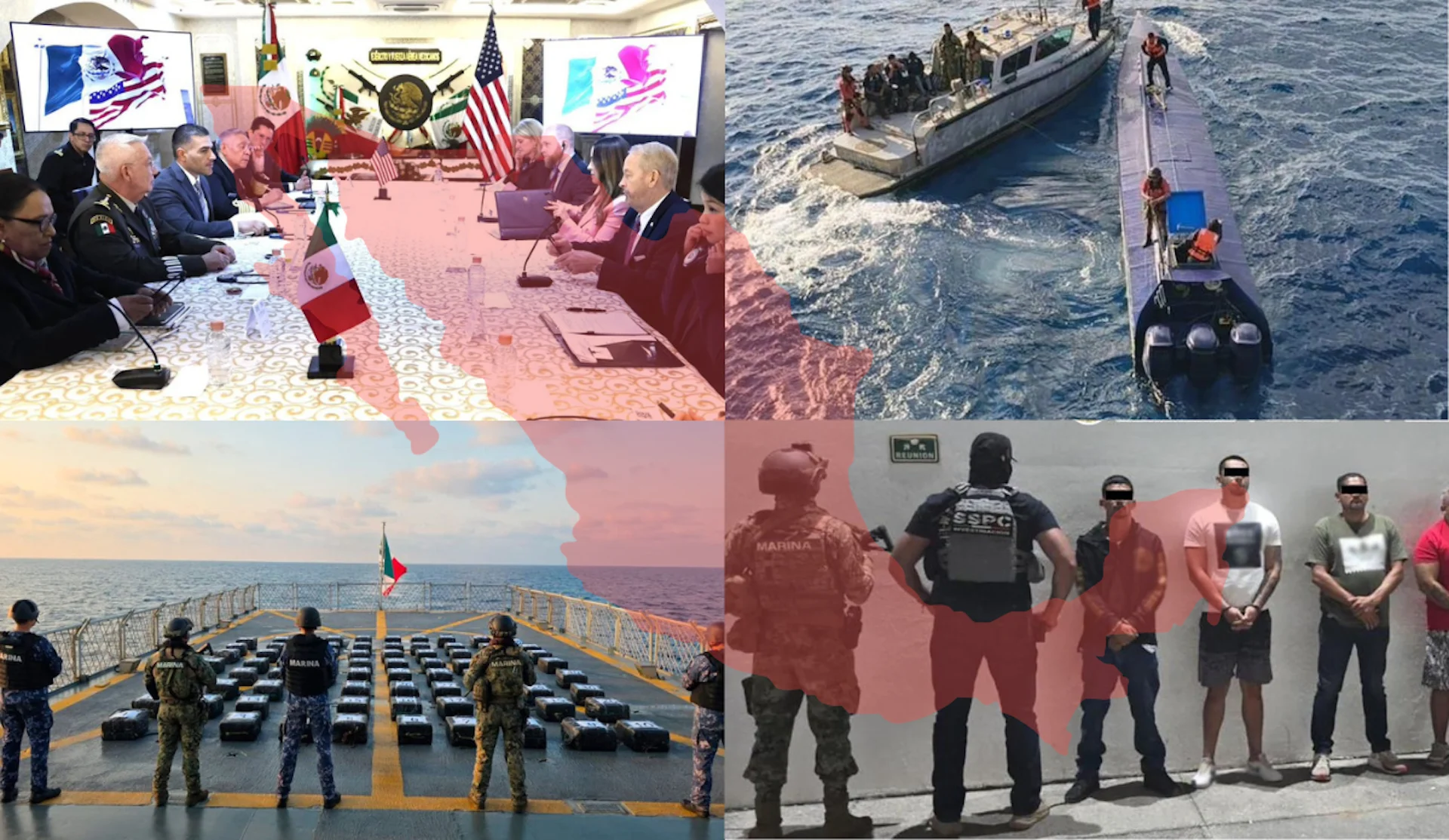
The Mexican government has intensified efforts against transnational criminal organizations (TCOs) operating across the hemisphere. These actions include drug seizures along maritime routes, arrests of members of these groups, and expanded coordination with international partners.
“This shift reflects an adjustment in security strategy observed since late 2025, focused on dismantling criminal structures through narcotics interdiction and the capture of leaders identified as instigators of violence,” Yadira Gálvez, a security expert and scholar at the National Autonomous University of Mexico, told Diálogo. “The approach seeks to reduce homicides in a context where transnational organized crime and drug trafficking continue to be the main challenges to national and public security, along with crimes such as the growing problem of extortion.”
One of the most significant blows occurred on February 22, 2026, in Tapalpa, Jalisco, with the operation that resulted in the death of Nemesio Oseguera Cervantes, alias El Mencho, leader of the Jalisco New Generation Cartel (CJNG). In an interview with Newsmax, Mexico’s Security Secretary Omar García Harfuch said that “the Mexican Army carried out the operation in less than 24 hours.”
Additionally, collaboration with international partners facilitated the arrest of Samuel “N,” one of the FBI’s most wanted fugitives, who was transferred to the United States. The Mexican Foreign Ministry emphasized that these operations reflect a joint effort between Mexico and its allies, underscoring the role of bilateral coordination in targeting high-value individuals.
Although the CJNG does not maintain a stable territorial presence outside Mexico, it sustains strategic alliances with criminal networks in countries such as Colombia, Ecuador and Guatemala to ensure the flow of cocaine to Mexico and the United States, according to the think tank InSight Crime. These alliances rely on emissaries who negotiate shipments, oversee production and coordinate trafficking routes.
The behavior of organizations following the capture of their leaders varies. Some groups lose operational strength, while others adapt.
One example is the Sinaloa Cartel, which, following the recapture of Joaquín “El Chapo” Guzmán, adopted a less hierarchical and more network-based model. In the case of the CJNG, its operational structure — based on affiliated cells — has facilitated its territorial expansion, although it could face leadership changes following the death of “El Mencho.” Gálvez noted: “Its central structure could undergo changes, but these are not yet defined.”
Mexico’s current strategy also focuses on targeting critical areas such as the trafficking of precursor chemicals, illicit financial flows and synthetic drug markets, particularly fentanyl. Gálvez emphasized that regaining territorial control and strengthening state institutions are key priorities, along with cooperation with international partners, including the U.S.
International cooperation has been a key component in recent operations, particularly along Pacific maritime routes, one of the main drug trafficking corridors. On March 10, federal forces seized nearly 2 tons of cocaine floating in the Pacific off the coast of Acapulco, Guerrero, attributed to the Sinaloa Cartel. According to El Universal, Mexican authorities have seized more than 60 tons of drugs at sea since October 2024.
Another notable operation took place on February 21, when authorities conducted three coordinated interdictions that resulted in the seizure of about 17 tons of cocaine in the Pacific region, including near Clarion Island, French Polynesia and Salvadoran waters. These operations, enabled by intelligence sharing among partner nations, involved El Salvador, France and Mexico with the support of the U.S. Coast Guard and Joint Interagency Task Force South (JIATF-S).
“Surveillance in the eastern Pacific increasingly incorporates radar and satellite capabilities, which has strengthened the detection and interception of vessels,” Gálvez said. In this region, Mexico’s southern coast has become a key transit point for maritime and aerial shipments, InSight Crime indicated.
On February 19, the Mexican Navy intercepted a semi-submersible vessel carrying nearly 4 tons of cocaine off the port of Manzanillo, Colima. The operation was supported by intelligence from U.S. Northern Command (USNORTHCOM) and JIATF-S, illustrating once more how shared intelligence and interoperable surveillance capabilities enable maritime interdictions.
In March 2026, Mexican authorities continued to prioritize the arrest of criminal organization leaders. On March 7, Roberto “Beto” Bazán-Salinas, linked to the Gulf Cartel, was arrested in Salamanca, Guanajuato, for drug trafficking to the U.S. This operation involved collaboration with U.S. agencies including the Drug Enforcement Administration, Homeland Security Investigations and U.S. Immigration and Customs Enforcement, German news agency DW reported.
In January, security forces arrested six members of the Venezuelan designated terrorist organization Tren de Aragua in Mexico City, including Lesli Valeri “N,” identified as a key operator in human trafficking networks, El Economista reported. Gálvez emphasized that “recent operations underscore the need for a comprehensive strategy that integrates operational capabilities, intelligence, and the dismantling of criminal networks, while also accounting for the impact of violence on the civilian population.”
“Cooperation between Mexico and the United States will remain essential in the coming years,” Gálvez said. Strengthening capabilities to counter financial and logistical networks, including money laundering and the trafficking of precursors and weapons, will be a key focus. Efforts are also underway to reinforce controls at customs, ports, and in cyberspace through coordinated efforts between Mexico and partner countries across the hemisphere.
“Operational cooperation has been strengthened through bilateral agreements, training, intelligence sharing, and coordinated actions,” Gálvez concluded, adding that sustaining trust and further strengthening coordination will be key to addressing these threats.
Diálogo Américas is a publication of U.S. Southern Command.