

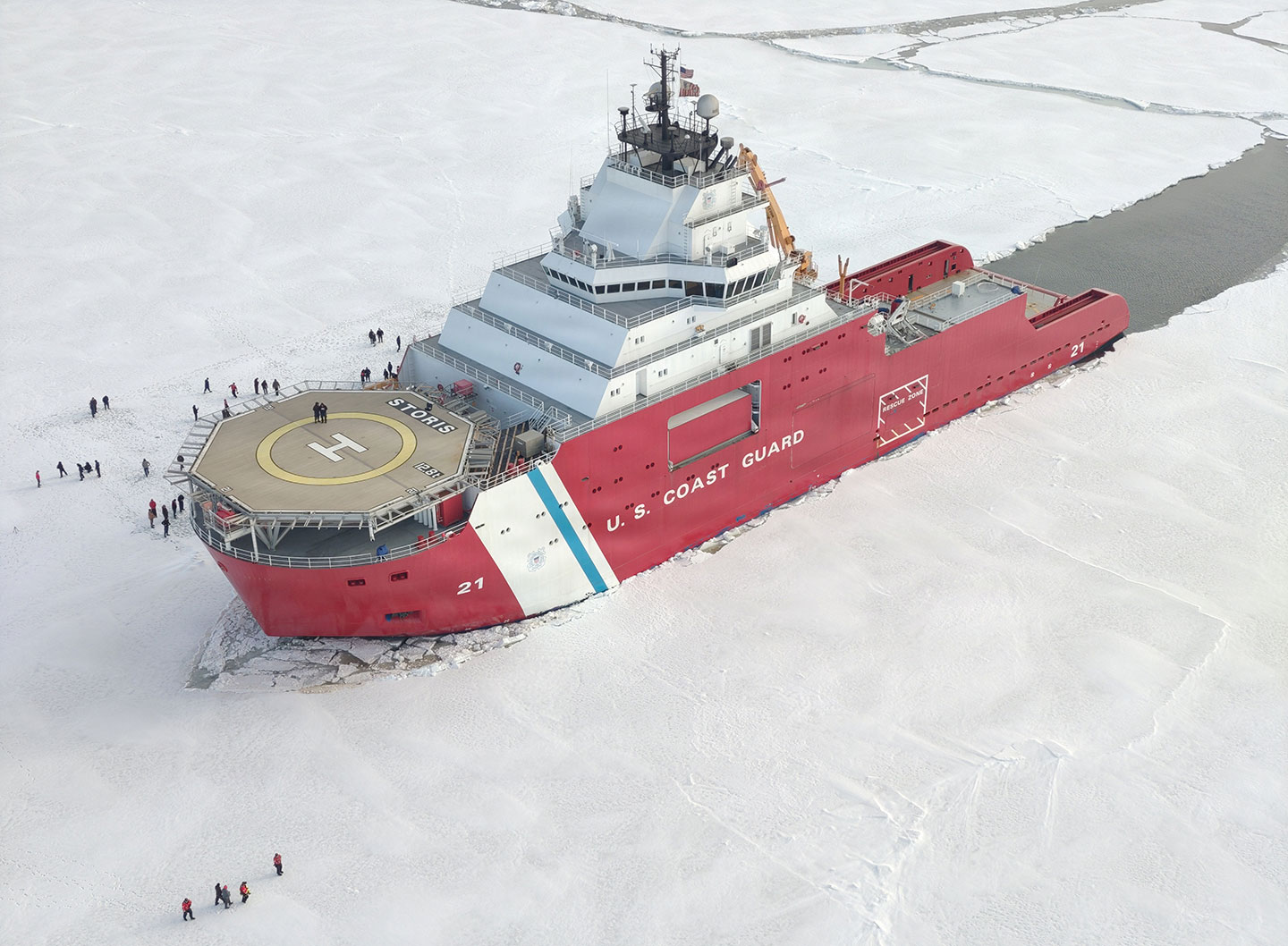
The United States Coast Guard’s newest polar icebreaker, the Storis, returned to its temporary Seattle home port on May 11, 2026, after a deployment to the Bering Sea that lasted 36 days and logged 4,800 nautical miles. The voyage marked an early operational test for the newest addition to a small but growing fleet that is expected to play a critical role in U.S. Arctic operations.
The winter patrol focused on strengthening operational readiness and interoperability with other military assets. The cutter’s crew also tested ways to support prolonged operations in the harsh Arctic maritime environment.
“Operating the Storis in the extreme conditions of an Arctic winter is a clear statement of our nation’s resolve,” Capt. Corey Kerns, commanding officer of the vessel, said in a Coast Guard news release. “Storis represents a critical bridge to our future icebreaker fleet. This mission is about preparation, rigorous training and asserting the continued importance of the Arctic to our nation.”
A primary mission was conducting an ice assessment to establish baseline performance in the Arctic. The crew evaluated the vessel’s icebreaking capabilities and gathered data to serve as a benchmark for the Storis and other U.S. and allied vessels in high-latitude environments.
The Storis conducted a joint passing exercise with the Coast Guard Legend-class cutter USCGC Waesche. Crewmembers executed the maneuver in challenging winter conditions less than a nautical mile from the ice edge, with visibility of only about 135 meters.
The Storis and Waesche also carried out a proof-of-concept cutter-to-cutter refueling maneuver at Dutch Harbor, Alaska, expanding their operational flexibility for future deployments. With a cutter-to-cutter fueling at sea capability, the vessels can maximize their operational reach and reduce the need for long trips back to port.
Crewmembers also trained in ice rescues, practicing complex lifesaving maneuvers and preparing for high-risk search and rescue missions. Arctic conditions pose grave threats, and skin can freeze in minutes.
The crew also conducted a live-fire gunnery exercise, providing essential hands-on training in an environment that presents unique challenges. The training reinforced the Coast Guard’s role as an armed service capable of defending national security interests and responding to emerging maritime threats.
Acquired in 2025, the Storis is the first polar icebreaker commissioned by the Coast Guard in 25 years. The cutter initially was built for Shell’s Arctic drilling operations in 2012 as an icebreaking tug supply vessel, the Aiviq, which means “walrus” in the Inupiat language. It has been modified and upgrades since being purchased in December 2024.
The Storis is a 110-meter medium icebreaker with a displacement of about 13,600 metric tons. With its four diesel engines, the cutter can navigate through about 1 meter of ice at 5 knots, adding critical capabilities to the nation’s Arctic forces.
The Storis is berthed temporarily in Seattle, alongside the Coast Guard’s other polar icebreakers, the cutters Healy and Polar Star. After infrastructure improvements are completed in Juneau, Alaska, the Storis will be permanently homeported there.
The Coast Guard plans to add 11 new Arctic Security Cutter icebreakers, with the first ships scheduled for delivery in 2028. They’re being built under a joint program with Finland. Contracts were awarded in December 2025 to Bollinger Shipyards Lockport LLC of Lockport, Louisiana, and Rauma Marine Constructions Oy of Rauma, Finland.
Davie Defense announced May 13 that a $3.5 billion contract with the U.S. Coast Guard to build five Arctic security cutters had been finalized. Two of the vessels will be constructed at Davie Defense affiliate Helsinki Shipyard in Finland and three will be built at the company’s Gulf Copper facilities in Galveston and Port Arthur, Texas.
In testimony before the Senate Armed Services Committee on March 19, Gen. Gregory M. Guillot, commander of U.S. Northern Command and the North American Aerospace Defense Command, said: “The ability of the Joint Force to conduct all-domain operations in the Arctic approaches to North America remains a strategic necessity as military and economic competition in the region steadily expands. … Expanded presence and forward operating locations along the northern approaches will provide commanders at every level with greater operational flexibility, efficiency, and effectiveness while improving deterrence and survivability.”