

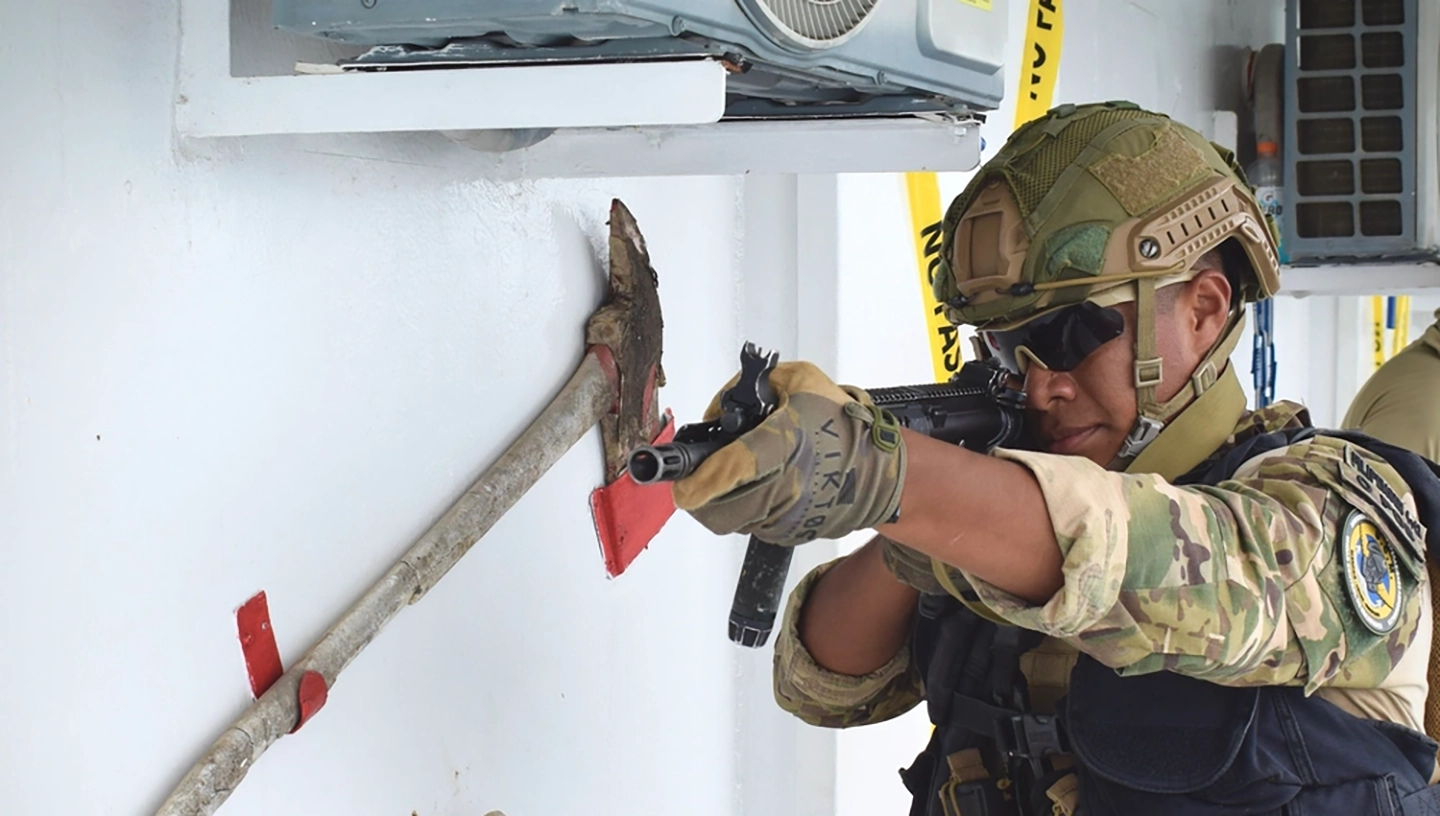
The Panama Canal remains one of the country’s most strategic assets, supporting Panama’s economy while serving as a critical artery for global trade. As transnational threats increasingly affect maritime routes, logistics systems and critical infrastructure across the hemisphere, Panama continues strengthening its capacity to protect the canal and the systems that depend on it through Panamax, the multinational exercise led by Panama with support from partner nations.
Panamax brings together security forces and civilian institutions in a coordinated effort focused on protecting the canal, strategic infrastructure and essential services linked to one of the world’s most important maritime corridors. Sponsored by U.S. Southern Command (USSOUTHCOM) and led by Panama, the exercise allows participating countries to strengthen coordination and preparedness in support of Panama’s national security objectives.
First launched in 2003, Panamax has evolved into one of the hemisphere’s principal multinational exercises focused on protecting the Panama Canal and strengthening coordinated responses to regional threats. Panamax 2026 also will mark a return to large-scale operational activities on Panamanian territory after previous editions focused primarily on command-post exercises. According to Panama’s Ministry of Public Security, the exercise will bring together forces and security personnel from more than 12 partner nations, along with naval, air and land assets operating under the coordination and authorization of the Panamanian government between July and August.
A Panama-led exercise
“During the training, common communication protocols and data-link systems are validated for real-time information exchange, under a joint doctrine that coordinates participating countries’ land, sea, air, and special forces,” Panama’s National Air and Naval Service (SENAN) Commissioner Luis Rodríguez, Panamax 2026 lead planner and director, said.
Rodríguez said this integration allows Panama and participating countries to strengthen early threat detection, improve coordination and reinforce the continuity of maritime operations. The exercise evaluates scenarios ranging from transnational organized crime and cyberattacks to threats against critical infrastructure and large-scale natural disasters. These scenarios are designed not only to improve operational readiness but also to strengthen the ability of Panamanian institutions to coordinate responses across multiple sectors during complex emergencies.
Rodríguez explained that Panamanian leadership is exercised through a national command composed of Panamanian officers operating under the supervision of the Ministry of Public Security and the National Security Council. Partner nations operate within a framework designed to support Panama’s strategic objectives while respecting national sovereignty. All multinational activities conducted during the exercise are coordinated under Panamanian authorization and operational leadership.
“The comprehensive protection of the canal is based on prevention, surveillance and response mechanisms led solely by Panama, while multinational cooperation strengthens the capacity to respond to potential crises,” Rodríguez said.
Protecting strategic infrastructure
The protection of the canal extends beyond maritime transit. The waterway remains closely linked to Panama’s broader economic stability, nearby communities and the continuity of essential services connected to canal operations and global supply chains. According to the Panama Canal Authority, about 5% of global maritime trade passes through the canal each year.
Rodríguez emphasized that one of Panamax’s principal objectives is “to ensure operational continuity and reduce risks that could affect supply chains and economic activity linked to the canal.” In recent years, Panama has expanded its maritime security capabilities amid evolving regional threats. In April 2026, SENAN incorporated two Interceptor 41C-class vessels provided by the United States to strengthen patrol, interdiction and rapid-response operations in strategic maritime areas.
Rodríguez added that cooperation with partner nations also strengthens Panama’s access to technical intelligence, surveillance capabilities and rapid-response support to improve preparedness during security incidents, environmental contingencies or other emergencies affecting canal operations.
Diálogo Américas is a publication of U.S. Southern Command.